Consideration about the profession of bioinformatics
Published in Computational Sciences
1. Preserving the Bioinformatics profession
Choosing the disciplines that will make up bioinformatics profession is not my responsibility. However, such interest can be expressed by any bioinformatician. The desire to preserve human energies is in both directions, for work and because of work. This means we will maintain a profession when we can practice it in good health, close to those to people we love, and with the rewards we need to finance our well-being. Furthermore, we will only maintain an occupation that allows us to support a family, ensure health, and accumulate wealth. This is the interest of all workers, from all fields.
Preserving the bioinformatics profession is linked to the following factors: choice of disciplines to be studied, the work environment, the computer ergonomics, salaries, hierarchies, and so on. Computer science and data science seem to be the most well-established foundations of bioinformatics. Moreover, it is to be considered that a private office favours healthy concentration. When the office cannot be individual, it must be one with few bioinformaticians. This is especially true when full workdays in front of a computer are the norm. Regarding, the salary, defining an exact figure is difficult. But it is known that the job demands attention to lifestyle that includes costs for maintaining health, supporting family, and updating technologies, etc. Since the salary returns to society in the form of consumption, it's possible to calculate the minimum amount the profession needs to be sustainable. Regarding hierarchy, bioinformatics is already mature enough not to need to be subordinated to other disciplines.
I also mention that rules and regulations for preserving professional expertise can be defined within legal frameworks and laws. Bioinformaticians can be protected by law in the same way that the integrity of any individual is protected. Defending integrity is defending expertise.
2. The ethics of bioinformatics in the home office era
Moral and ethics in bioinformatics are embedded in the rules of the universities and research centres. The scientist of ethics at the university is responsible for defining the criteria and rules of the environment and of the social interactions. And the ethics committee of each discipline is consulted within the academic context for research rules. Generally, all that the bioinformatician has to do is follow the rules of the institution without much concern for the ethics [1].
However, considerations of ethics can be consciously made by the researcher or scientist working from home. Ethical sciences offer methods for defining the power of a product, its contribution to wealth, its production values in a community, and so forth. Moreover, international communication also deserves awareness. Opportunities exist in legal and cultural loopholes when working from home. Care is needed to understand the rules and not let these loopholes harm rather than help.
3. Interdisciplinarity in bioinformatics
The work environment for a computer scientist is different from that of a biologist. The rules of ergonometry are also different when working seated in front of a computer, or standing with a pipette and microscope at a workbench.
The scientist's goal in both cases is to achieve a mind capable of concentrating, investigating, contemplating, solving, etc. Body posture and the attitude of wanting knowledge are important. In the laboratory, the environment is shared, and working standing up is appropriate; where even conversation can help the task. In a computer office, it is more appropriate to work seated and in silence. Although the opposite can also happen: the laboratory bench may have chairs for working seated; while in the computer office there may be computer monitor stands for working standing up. Flexibility around rules without sacrificing ergonomics is healthy.
Interdisciplinarity is an ethical value. The interdisciplinary ability comes from a scientist being able to see a mind working in another discipline. It comes from being able to see a colleague in another environment striving to achieve a mind capable of concentrating, investigating, contemplating, solving, etc. These are challenges in any discipline and to varying degrees. Naturally, interdisciplinarity also depends on the language that can be used to communicate between disciplines. Furthermore, the difference between disciplines correlates with differences in the lifestyles of scientists.
4. On intellectual property in bioinformatics
The discussion about intellectual property doesn't begin with talking about money. It begins with the possibility of bioinformaticians benefiting from their thoughts, actions, and statements. This is so because professional authenticity comes at a cost in terms of money, effort, and health for both employer and employee. Therefore, the discussion starts with the potential for benefiting from the intellectual environment in personal life as well.
Europe has stricter intellectual property laws than Brazil. Being able to receive full credit for intellectual property is a personal and professional achievement. This is already a form of professional recognition in Europe. In Brazil, it's not culturally ingrained. What cannot happen is that professionals outside of Europe are devalued because of European protective legislation.
Due to legislation, or lack thereof, it's understandable that a European would not politically appoint a non-European to the cover of a European bioinformatics journal. The solution to avoid discrediting the work, however, is to protect the authorship of bioinformaticians at all costs. Protecting authorship can be done on platforms like biorxiv.org (the preprint server for Biology), Preprints.org (an open-access multidisciplinary preprint platform), among others. These platforms do not require article review, but they ensure authorship until the legal issue is resolved without interrupting the scientists.
Furthermore, a company monetizes scientific discoveries in various ways, while the scientist depends on the recognition that comes from publications. Therefore, it may be necessary to defend participation in academic work. Preprints.org can be used to defend authorship until a dispute is resolved.
5. Image usage in Bioinformatics
The regulation of use of image in Bioinformatics is related to defining what the role can and should do. The image of this professional category can be defined by the professional's age, laboratory style, salary, research disciplines, contract format, etc. It is conditioned by the roles of student, post-doc, professor, technician, and leaders. Generally, the image is determined by few people representing the position worldwide.
Often, bioinformaticians are subordinate to the professional hierarchies of biological sciences. Therefore, the influence of bioinformaticians is also regulated in terms of hierarchy. For example, the use of the scientific findings (gene names and biomarker lists) is almost always protected by the biologists and physicians due to financial interests.
Unfortunately, the use of image has also been conditioned by the professional's nationality. So what a bioinformatician can do in one country has a different rule than a colleague in the same position in another country. Less absurdly, the institution's image is also a determining factor. For example, an institution with an image of transparency does not have the power to directly monetize the product of its findings. While, an institution with an image of applied medicine allows doctors to use biomarkers and genes for treatment before the scientific articles are published. Contrasting with these, an institution with a very influential image politicizes its findings. These are just examples.
Finally, the use of images of bioinformaticians with diplomasfrom European University is regulated within Europe, even if the professional possesses expertise independent of European institutions. The influence of bioinformaticians outside of Europe is competitive and recognized worldwide, but it is not rewarded. Therefore, most professionals leave the field after accumulating experience.
6. International policy in Brazilian agencies that fund scientific and technological research
Brazilian scientific and technological research funding agencies are lost. They don't release funds until the researcher's interests align with those of European competitors, contradicting values that could be used for our own national or local benefit.
FAPESP itself confirms the misappropriation of R$ 5.3 million at Unicamp and is taking legal action against 34 researchers [2]. It is suspected that this may be because our scientists are working under European influence and/or under European hierarchy. The case is naturally chronic for Brazilians who hold a degree from a European institution.
Europeans manipulate the law more quickly than Brazilians, adapting to the financial market. Furthermore, Europeans have a competitive advantage in the law of the strongest: European legislation requires competitors to profit more than Europeans on the same product before receiving European funding. This will never happen for a product that benefits only Brazilians if there is a competitor in Europe. As in the case of Bioinformatics.
It's the law of power. Blame the Brazilian leader who doesn't speak a second language, or a legislator without academic training. Blame the promiscuity in European legislation. Don't blame the Brazilian scientist, please.
7. Transfer of specialized knowledge in machine learning from bioinformatics to engineering
Both engineering and bioinformatics require interdisciplinarity with computer science, data science, and machine learning (ML). Data science deals with the ethics surrounding data, such as the reproducibility of experiments, data consistency, coherence of hypotheses, scientific relevance, and so on. Furthermore, ethical parameters surrounding ML techniques (usability, transferability, generality, interpretability, applicability, adaptability, among others) are considered. A complete definition of selection criteria for characterizing ML techniques can be found in [3].
In bioinformatics, data typically represent the expression of biomolecules, such as quantities of DNA, genes, and proteins in contrasting samples. The usual bioinformatics question is which biomolecules are significantly differentially expressed between groups of samples. Basically, to answer this question, statistical techniques are applied to compare values between two groups, such as Student's t-test or differential expression tests. Then, analyses are performed using unsupervised ML techniques (principal component analysis, clustering, etc.) to investigate the data distribution and group molecules by expression pattern. In this step, biomolecule groups are annotated based on already published databases. Finally, supervised ML techniques are used to select groups of biomarkers to diagnose each sample in one of the compared groups. Various methods supervised methods can be applied to select biomarker signatures (k-nearest neighbours, decision tree, regression tree, Bayesian network, linear regression, random forest, artificial neural networks, K-means, etc.).
In engineering, common problems include fault diagnosis and classification, as well as equipment performance prediction. Performance variables are used to assess equipment health. Usually, variables that can be measured in the equipment are monitored, such as flow rate, pressure, temperature, density, viscosity, voltage, etc. These variables are easily measured in the machine, and equations to calculate performance variables from them [4] have already been proposed. In addition to equations, ML techniques have been applied to predict performance variables, which is useful if some of the variables cannot be measured [4]. ML is mainly used to diagnose faults, which has been done with supervised or unsupervised methods [6].
Common to both areas are the tasks of diagnosis. However, the type of data is different. In the case of bioinformatics, we will have quantities of biomolecules, while in machine fault prediction we can have machine measurements (flow rate, temperature, pressure, torque, voltage, etc.). The techniques that can be used to perform analyses in both areas may be the same, since the nature of both is to classify and to predict. However, the number of variables in bioinformatics problems can be much greater, as the number of genes can reach 30,000, as in the case of experiments with humans. It can also be considered that biological data are more heterogeneous, since samples are never identical. The heterogeneity of the data must be considered in engineering when data are collected from equipment in real operation.
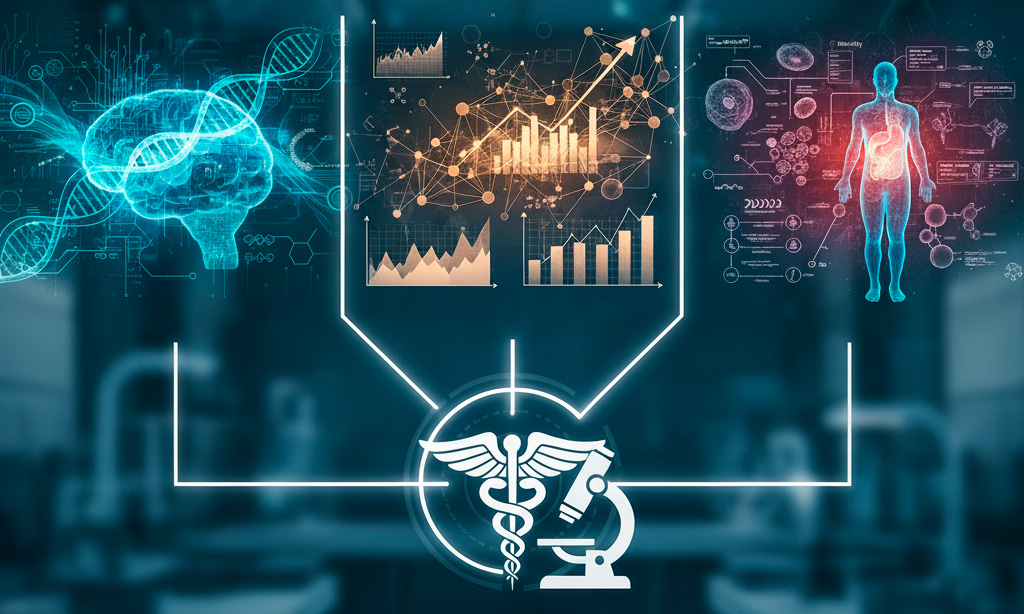
Cover figure taken from [7].
References
[1] Sánchez Vázquez, Adolfo. Ética. Barcelona: Editorial Crítica, 1984.
[2] Fapesp confirma desvio de R$ 5,3 milhões na Unicamp e aciona 34 pesquisadores na Justiça. https://g1.globo.com/sp/campinas-regiao/noticia/2025/05/03/fapesp-confirma-desvio-de-r-53-milhoes-na-unicamp-e-aciona-34-pesquisadores-na-justica.ghtml
[3] Miguel A. De C. Michalski; Carlos A. Murad; Fabio N. Kashiwagi; Gilberto F. M. De Souza; Halley J. B. Da Silva; Hyghor M. Côrtes. A Multi-Criteria Framework for Selecting Machine Learning Techniques for Industrial Fault Prognosis. 2025.
[4] W. Monte Verde, E. Kindermann, J. L. Biazussi, V. Estevam, B. P. Foresti, and A. C. Bannwart. Experimental Investigation of the Effects of Fluid Viscosity on Electrical Submersible Pumps Performance. SPE Prod & Oper 38 (01): 1–19. 2023.
[5] Natan Augusto Vieira Bulgarelli, Jorge Luiz Biazussi, William Monte Verde, Carlos Eduardo Perles, Marcelo Souza de Castro a, Antonio Carlos Bannwart. Experimental investigation on the performance of Electrical Submersible Pump (ESP) operating with unstable water/oil emulsions. Journal of Petroleum Science and Engineering. Volume 197, February 2021, 107900.
[6] Junqian Zhang, Shuaishuai Dong, Shengyu Zhang, Heng Zhang, Hongli Li, Qingfeng Dong, Pin Wu and Chun Feng. Review on Fault Diagnosis of Electric Submersible Pump using Machine Learning. Journal of Physics: Conference Series. (2025).
[7] Felipe Leal Valentim. Bioinformática, ciência de dados e biologia de sistemas para medicina de precisão. Revista BIOINFO A Revista Brasileira de Bioinformática e Biologia Computacional (2025).

Of all the courses offered by the Federal University of Lavras in 2002, I ranked second. I chose Computer Science because I learned to use a computer on my own. I have experience in data science and artificial intelligence, mainly with the R programming language. I hold a PhD from Wageningen University and currently work as a postdoctoral researcher in Artificial Intelligence at USP (University of São Paulo). I have completed postdoctoral internships at ISPED/INSERM Bordeaux, Médecine Sorbonne Université/INSERM Paris, LACEN-TO/OPAS Palmas, UNIFESP/FAPESP São Paulo, and Fiocruz Rio de Janeiro.