From the Big Bang to Life: The Power of Heat (From the Big Bang to life on Earth, heat and light drive cosmic evolution, power ecosystems, and sustain both living and non-living systems) and Light-


Life on Earth is sustained by two fundamental forms of energy: heat and light. From the birth of the universe to the growth of a tiny seed, from the warmth of a mother's womb to the ripening of a mango fruit, heat and light play essential roles in creating, nurturing, and sustaining life. Wherever life exists, these two forces are almost always present.
The story begins with the Big Bang, approximately 13.8 billion years ago. The universe emerged from an extremely hot and energetic state. This immense heat enabled the formation of elementary particles, atoms, stars, galaxies, and eventually planets. The first stars became cosmic furnaces, producing light and heat that shaped the evolution of the universe.
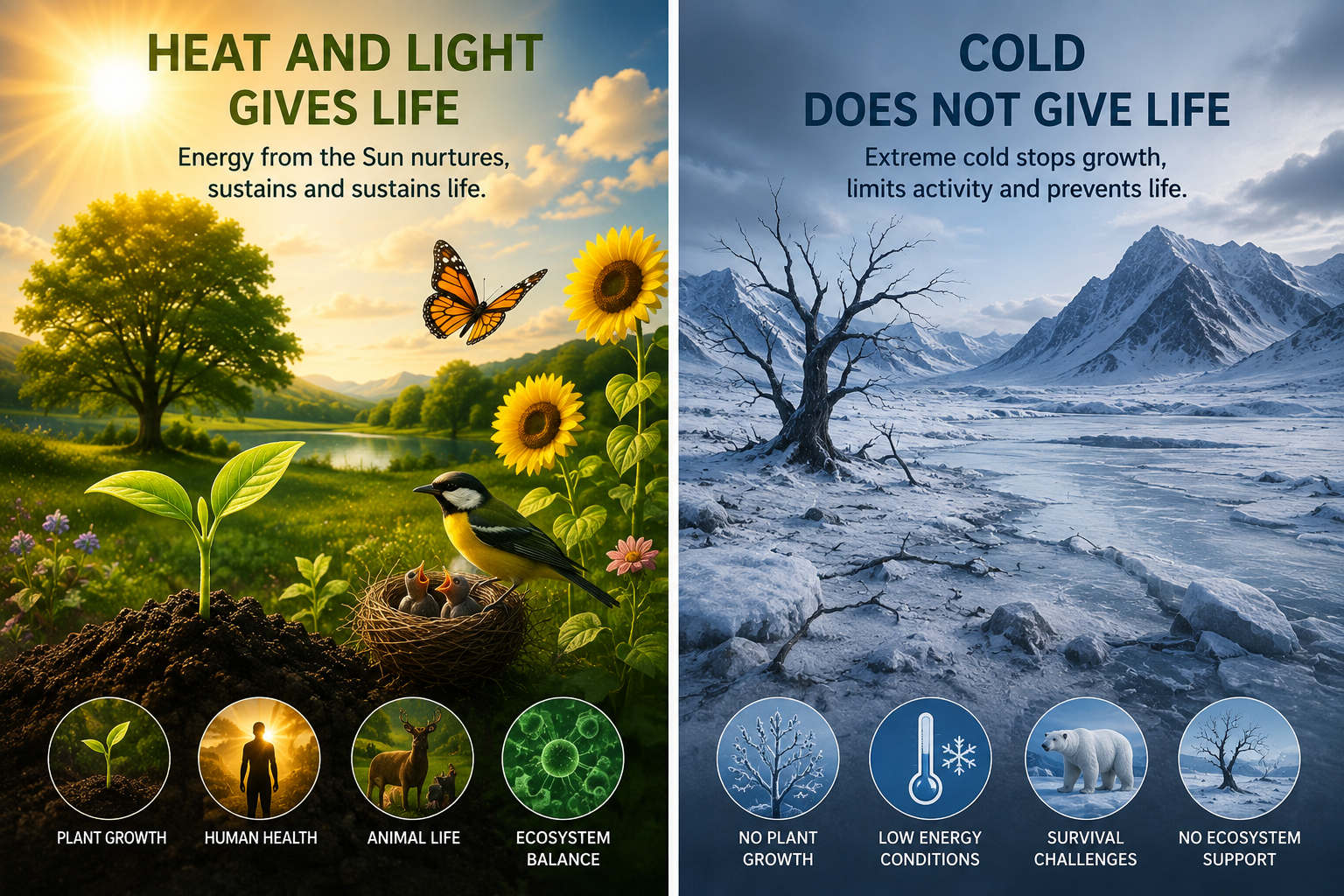
Our Sun is the most important source of heat and light for Earth. Its energy maintains the planet's temperature within a range suitable for life. Without solar heat, Earth would become a frozen world. Without sunlight, plants could not produce food, and the food chain would collapse.
Light drives one of the most important biological processes—photosynthesis. Green plants absorb sunlight and convert carbon dioxide and water into food and oxygen. Every animal, including humans, depends either directly or indirectly on this process. Plants also exhibit phototropism, growing toward light because their survival depends on capturing solar energy.
Heat and light influence life from its earliest stages. Human life develops within the warm and protected environment of the mother's womb. Premature babies often require incubators that provide controlled warmth, and special light treatments are used to manage neonatal jaundice. Similarly, birds incubate their eggs using body heat, enabling embryos to develop and hatch successfully.
The importance of heat can be seen throughout nature:
- The Big Bang created a hot universe from which matter emerged.
- Heat enabled the formation of stars and planets.
- Solar heat maintains Earth's habitable climate.
- Seeds germinate when suitable temperatures are available.
- Birds incubate eggs using body heat.
- The mother's womb provides a warm environment for fetal growth.
- Human metabolism depends on maintaining body temperature.
- Enzymes function efficiently only within specific temperature ranges.
- Blood circulation distributes heat throughout the body.
- Bees regulate hive temperature for larval development.
- Composting generates heat through microbial activity.
- Fermentation requires appropriate temperatures for microbial growth.
- Fruits such as mangoes ripen faster in warm conditions.
- Animals build warm nests to protect their young.
- Coral reefs flourish within suitable warm-water temperatures.
- Soil microorganisms become more active in warm environments.
- Reptile eggs depend on environmental heat for development.
- Insect growth and metamorphosis are influenced by temperature.
- Deep-sea hydrothermal vent ecosystems rely on geothermal heat.
- Many scientists believe early life emerged in warm aquatic environments.
Heat is also essential for agriculture. Farmers depend on seasonal temperature variations for crop cultivation. Warm soil promotes root development, microbial activity, and nutrient availability. Mango trees, rice fields, and countless agricultural systems thrive because of an appropriate balance of sunlight and warmth.
The role of heat extends to ecosystems. Coral reefs, among the most diverse ecosystems on Earth, survive within specific temperature limits. Bees maintain hive temperatures to protect developing larvae. Soil bacteria and fungi decompose organic matter more efficiently under warm conditions, recycling nutrients that support plant growth.
Remarkably, life can even exist in extreme environments. Around deep-sea hydrothermal vents, organisms thrive using geothermal heat from Earth's interior rather than sunlight. These ecosystems demonstrate that heat itself can sustain biological activity even in complete darkness.
However, life requires balance. Excessive heat can damage cells, denature proteins, and cause dehydration. Likewise, extreme cold slows biological processes and inhibits growth. Refrigerators preserve food because low temperatures reduce microbial activity and metabolic reactions. Thus, life flourishes not in extremes but within a suitable temperature range often called the "Goldilocks Zone."
Light is equally important. It regulates biological clocks, influences plant growth, guides animal behavior, and provides the energy that drives photosynthesis. Sunlight helps maintain ecological balance and supports nearly every food web on Earth.
From the fiery birth of the cosmos to the warmth of a nest, from a germinating seed to a newborn child, heat and light remain the invisible architects of life. They shape our environment, power biological processes, sustain ecosystems, and enable growth and reproduction. The history of life is, in many ways, the history of heat and light working together.
As we explore the universe and search for life beyond Earth, scientists continue to look for environments where heat, light, and liquid water coexist. This search reflects a profound scientific truth: wherever suitable heat and light are present, the possibility of life emerges. Heat and light are not merely forms of energy; they are the universal foundations upon which life itself is built
Follow the Topic
-
Discover Materials
This is a broad, open access journal publishing research from across all fields of materials research.
-
Gravitation and Cosmology


Related Collections
With Collections, you can get published faster and increase your visibility.
Smart Materials for Biomedical and Healthcare
The rapid convergence of materials science, biotechnology, and artificial intelligence is transforming the landscape of modern healthcare. The emergence of next-generation smart materials engineered to dynamically sense, respond, and adapt to biological stimuli represents one of the most exciting frontiers in biomedical innovation. This special issue aims to bring together pioneering advances, conceptual breakthroughs, and translational research in the evolving domain of intelligent and multifunctional materials designed for healthcare applications. The focus extends beyond conventional biomaterials to encompass adaptive, stimuli-responsive, and bioinspired systems that can autonomously interact with their environment, enabling precise diagnostics, targeted therapy, regenerative healing, and continuous health monitoring.
In recent years, the field has witnessed remarkable progress in the development of nanostructured, polymeric, hydrogel-based, and hybrid materials capable of mimicking natural tissues and dynamically interfacing with biological systems. Smart materials integrated with biosensing, drug delivery, and regenerative functionalities are opening new avenues for personalized medicine, soft robotics in surgery, and bioelectronic interfaces that seamlessly connect with neural and muscular tissues. Equally transformative is the integration of artificial intelligence and data-driven materials design, where predictive modeling and machine learning algorithms accelerate the discovery and optimization of novel materials with programmable and adaptive properties. These interdisciplinary approaches hold enormous potential for precision healthcare, point-of-care diagnostics, and remote patient monitoring. The issue will explore the convergence of bioelectronics, flexible and wearable materials, and energy-harvesting systems for sustainable biomedical devices that can function autonomously within or outside the human body. From biodegradable implants and self-healing materials for tissue engineering to magneto- and photo-responsive systems for controlled therapeutic release, the scope embraces both fundamental science and practical engineering perspectives. Emerging directions such as organ-on-chip platforms, 4D printing of shape-memory biomaterials, and quantum-inspired materials for biosensing further expand the boundaries of what is possible in healthcare technologies.
The Collection aims to foster collaboration among material scientists, biomedical engineers, clinicians, and data scientists to accelerate the translation of laboratory innovations into real-world healthcare solutions. By highlighting cutting-edge research and forward-looking perspectives, it seeks to inspire novel paradigms for intelligent, sustainable, and patient-centric materials systems that redefine diagnostics, therapy, and rehabilitation. Ultimately, the compilation aspires to create a vibrant knowledge exchange platform to drive the next wave of discovery and innovation in smart materials for biomedical and healthcare applications.
1. AI-driven bioinspired composites for dynamic tissue regeneration and autonomous healing response
2. Next-generation piezoelectric and triboelectric nanomaterials for self-powered implantable biosystems
3. Quantum-engineered smart materials for ultrafast biosensing and precision molecular diagnostics
4. Multifunctional biointerfaces integrating neuromorphic computing for adaptive neuroprosthetic applications
5. 4D bioprinted shape-transforming materials for personalized regenerative and surgical interventions
6. Biohybrid soft robotics using responsive polymers for minimally invasive medical procedures
7. Photonic and plasmonic nanomaterials for real-time, noninvasive health monitoring platforms
8. Sustainable and biodegradable smart polymers for green healthcare and environmental biosafety
9. Magneto-responsive nanostructures for controlled gene editing and spatiotemporal therapeutic delivery
10. Cognitive materials coupled with embedded ai for predictive therapeutic decision-making systems
11. Metamaterial-based bioelectronics for high-fidelity signal transduction and neural communication enhancement
Keywords:
• Smart materials
• Biomedical engineering
• Healthcare innovation
• Bioinspired materials
• Stimuli-responsive systems
• Adaptive biomaterials
• Regenerative medicine
• Intelligent materials
• Multifunctional materials
• Personalized medicine
This Collection supports and amplifies research related to SDG 3, SDG 9, and SDG 12.
Publishing Model: Open Access
Deadline: Feb 28, 2027
Materials in Structural Engineering: Challenges and Innovations under Extreme Loading Conditions
In materials science and engineering, the pursuit of robust and resilient materials capable of withstanding extreme loading conditions and demanding service environments is more pressing than ever. The field of structural engineering and related materials and computational engineering disciplines, at the forefront of this endeavor, faces constant challenges posed by natural hazards, complex service environments, and high-temperature exposure. The ability of structural systems and materials to endure such events depends crucially on their properties and performance. Discover Materials, as part of the Discover journal series committed to advancing materials research, provides an ideal platform for addressing these challenges and accelerating innovation across the full spectrum of materials design, modelling, processing, and application.
The Collection, titled “Materials in Structural Engineering: Challenges and Innovations under Extreme Loading Conditions,” aims to delve deeply into the intersection of materials science and structural resilience across experimental, numerical, and applied perspectives. This collection is driven by the urgent need to develop advanced materials, structural systems, and engineering methodologies that can withstand diverse forms of extreme loading, including blast and impact forces, as well as thermal, durability-related, and environmental effects, while ensuring reliable performance across experimental, computational, and real-world engineering applications.
This Collection will encompass a diverse array of topics essential to advancing our understanding and capabilities in structural, materials, and interdisciplinary engineering systems. Key themes include but are not limited to:
(1) Experimental studies on the behavior of structural materials subjected to blast and impact forces, high temperatures, and other severe service conditions, aiming to uncover fundamental mechanisms and develop protective measures;
(2) Analytical modeling approaches to simulate and predict the response of structures under extreme loading conditions, including coupled mechanical and thermal effects, facilitating the design of resilient systems;
(3) Numerical simulations that leverage advanced computational methods to model complex interactions between materials and dynamic forces, including finite element and related numerical techniques;
(4) Application of machine learning techniques to analyze vast datasets and extract actionable insights for enhancing structural resilience and performance prediction.
Additionally, the scope of this collection is broadened to include studies on multifunctional and advanced engineering materials, materials processing, manufacturing processes, and optimization techniques, as well as data-driven and artificial intelligence-based engineering systems, relevant to structural, mechanical, civil infrastructure systems, and multidisciplinary engineering systems.
At its core, this topic collection aligns with Discover Materials’ mission to catalyze innovation in materials research across diverse applications. By publishing pioneering research in structural engineering and related advanced and functional material systems, the collection aims to not only expand our fundamental understanding of materials behavior but also to accelerate the development of materials with enhanced properties for a safer and more sustainable built environment including conventional, advanced, and emerging material systems.
Authors are invited to submit original research articles, reviews, and case studies that contribute to the understanding of structural and functional materials, their processing and performance behavior, and related computational, experimental, and data-driven approaches under extreme loading and engineering service conditions. Submissions should emphasize practical applications and theoretical advancements relevant to the fields of structural engineering, materials science, and allied engineering domains.
This Collection will serve as a valuable resource for researchers, engineers, and policymakers involved in the design, analysis, and implementation of advanced materials and engineering systems, spanning experimental studies, numerical modeling, data-driven approaches, and real-world applications. It aims to foster collaboration and innovation in addressing challenges in structural, mechanical, and materials engineering through cutting-edge research in extreme loading conditions, materials processing, and performance optimization.
Feature Conferences:
(1) 2025 International Conference on Materials, Mechanical, and Civil Engineering Technologies (MMCET 2025), to be held in Tokyo, Japan, from December 17th to 19th, 2025.
(2) 2025 2nd International Symposium on Civil Engineering and Smart Structure Technology (CESST 2025), to be held in Zhengzhou, China, from December 5th to 7th, 2025.
(3) The 4th International Conference on Civil Engineering and Intelligent Construction, to be held in China, on September 23, 2026.
High-quality papers presented at the conference, as well as directly submitted manuscripts, will be considered for inclusion in this Collection, subject to a rigorous peer-review process in accordance with Springer Nature policies. We welcome innovative research that advances knowledge and practice in this critical field.
“This Collection continues to advance experimental, computational, and data-driven innovations toward resilient, sustainable, and high-performance structural systems under extreme engineering demands.” — Guest Editor
Keywords:
Structural Engineering; Extreme Loading Conditions; Blast and Impact Forces; Resilient Infrastructure; Material Performance; Simulations; Finite Element Modeling; High-Temperature Effects; Durability; Composite Materials; Numerical Methods; Artificial Intelligence; Machine Learning; Neural Networks; Optimization Techniques; Civil Infrastructure Systems; Structural Health and Performance Assessment; Materials Processing; Functional and Structural Materials
Publishing Model: Open Access
Deadline: Dec 31, 2026
Please sign in or register for FREE
If you are a registered user on Research Communities by Springer Nature, please sign in