How do melanoma cells decide their fate? A mathematical view of cell state dynamics
Published in Mathematics


Speakers
- Charlotte Taylor Barca — University of Manchester
Abstract
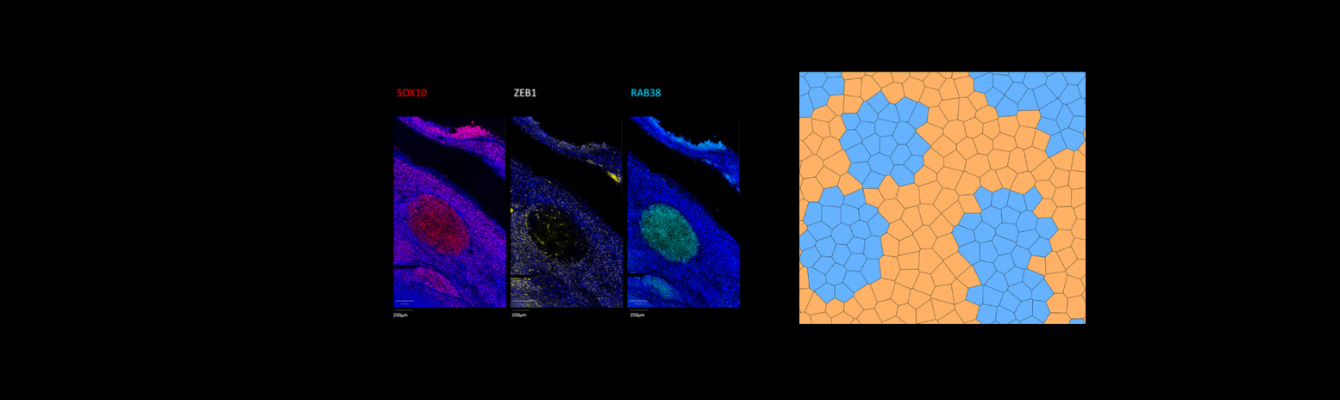
Melanoma is the most aggressive form of skin cancer, arising from the pigment-producing cells of the skin. Within a single melanoma tumour, cells can commit to strikingly different gene-expression profiles, which encode different phenotypic identities. Furthermore, cells do not commit to a single identity; they are known to dynamically and reversibly switch. This so-called phenotypic heterogeneity leads to therapy resistance in this skin cancer, as well as evasion of the body’s immune response. Our study investigates how cells decide which phenotypic identities to adopt and when these transitions occur, and why these identities emerge as coherent patches within a tumour rather than a random mixture of cells.
In this talk, I will walk through the collaboration and modelling process behind our recently published paper, which tackles a refined gene regulatory network in melanoma comprising key transcription factors. Our approach brings together an array of classical techniques from mathematics to produce a novel perspective on a well-established biological question. Through a simplifying assumption on how transcription factors bind cooperatively, we obtain a model that can be solved exactly, allowing us to determine all states that are possible in the regulatory network. We show how each gene-expression profile corresponds to a biologically meaningful state, spanning both states already well-established in the melanoma literature and novel states not previously described. Extending this to a population of communicating cells, we use a travelling-wave analysis to derive a condition that predicts which state will dominate a tissue.
With an authorship spanning mathematics and biology, this project was shaped by a close collaboration. The model’s central questions were framed by experimental imaging, and the model’s predictions have pointed us toward new experiments for validation. Throughout the process, many precautions were taken to remain biologically relevant and mathematically tractable, and the result has led to valuable insights into the problem.
Looking for more in the field?
Explore more events from MathBioNexus and Springer Nature's Mathematics & Statistics.

Research Seminars by Springer Nature - giving you access to the latest research talks, direct from authors and editors.