Inception Report and Methodological Framework for the Application of the WAMED Model in Dhaka City: An Integrated Ecological–Economic Evaluation of Solid Waste Management Systems
Published in Civil Engineering
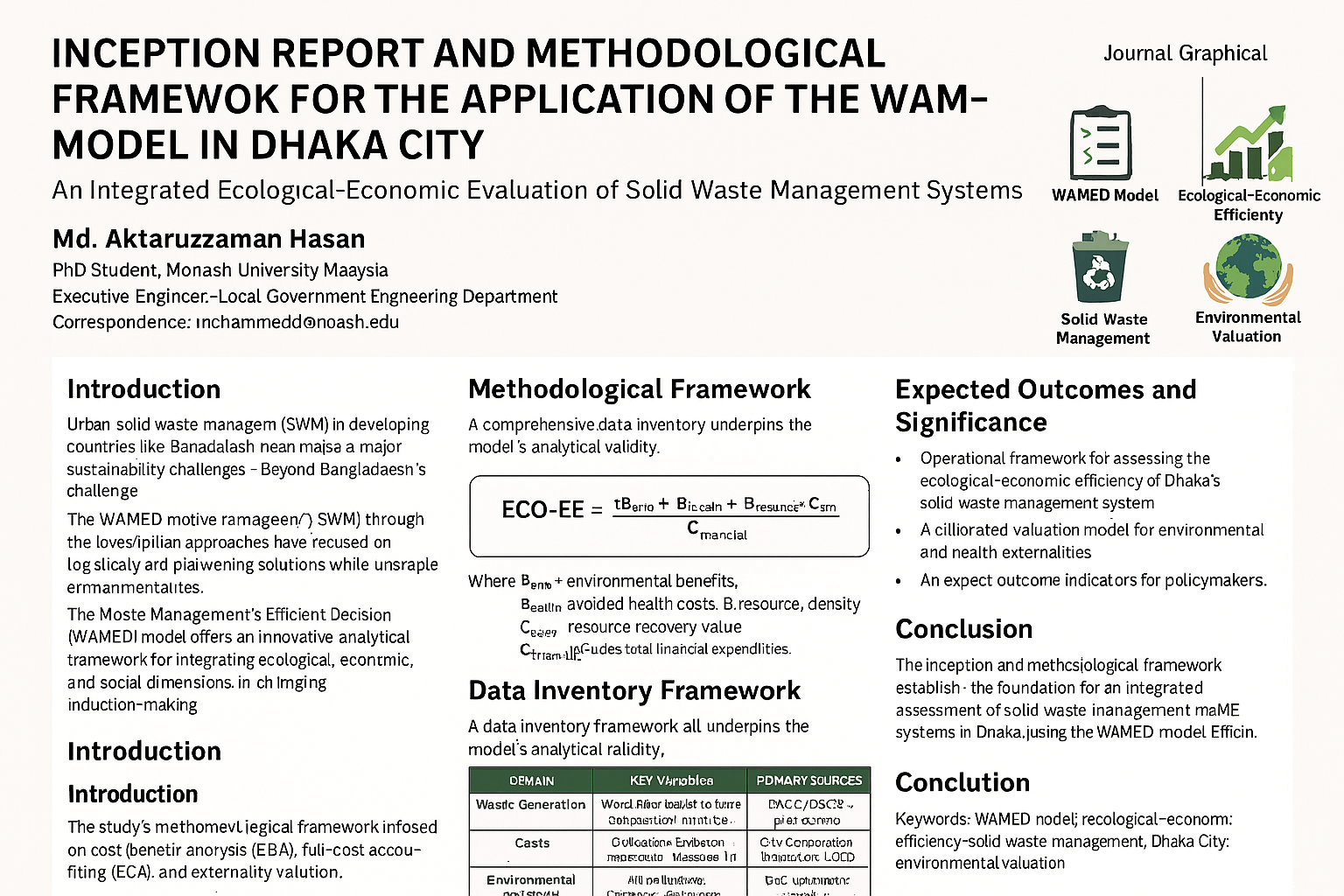
Urban solid waste management (SWM) in developing countries like Bangladesh represents one of the most persistent sustainability challenges [5,6]. Dhaka, the capital city, generates thousands of tonnes of municipal solid waste daily, with inadequate infrastructure for proper segregation, treatment, and disposal [8,9]. Traditional approaches to SWM have primarily emphasized logistical and engineering solutions while underrepresenting the associated environmental and health externalities. The Waste Management’s Efficient Decision (WAMED) model offers an innovative analytical framework for integrating ecological, economic, and social dimensions within waste management decision-making [1,3]. This paper outlines the inception framework and methodological approach for applying the WAMED model in Dhaka, aiming to quantify and optimize the ecological–economic efficiency (ECO-EE) of existing and alternative waste management systems.

Career Summary:
• Dynamic and results-oriented Executive Engineer with over 18 years of progressive experience in civil engineering, currently leading impactful projects at the Local Government Engineering Department.
• Adept at driving infrastructure development in alignment with national objectives, specializing in structural engineering, project management, and environmental stewardship.
• Proven track record of orchestrating multidisciplinary teams to successful completion of diverse projects including roads, buildings, dams, and riverbanks, consistently adhering to industry standards.
• Currently, as Executive Engineer, ensure stringent quality control and compliance with rigorous testing protocols for cement and bitumen, fostering excellence in project execution.
• Recognized as a Project Management Professional (PMP) and Internal Audit Leadership (QUIAL) certified expert, leveraging technology for efficient resource utilization by e-procurement methods.
• Holistic approach integrates social, economic, and environmental considerations into project planning, ensuring sustainable outcomes.
• PhD candidate in Environmental Engineering at Monash University, starting in June 2025.
• Experienced in QGIS software, project monitoring, and problem-solving for project management.
Please sign in or register for FREE
If you are a registered user on Research Communities by Springer Nature, please sign in