Is a Contexture Just Another Algorithm? No.
Published in Computational Sciences

Algorithms, contextures, and the one programmable route to real quantum computation that the Axiom of Algorithmic Closure leaves open
Dr. Ilan Kreitmann · QPC, Quantum Polycontextural Computation · November 2026
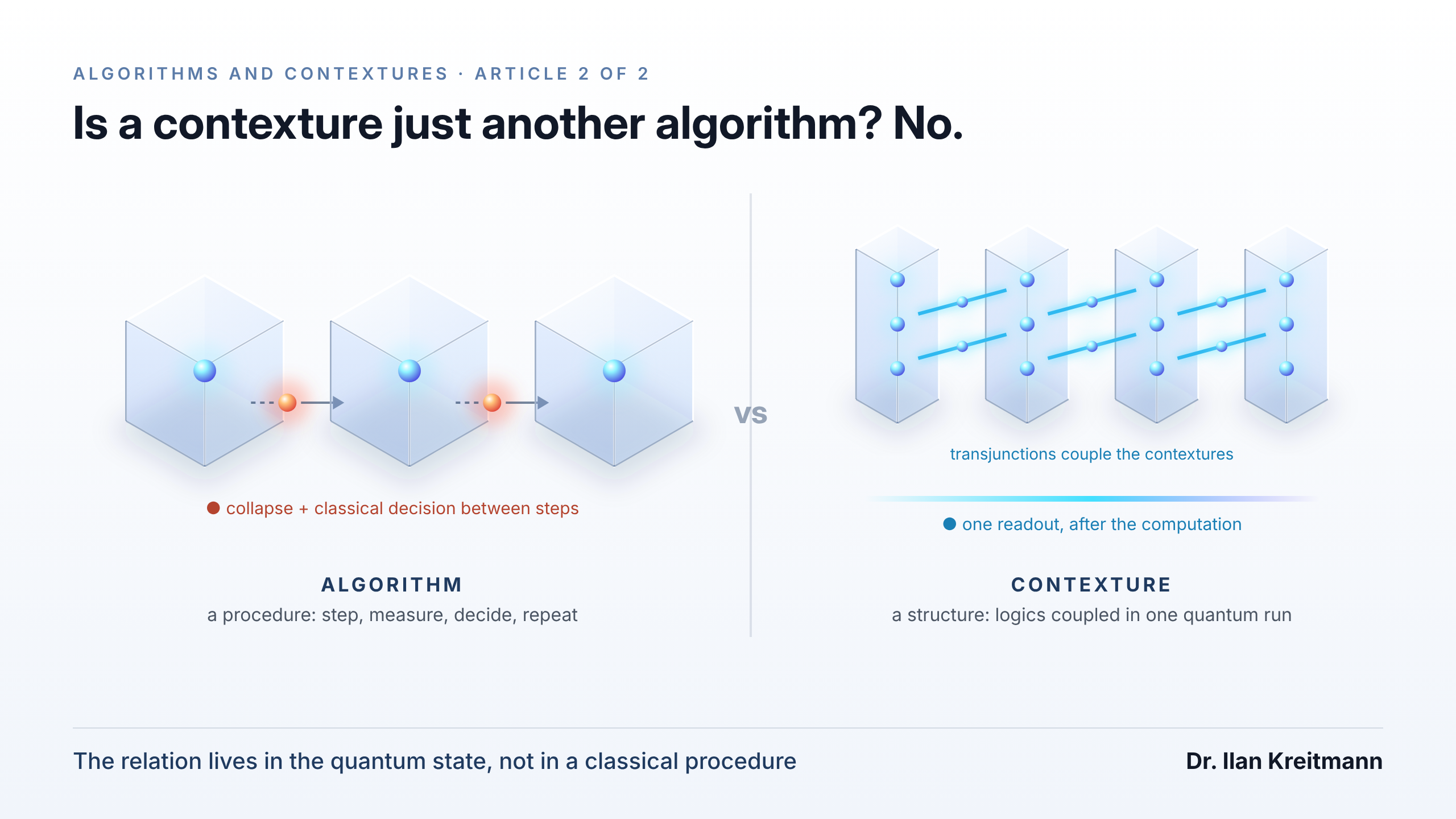
No. An algorithm is a procedure: a sequence of steps, each defined in two-valued logic, executed in order, with classical control deciding what comes next. A contexture is a structure: a register of qubits that carries its own logic, co-resident on the processor with other contextures and coupled to them by transjunctions, so that the relation between the logics lives in the quantum state and nowhere else. A procedure tells the machine what to do. A structure tells the machine what to be.
The first article in this pair, The Axiom of Algorithmic Closure, showed that the procedure cannot bring a pure quantum real-world answer out of a quantum computer. This article shows where exactly the procedure fails, why the contexture is the only programmable architecture built on the one route the axiom leaves open, and, with the same severity the first article applied to IBM, Google and D-Wave, what the contexture has proven on hardware and on named tasks.
1. How algorithms are used in quantum computation today
Four patterns account for practically every quantum computation reported in 2025 and 2026.
The hybrid loop. VQE, QAOA and their variants put a classical optimiser in control. The quantum processor evaluates a cost function, a measurement collapses the state, the optimiser chooses new parameters, and the cycle repeats hundreds or thousands of times. The quantum device is a subroutine. The decision is classical.
Sample, then compute classically. Sample-based diagonalisation and its relatives use the quantum processor to produce bitstrings, then hand them to a classical supercomputer that builds and diagonalises the matrix that contains the answer. The quantum part proposes; the classical part decides.
The sequential pipeline. A problem with several factors is cut into separate jobs, one per factor, with a measurement between each stage and classical mathematics joining the results afterwards. Each factor is computed quantum-mechanically; the relation between the factors is computed classically.
The benchmark. Random circuit sampling, out-of-time-order correlators and doped Clifford sampling run an algorithm whose purpose is to be hard. They establish classical hardness and, by design, nothing about a real system.
The common feature. In the first three patterns the relation between the parts of the problem is held in classical logic. Every measurement between steps is a collapse: a forced single-valued valuation of the state, after which a classical procedure decides. The quantum state is created, used, dissolved, and its remains are joined by a machine that could have joined them without any quantum computer at all. Whatever a classical procedure joins, a classical computer can join. That is the operational root of the capture pattern documented in the first article.
2. What a contexture is
QPC takes each logic of a task and makes it a contexture: its own qubits, its own quantum logic, its own part of the wave function. Several contextures are co-resident on one processor and compute simultaneously. They act on each other through transjunctions that couple contextures when the task needs joint structure. The transjunction is the operating primitive between contextures. Together with the logics they carry, they are the architecture.
The computation runs on the hardware from start to end as one job. The ranking or decision is read from the counts of that job. The reported result is a measured property of the quantum state. Qiskit is the port through which the structure enters the processor, not the place where the computation happens. The application metric is formed only after the computation ends, from that single readout.
The logical root is Gotthard Günther's polycontextural logic and his transjunctional operations, developed from the late 1950s, with Rudolf Kaehr's later morphogrammatics. Günther's rejection value negates a whole two-valued system rather than taking a position inside it. That is the formal statement of what quantum mechanics enforces physically, as Kochen and Specker proved in 1967: there is no single global assignment of definite values to all observables. Classical logic needs one context. Quantum reality refuses it. A contexture architecture is the first computational design that accepts the refusal instead of fighting it.
3. Five fundamental differences
Procedure against structure. An algorithm is a list of instructions, and its meaning is the order in which they run. A contexture is a configuration of coupled logics, and its meaning is the joint state those logics create.
Sequence against simultaneity. An algorithm computes one thing after another, even when its gates act in parallel, because each stage depends on a decision taken at the stage before. Contextures compute at the same time, on one chip, in one run.
Where the relation lives. In the algorithmic patterns the relation between the parts of a problem is computed in classical memory after measurement. In a contexture architecture it is carried by transjunctions inside the quantum state before measurement. This is the decisive difference. Everything else follows from it.
Many collapses against one. A hybrid loop collapses the state at every iteration and a pipeline at every stage. A contexture run collapses once, at the end, when the computation is complete.
One logic against many. Every step of an algorithm is valued in one two-valued logic. A polycontextural computation holds several logics at once without forcing them into a single valuation, which is exactly the situation that quantum contextuality describes.
4. Why the route to real quantum computation runs through contextures
The first article stated the Axiom of Algorithmic Closure in terms of the algorithmic interface: a classical description in, finite measurement out. That formulation is correct but not yet sharp. The closure has two sources, and they must be separated.
The first source is readout. The Holevo bound and the tomography lower bound limit what any quantum computation can export, whatever its architecture. A contexture run exports a ranking or a joint-structure gap from one set of counts. It leaves the full state inside the device, as those theorems require of every architecture.
The second source is classical control of the relation between the parts. This is where algorithmic quantum computation forfeits. When a classical procedure decides the next step, joins the stage results or steers the parameters, the joint structure of the problem passes through classical logic. What passes through classical logic is, by construction, within classical reach. The capture of IBM's 2023 utility result, D-Wave's spin-glass result and the dequantized machine-learning algorithms all exploited outputs whose structure was organised by a classical design.
The sharpened axiom. A quantum computation can deliver content beyond classical reach only if the relation between the parts of the problem is carried by the quantum state up to the single final measurement, and no classical procedure decides any step in between.
Three routes satisfy the first half of that condition, and only one satisfies both halves while remaining programmable. Analog quantum simulation carries its relations in the state, but it computes only the physics it is: a lattice of cold atoms simulates the lattice model it implements and nothing else. Algorithms are programmable, but classical control holds their relations. Contexture architectures are programmable and hold the relation between logics in the state through transjunctions, with one collapse at the end. That is the route the axiom leaves open, and it is the route QPC has already run.
5. What the contexture has demonstrated
QPC applies to itself the standard the first article applied to every other company: what ran, on which machine, at what size, against which baseline, with which job identifiers. Every such identifier is the objective record of what the computation returned. It depends only on the counts.
Co-residence at scale. Photomask synthesis on IBM Heron r2, ibm_kingston, job daas1burrl7c73860bd0: six candidate masks, six manufacturing logics, four public ICCAD-2013 layouts, one Sampler job on the 156-qubit register. ADMET on ibm_marrakesh and FLiBe on ibm_fez each held seventeen logics with nine named units on that same register width. The public record holds 63 documented QPC tasks, each with a published job identifier.
The transjunction does work. In the pre-registered Joint Structure Challenge on IBM Fez, bars were fixed before the runs: coupled ICC at least 0.02, gap at least 0.05, intracontext ratio at least three. Seeds 7, 11 and 42. L5a raw ICC gaps 0.289, 0.101 and 0.130. L5b depth-matched intracontext control: gaps 0.291, 0.101 and 0.145, ratios 22, 9 and 31 times. All three seeds passed. In the Wang and Busemeyer question-order pilot on IBM Fez, eighteen public jobs, four contextures reduced total-variation distance to the target from 0.302 at one contexture to 0.251, stable across 2,000 bootstrap replicates.
That is architecture discrimination: switching the transjunctions on and off on the hardware changes the measured joint structure, on raw counts from one job. It establishes that the relation between contextures lives in the quantum state. It is the experimental basis of Section 4. The paper is deposited as One-run polycontextural quantum computation on a 156-qubit processor on Zenodo.
6. What the contexture has proven on named real-world tasks
Section 5 established architecture discrimination, including the Joint Structure Challenge and the Wang and Busemeyer eighteen-job pilot. This section applies the same standard to named public desks. These are results. Each finding is the ranking or gap the published IBM job identifier records.
Photomask synthesis, IBM Heron r2, ibm_kingston, job daas1burrl7c73860bd0. Six candidate masks from the public ICCAD-2013 panel, six manufacturing logics, four layouts, one Sampler job. The pre-registered industry expectation was that the inverse-lithography mask would lead. The coupled ranking returned the uncorrected mask at 0.622 against the inverse-lithography mask at 0.460. The expectation was rejected. Printability, edge placement, process window, mask width, mask space and writer cost were held together until one readout. The job identifier records that ranking. A lithography simulation of the same six masks would be a different computation, with its own record.
Kinase selectivity, IBM Heron r2, ibm_kingston, job da632keaa69c739lgpag. The public Davis 2011 panel: intended hits, collateral hits and safety kinases co-resident. Imatinib 0.610 over dasatinib 0.547. Raw junction gap 0.197. PASS on the pre-registered bar.
ADMET lead desk, IBM Heron r2, ibm_marrakesh. Nine named drug compounds under seventeen pharmacological logics, absorption, distribution, metabolism, excretion and toxicity among them, on the 156-qubit register. Raw junction gap 0.185. Coupled jobs include d9qubi7pemts73crsa2g. The ranking is a measured property of that job family.
FLiBe tritium-binding landscape, IBM Heron r2, ibm_fez, job d9a06m52su3c739l0eeg. Nine published molten-salt conformations under seventeen contextures, full 156-qubit register, one job. Joint-structure gap +0.0095. Top recovery 9, then 1, then 4.
RNA fold ranking, IBM Heron r2, ibm_kingston, job dbnj8ogqtr0c73ad6550. A named 17-nucleotide sequence, four named helices, stack, hairpin and occupancy held together in one Sampler job. Pre-registered Path A: nested H0+H3 on the coupled arm, competing stem H3 on the separable arm. Raw nested P = 0.241. E1 and E2 both passed on raw counts.
Anyone with an IBM Quantum account can check that these jobs ran as recorded. The method paper is on Zenodo. The community statement of the architecture is on Springer Nature Research Communities. That is most of what Section 4 required of a programmable route: several logics co-resident, the relation carried in the state by transjunctions, one readout, a named public instance, a pre-registered expectation, and a finding a domain reader can use and test against the published job identifier. The first article's capture pattern was classical control of the relation. These jobs removed that control and returned the ranking from the chip.
7. Why the algorithm-axiom's Section 8 test is not a debt this architecture still owes
The first article's Section 8 is the experiment that would refute the Axiom of Algorithmic Closure. It asks for a quantum-native property of a named molecule, catalyst, material or nucleus, unmatched by classical methods on an open tracker, and verified by laboratory measurement of that physical system. That is the right finishing line for an axiom about algorithms. It is the wrong finishing line for an architecture that is not an algorithm.
A contexture run does not claim to export the full quantum state. Holevo and the tomography lower bound already say that no architecture does. Section 4 of this article stated that bound once, as physics. QPC's product is a ranking or a joint-structure gap read from one set of counts. That is a thin classical export by design, the same class of export every Sampler job returns. The axiom's Wall one forbids handing over the state. It does not forbid handing over a decision that was computed while several logics were still coupled.
Architecture discrimination compares coupled contextures with separable contextures, both on quantum hardware. That is exactly the test of where the relation lives. IBM's 127-qubit kicked Ising experiment was captured on a laptop because the output was a handful of expectation values of a classically organised model. QPC's output on the desks above is a ranking of named options under co-resident logics, with the separable twin in the same job set. Capturing a kicked Ising correlator does not capture that object. The first article's Wall two was about algorithmic outputs organised by classical design. These outputs were organised on the chip.
The published job identifier is the objective proof of what the computation returned. It depends only on the counts. The first article judged IBM, Google and D-Wave on machine, task, baseline and identifier. QPC publishes the same, plus a pre-registered expectation and a coupled-versus-separable control, on raw counts. That is a stricter public standard than the utility and sampling papers the first article examined.
A laboratory measurement of a molecular energy that no classical method can match would be a further, and welcome, experiment. It would speak to the first article's pure-quantum-system clause. It would not be the first day on which a contexture computation became real. That day is already on the ledger: named masks, named kinases, named compounds, named RNA, named FLiBe conformations, public IBM jobs, one readout each.
If a later contexture run also meets the first article's Section 8 conditions together, the sharpened axiom of Section 4 is confirmed on a molecular object as well. If classical methods then capture that molecular object, the question becomes whether that object was still organised as an algorithm. Either outcome is physics. Neither outcome reopens the architectural result already in hand. Classical simulability of a later molecular object is a question about that object. It is not a question about the jobs already signed on the IBM ledger.
Conclusion
A contexture is not another algorithm. An algorithm keeps the relation between the parts of a problem in classical logic and collapses the state wherever it needs a decision. A contexture keeps that relation in the quantum state and collapses once. Every algorithmic claim examined in the first article was captured or confined to benchmarks, and the cause is the same in each case: the classical procedure in control.
The contexture is the only programmable architecture that removes that procedure. QPC has proven the point on hardware. Transjunctions carry joint structure on raw IBM counts, with public job identifiers, at the scale of a 156-qubit Heron r2 register. Named real-world desks have already returned pre-registered rankings from one job: photomask synthesis on ibm_kingston, kinase selectivity on ibm_kingston, ADMET on ibm_marrakesh, FLiBe on ibm_fez, RNA on ibm_kingston. The Axiom of Algorithmic Closure stands for algorithms. The programmable route it leaves open is occupied.
Sources
I. Kreitmann, "Will an Algorithm Running on a Quantum Computer Ever Solve a Pure Quantum Real-World Task? No. The Axiom of Algorithmic Closure" (November 2026).
I. Kreitmann, "One-run polycontextural quantum computation on a 156-qubit processor," Zenodo (2026). zenodo.org/records/22831221
I. Kreitmann, "Quantum Polycontextural Computation: many logics, one quantum run," Springer Nature Research Communities (2026). communities.springernature.com/posts/quantum-polycontextural-computation-many-logics-one-quantum-run
QPC job record and Joint Structure Challenge. quantumpolycontextural.ai
G. Günther, "Cybernetic Ontology and Transjunctional Operations," in Self-Organizing Systems (1962).
R. Kaehr, writings on polycontexturality and morphogrammatics. thinkartlab.com
S. Kochen, E. P. Specker, "The problem of hidden variables in quantum mechanics," J. Math. Mech. 17 (1967).
A. S. Holevo, "Bounds for the quantity of information transmitted by a quantum communication channel," Probl. Inf. Transm. 9 (1973).
Haah, Harrow, Ji, Wu, Yu, "Sample-optimal tomography of quantum states," IEEE Trans. Inf. Theory 63 (2017). arxiv.org/abs/1508.01797
Begušić, Chan, "Fast classical simulation of evidence for the utility of quantum computing before fault tolerance" (2023). arxiv.org/abs/2306.16372
IBM Research, "Researchers demonstrate quantum advantage through trusted quantum computation" (30 Jul 2026). ibm.com/quantum/blog/quantum-advantage
Quantum Advantage Tracker. quantum-advantage-tracker.github.io


