Livestock and Climate: Looking Beyond Carbon Tunnel Vision
Published in Agricultural & Food Science and Zoology & Veterinary Science

Livestock and Climate: Looking Beyond Carbon Tunnel Vision
Public discussion about livestock and climate change is often reduced to a simple proposition: livestock emit greenhouse gases, therefore eating less meat and dairy is an obvious climate solution. A recent peer-reviewed review by Leroy and colleagues (2026), together with a subsequent commentary by several of its authors, challenges this reductionist framing.
I find their central argument persuasive, but it is important to state it carefully. Livestock production has genuine environmental impacts, and reducing avoidable emissions remains necessary. The issue is whether greenhouse gas emissions—particularly when represented through a single carbon-equivalent metric—provide enough information to judge the overall sustainability of livestock systems.
They do not. Livestock systems interact simultaneously with climate, nutrition, land use, biodiversity, soil carbon, rural livelihoods and food security. These interactions vary greatly among production systems and regions. Looking beyond “carbon tunnel vision” therefore does not mean looking away from climate change. It means putting carbon into its proper context.
Global numbers need regional context
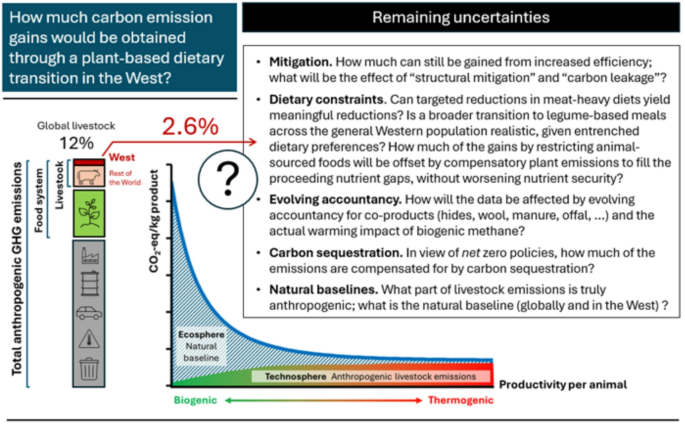
Leroy et al. identify approximately 12% of global anthropogenic greenhouse gas emissions as the most authoritative estimate for livestock. This is significant, but it is a global average. The review estimates that livestock production in Europe, North America, Australia and New Zealand accounts for about 2.6% of global anthropogenic emissions, with the EU27 accounting for about 1%.
These differences matter. Livestock systems vary substantially in productivity, feed resources, land use, manure management and emissions intensity. A universal prescription to “eat less meat” risks treating very different production systems as interchangeable.
The same context is needed when considering consumer choices. The review estimates annual emissions savings of approximately 0.2 tonnes CO₂e for a flexitarian diet, 0.5 tonnes for a vegetarian diet and 0.8 tonnes for a vegan diet, compared with an overall Western individual footprint of roughly 9–15 tonnes CO₂e per year.
Dietary change can therefore reduce emissions, but its contribution needs to be considered alongside transport, housing, energy use, travel and consumption. Its real-world impact also depends on whether dietary changes can be maintained over time.
Food is more than its carbon footprint
Removing animal-source foods does not simply remove their attributed emissions. Their nutritional contribution must be replaced, and producing replacement foods also has consequences for land use, agricultural inputs, transport and nutrient cycling.
Nutrition therefore belongs within sustainability assessments. Leroy et al. highlight potential inadequacies in vitamins B2, B6 and B12, iodine, calcium, zinc and selenium in some low-emission dietary patterns, while also drawing attention to iron adequacy among premenopausal women, particularly during pregnancy and lactation.
This does not mean that nutritionally adequate diets with little or no meat are impossible. It means that substitution needs to be evaluated nutritionally as well as environmentally. Pulses and alternative proteins can contribute to future food systems, but nutritional quality, digestibility, consumer acceptance and production constraints influence how effectively they can replace animal-source foods in practice.
A sustainable food system must reduce environmental impacts, but it must also nourish people.
Grazing land and carbon need context
Much grazing occurs on land poorly suited to crop production. Ruminants can convert vegetation from these landscapes into food, although the environmental performance of grazing systems varies considerably.
Leroy et al. highlight evidence that improved grazing management can increase soil carbon under some conditions, particularly on degraded land. But sequestration depends on soil, climate, previous land condition, grazing intensity and management. Soil-carbon gains should therefore neither be ignored nor assumed for every grazing system.
Afforestation requires similar ecological care. Restoring forests where forests naturally belong can provide important climate and biodiversity benefits, but naturally open ecosystems should not automatically be treated as degraded forests awaiting trees. Poorly designed afforestation can affect biodiversity, ecosystem function and wildfire dynamics.
Nor must the choice always be trees or livestock. Agroforestry and silvopastoral systems demonstrate that woody vegetation and grazing can coexist and provide multiple ecological benefits.
The right question is therefore not whether trees or grazing are always better, but which land use best fits a particular ecosystem.
Methane metrics shape the picture
Methane adds another layer of complexity. It is a potent greenhouse gas but behaves differently from long-lived carbon dioxide. Consequently, GWP100 and GWP* describe different aspects of its climate effect.
Leroy et al. note that under GWP*, a sustained annual reduction of approximately 0.3% in herd methane emissions could stabilize that herd's future contribution to global temperature. The review therefore supports considering GWP100 and GWP* side by side rather than treating either as a universal replacement for the other.
There is also an important distinction between biogenic and fossil carbon. Carbon in ruminant methane largely cycles from atmospheric CO₂ through plants and animals, whereas fossil-fuel use introduces geologically stored carbon into the atmosphere.
Recognizing this distinction does not make livestock methane harmless. It means that its climate effects should be represented accurately.
Better livestock systems are part of climate action
Looking beyond carbon does not justify inaction. Better genetics, veterinary care, feeding, herd management, manure management and improved grazing practices can reduce environmental impacts while maintaining food production.
But sustainability cannot be determined from one number alone. Reducing emissions while worsening nutrition, biodiversity, animal welfare, soil health or rural livelihoods may simply shift problems elsewhere. Equally, the nutritional or ecological benefits of livestock should not be used to dismiss their greenhouse gas emissions or other environmental impacts.
The debate therefore should not be about whether livestock are inherently “good” or “bad” for the planet. More useful questions are: What is being produced, where and how? What are the emissions? What happens to the land, soil and biodiversity? What nutrients are provided? And what are the consequences of the alternatives?
Complex food systems rarely yield simple answers. Looking beyond carbon tunnel vision is not an argument for climate inaction. It is an argument for better science—and for climate solutions that recognize the full complexity of livestock, food systems and the landscapes on which they depend.
This commentary reflects my perspective on the arguments presented in Leroy et al. (2026) and the subsequent commentary by several of its authors. The primary scientific source is Leroy, F., Beal, T., Dunshea, F. R., Ederer, P., Lee, M. R. F., Manzano, P., Mitloehner, F. M., Place, S. E., del Prado, A., Pulina, G., Ridoutt, B. & Rowntree, J. E. (2026). “Carbon tunnel vision and sustainable meat production in the West: A disproportionate focus on dietary greenhouse gas emissions?” Food Science of Animal Resources, 46, Article 69.

Izhar Hyder Qazi is a veterinarian and animal scientist with a PhD from Sichuan Agricultural University, China, and postdoctoral training at South China Agricultural University. He is a faculty member at SBBUVAS, Pakistan, working on animal production, One Health, and sustainable livestock systems. His research focuses on microbiome–host interactions, integrative omics, and livestock sustainability. He has authored 50+ peer-reviewed publications and serves in editorial roles for multiple international scientific journals.