Spacetime Curvature Inside a Stationary Volume Completely Enclosed by a Near-Light-Speed Energy Shell: The New Energy Field Apparatus, the Redesigned New Metric and Antimatter Production
Published in Physics
 A New Hypothesis on Spacetime
Curvature
The New Energy Field (BEF) hypothesis proposes that a near-light-speed (β ≈ 0.9998c)
rotating electromagnetic (EM) shell can sufficiently isolate the interior quantum vacuum from
the external environment, thereby generating measurable spacetime curvature at energy levels
far below the Planck threshold. We formulate the Börekci Metric, a phenomenological
extension of Einstein's linearised field equations incorporating the coupling term
ξ_B·β²_s·Ψ_iso, where ξ_B is the Börekci coupling parameter (equal to 1 in standard General
Relativity; >>1 in the BEF hypothesis), β_s = v_arc/c = 0.9998, and Ψ_iso [0,1] is the ∈
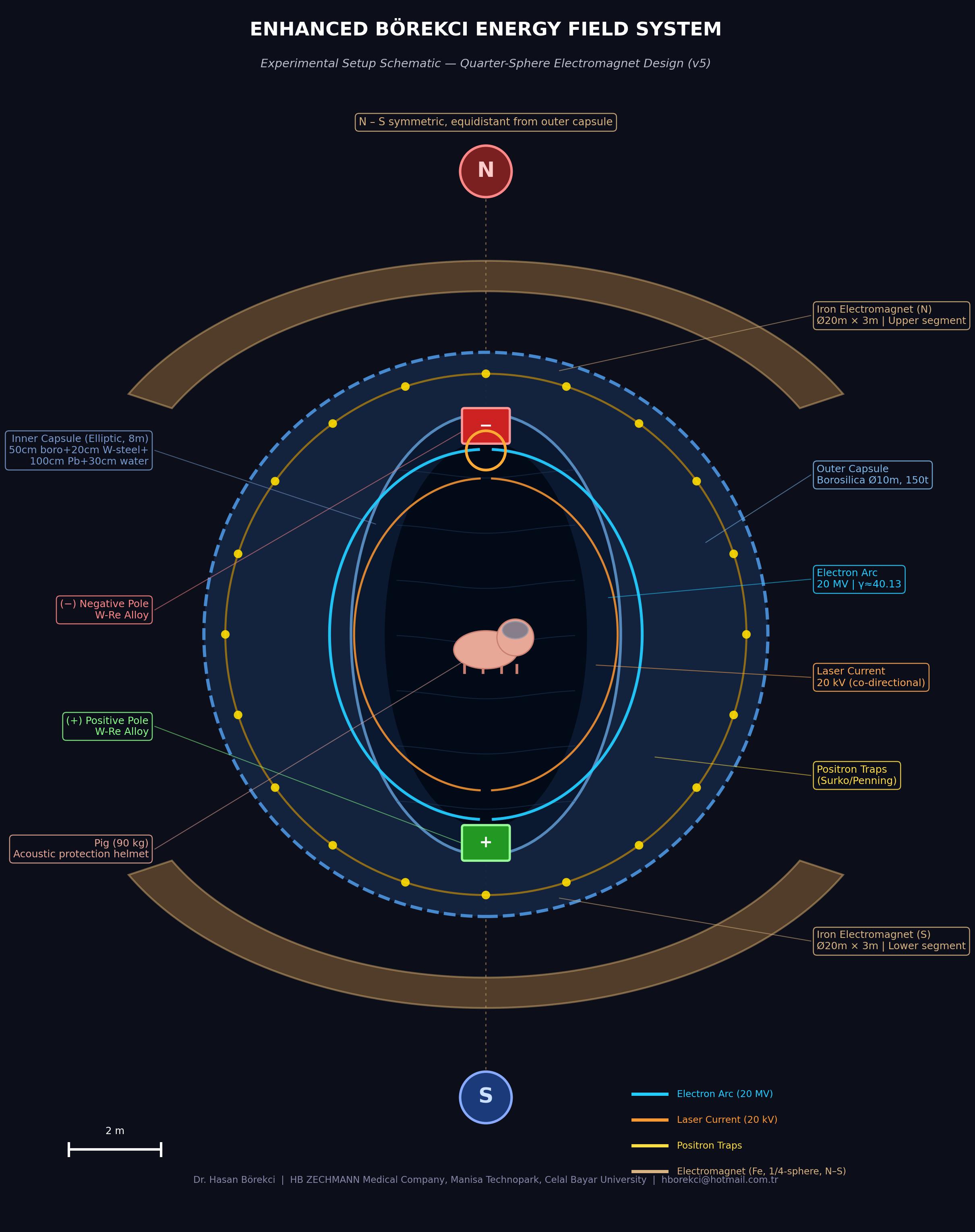
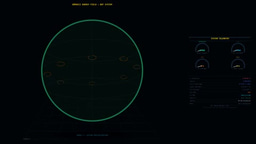
quantum field isolation completeness function. The proposed apparatus consists of a 16 m
diameter, 150-ton outer sphere (Borosilicate-SiC-SiC composite) and a 90-ton elliptical inner
capsule, operated in a sealed underground facility. An independent superconducting
electromagnet frame (8 C-shaped coils, B = 5 T, 1500 RPM counter-clockwise) drives a 25
MeV electron arc (γ = 50, β = 0.9998c) via W-26%Re electrodes at 3500 RPM with 100 Hz
axial vibration. Continuous lead (Pb, Z = 82, 0.1 atm) vapour serves as a Bethe-Heitler pair
production target and additional stress-energy contribution T_μν. Standard GR calculations
yield magnetic energy density u_B = 9.947×10⁶ J/m³ and a positron production rate of ≈
2.13×10¹³ e /s (1.68 pg/24 h). The central BEF prediction is: when Ψ_iso → 1, the effective ⁺
spacetime Lorentz factor γ_BEF = 50, matching the electron arc Lorentz factor, implying
τ_inside/τ_outside = 1/50. A 9 kg pig pre-experimental protocol and a Bose-Einstein
condensate analogue gravity miniaturised test are also described. This work is entirely pre
experimental; all claims require empirical verification
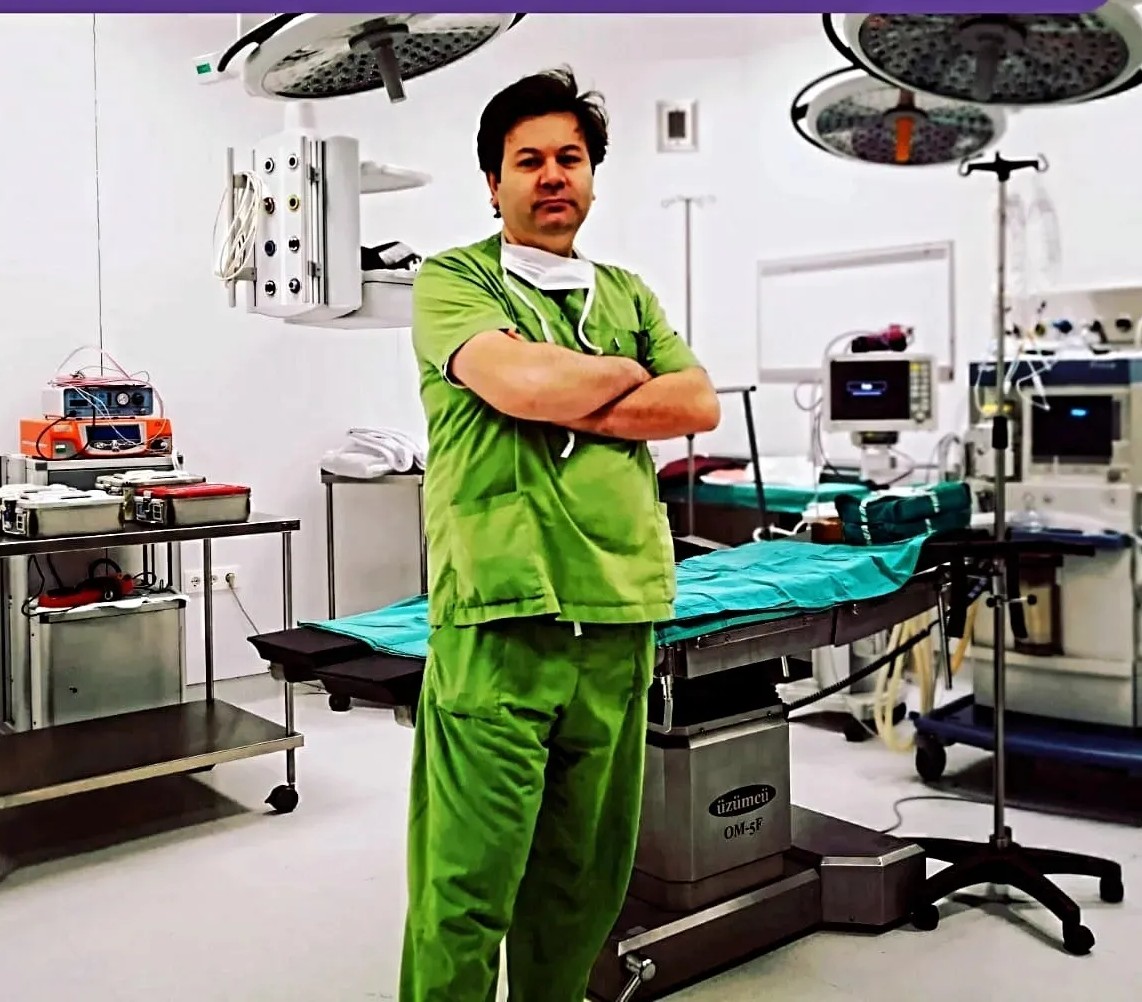
I am Dr. Hasan Börekci, M.D. — an Assistant Professor Doctor, General Surgeon, Alongside my surgical and clinical work, I pursue independent research at the intersection of classical electromagnetism, general relativity, and quantum field theory — precisely the frontier where the two pillars of modern physics have not yet been reconciled.
My research is entirely self-funded and independent of any government institution, university grant, or corporate sponsor. I believe that medicine and physics share the same root: the disciplined, curious observation of nature. Physicians have always been at the frontier of science — and that tradition continues.
My Primary Research: The Börekci Energy Field (BEF) Framework
The central question I am pursuing is this: Can a near-light-speed (β ≈ 0.9998c) rotating electromagnetic shell isolate the quantum vacuum of its interior from external spacetime — and, in doing so, generate a measurable and controllable local modification of the spacetime metric?
I have formulated the Börekci Metric — a phenomenological extension of the Schwarzschild solution incorporating a coupling term ξ_B·β²_s·Ψ_iso, where Ψ_iso ∈ [0,1] is the quantum field isolation completeness function. Under complete isolation (Ψ_iso → 1), the effective spacetime Lorentz factor γ_BEF = 1/√(1 − ξ_B·β²_s·Ψ_iso) reaches 50 — predicting that time flows fifty times more slowly inside the capsule relative to an external observer.
The proposed apparatus — a 16 m diameter, 150-ton Borosilicate-SiC-SiC outer sphere enclosing a 90-ton elliptical inner capsule, driven by 8 superconducting C-coils (B = 5 T) and a 25 MeV relativistic electron arc — incorporates Lense–Thirring frame dragging, Euler–Heisenberg vacuum nonlinearity, Schwinger-regime field densities, and Bethe–Heitler pair production in lead vapour (Z = 82), yielding a predicted positron flux of ≈ 2.13 × 10¹³ e⁺/s. A Bose–Einstein Condensate analogue-gravity pre-validation protocol is also described for laboratory-scale testing.
The manuscript (42 numbered equations, 4 data tables, 3 system figures) has been submitted for peer review. A preprint is available at ResearchSquare: DOI: 10.21203/rs.3.rs-9999735/v1.
Patent & Intellectual Property
Dr. Börekci has filed a patent application for the "BÖREKCI ENERGY FIELD — SPACETIME DILATION AND ANTIMATTER PRODUCTION SYSTEM." The apparatus design, operating principles, and all system components described in the associated manuscript are the original intellectual work of Dr. Börekci. Communication channels are open for licensing discussions, collaborative development, and joint venture proposals.
Potential Applications & Scientific Significance
If the core BEF prediction is experimentally confirmed, the implications extend far beyond theoretical physics:
▸ New energy paradigm: Controlled spacetime metric modification may open pathways to energy extraction and conversion mechanisms not described by current thermodynamic frameworks.
▸ Antimatter production: A scalable, laboratory-controlled positron source (≈ 2.13×10¹³ e⁺/s) would be transformative for medical PET imaging, materials science, and fundamental particle physics.
▸ Biomedical and biological research: The isolated interior environment — shielded from external quantum field fluctuations — provides a unique platform for in vivo / in vitro biological, genetic, surgical, and chemical experiments under conditions unattainable in any conventional laboratory.
▸ Gravitational engineering: Controllable local spacetime curvature, if achievable, represents a qualitatively new engineering domain with applications in propulsion, materials processing, and fundamental metrology.
▸ Fundamental physics: The BEF framework directly probes open questions in QFT-GR unification: vacuum nonlinearity, macroscopic Casimir boundaries, gravitomagnetic coupling, and the limits of the standard stress-energy tensor formalism.
Research Interests & Engagement
I maintain an active interest in the following areas and welcome connections with researchers working in any of these fields:
• Strong-field QED and vacuum birefringence (ELI-NP, HIBEF, LUXE experimental programs)
• Gravitomagnetism and Lense–Thirring phenomenology (Gravity Probe B, Tajmar experiments)
• Quantum simulation and BEC analogue gravity (Unruh radiation, sonic black holes)
• Antihydrogen and antimatter gravity (ALPHA, AEgIS, GBAR at CERN)
• Casimir effect in macroscopic and dynamical boundary configurations
• Post-Newtonian and metric extension approaches to classical GR
• Biomedical physics and unconventional experimental platforms in medicine
What I Am Looking For
▸ Critical peer review: Physicists and mathematicians willing to rigorously engage with the BEF framework — I welcome objections as much as endorsements.
▸ Experimental collaborators: Groups with access to strong-field laser facilities, superconducting magnet labs, BEC platforms, or particle beam infrastructure who see value in testing the BEF predictions.
▸ Technology & commercialisation partners: Investors, technology transfer offices, and industrial partners interested in the patent portfolio and the development roadmap for the BEF apparatus.
▸ Academic positions & visiting fellowships: Institutions willing to host an independent surgeon-scientist in a formal research capacity — bridging clinical medicine and theoretical physics.
▸ Science communication: Journalists, documentary producers, and science communicators interested in the BEF project and the broader story of physician-scientists in fundamental research.
Science has always advanced when people from unexpected disciplines asked questions the specialists had stopped asking. The BEF hypothesis may be right, or it may require substantial revision — but it is grounded in published physics, formulated with mathematical precision, and submitted for open peer review. I am here to engage, to be challenged, and to contribute whatever I can to the frontier.
I am available for correspondence, collaboration, and consultation.
Thomas Young (1773–1829) discovered the wave nature of light and performed the definitive double-slit experiment that reshaped modern physics — while he was a medical student, having never formally studied physics. He was a physician. I am a physician, too.
Dr. Hasan Börekci, M.D.
Assistant Professor Doctor | General Surgeon |
Independent Theoretical Physics Researcher
Preprint: https://doi.org/10.21203/rs.3.rs-9999735/v1
Please sign in or register for FREE
If you are a registered user on Research Communities by Springer Nature, please sign in