The power of 810 nm near-infrared photobiomodulation therapy for human asthenozoospermia
Scientific Reports: Photobiomodulation at a wavelength of 810 nm, 1 W, 60 sec, 1 cm², 60 J/cm² in continuous wave mode) effectively enhances the motility of asthenozoospermic sperm by restoring compromised mitochondrial energy metabolism.
Published in Chemistry, Physics, and General & Internal Medicine

Like
Be the first to like this
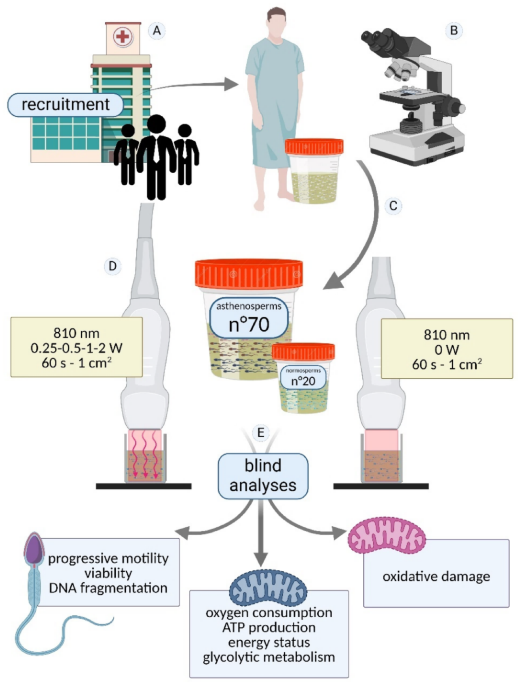

Sperm motility is a crucial factor in male fertility. Photobiomodulation (PBM) has been reported to increase sperm motility, but a consistent approach suitable for identifying standardizable protocols is lacking. We collected asthenozoospermic (n = 70) and normozoospermic (n = 20) semen. The asthenozoospermic samples were irradiated with an 810 nm diode laser, in continuous wave mode, at 0.25 W, 0.5 W, 1 W and 2 W for 60 s on a circular area of 1 cm2 through a novel handpiece with an innovative flat-top profile. Sperm motility was assessed immediately, after 30 and 60 min. A sample size calculator, unpaired t-test and one-way ANOVA with post-hoc Tukey HSD tests were used for statistics. One and 2 W were the most effective outputs in increasing progressive motility compared to control (p < 0.001). The maximum effect was immediately after 1 W-PBM (p < 0.001) and decreased after 60 min (p < 0.001). Time physiologically decreased vitality (p < 0.001), but less in the 1 W-PBM samples (p < 0.05). 1 W-PBM did not affect chromatin condensation. Asthenozoospermic samples displayed an impairment of 80% in oxygen consumption and ATP production and a slight inefficiency of oxidative phosphorylation compared to normozoospermic samples (p < 0.001). 1 W-PBM partially restored the functionality of aerobic metabolism (p < 0.001) by recovery of oxidative phosphorylation efficiency. PBM did not affect lactate dehydrogenase (glycolysis pathway). No irradiated samples increased accumulated malondialdehyde, a marker of lipidic peroxidation. In conclusion, PBM improves progressive motility in asthenozoospermia through increased mitochondrial energetic metabolism without harmful oxidative stress.
Multiple Contributors
Follow the Topic
Photobiology
Physical Sciences > Chemistry > Inorganic Chemistry > Photochemistry > Photobiology
Male Factor Infertility
Life Sciences > Health Sciences > Clinical Medicine > Diseases > Urogenital Diseases > Male Factor Infertility
Infertility
Life Sciences > Health Sciences > Clinical Medicine > Diseases > Reproductive Disorders > Infertility
Metabolism
Life Sciences > Biological Sciences > Physiology > Metabolism
Photonics and Optical Engineering
Technology and Engineering > Biological and Physical Engineering > Photonics and Optical Engineering
Biophotonics
Physical Sciences > Physics and Astronomy > Optics and Photonics > Applied Optics > Biophotonics
-
Scientific Reports
An open access journal publishing original research from across all areas of the natural sciences, psychology, medicine and engineering.

Related Collections
With Collections, you can get published faster and increase your visibility.
Phytochemicals and health
This Collection welcomes original research investigating the mechanisms underlying phytochemical health effects, therapeutic potential, and challenges related to bioavailability and clinical application.
Publishing Model: Open Access
Deadline: Jul 28, 2026
Advances in neurodegenerative diseases
This Collection aims to bring together research from various domains related to neurodegenerative conditions, encompassing novel insights into disease pathophysiology, diagnostics, therapeutic developments, and care strategies. We welcome the submission of all papers relevant to advances in neurodegenerative disease.
Publishing Model: Hybrid
Deadline: Jun 30, 2026
Please sign in or register for FREE
If you are a registered user on Research Communities by Springer Nature, please sign in