Share your thoughts about the Research Communities in our survey.
The Silent Pandemic Is Getting Louder: What the Newest AMR Reports Tell Us
New reports from the WHO, CDC and the GRAM/Lancet project show antimicrobial resistance is rising, the antibiotic pipeline is thinning, and surveillance gaps leave much of the world blind. Here is what the latest data say, and what researchers and policymakers can do next.
Imagine a routine surgery, a round of chemotherapy, or a newborn’s first week in intensive care. Each quietly assumes one thing: that antibiotics will work when we need them. Antimicrobial resistance (AMR) - when bacteria, fungi and other microbes stop responding to the drugs designed to kill them is steadily eroding that assumption. As a microbiology PhD candidate working on AMR surveillance, I think the reports of the past two years deserve a close read. Here is what they actually say, with every figure traced to its source.
The global picture: one in six infections is already resistant
The World Health Organization’s Global Antibiotic Resistance Surveillance Report 2025, published on 13 October 2025 and drawing on more than 23 million laboratory-confirmed infections from 104 countries, found that one in six common bacterial infections worldwide in 2023 were resistant to antibiotic treatment rising to roughly one in three urinary tract infections [1]. The trend is the worrying part: between 2018 and 2023, resistance increased in over 40% of the pathogen–antibiotic combinations monitored, by an average of 5-15% per year [1].
The burden is deeply uneven. Resistance is highest in WHO’s South-East Asian and Eastern Mediterranean Regions, where about one in three reported infections was resistant, and about one in five in the African Region [1]. For some last-line drugs the picture is worse still: in parts of the African Region, resistance to third-generation cephalosporins a first-choice treatment for serious Gram-negative infections exceeds 70% [1]. The places with the least capacity to respond are carrying the most risk.
The human and economic toll
The most rigorous burden estimate comes from the Global Research on Antimicrobial Resistance (GRAM) project, published in The Lancet in 2024. It estimated 4.71 million deaths associated with bacterial AMR in 2021, including 1.14 million directly attributable to it [2]. One honest caveat: those 2021 figures are actually lower than the 2019 estimates (1.27 million attributable; 4.95 million associated), which the authors attribute largely to reduced non-COVID respiratory infections during pandemic social distancing a reminder that these are modelled estimates built on imperfect data [2].
Looking forward, the same study forecasts more than 39 million deaths directly attributable to bacterial AMR between 2025 and 2050 without stronger action, with the annual toll climbing to about 1.91 million direct deaths a year by 2050 [2]. The flip side is genuinely hopeful: the authors estimate that better care for severe infections and wider access to existing antibiotics could save up to 92 million lives over that period [2]. This is a tractable problem, not a law of nature.
The economics track the biology. The WHO’s updated Global Action Plan projects that, without robust action, global AMR-related treatment costs and productivity losses could reach US$412 billion and US$443 billion, respectively, by 2035 [6]. Earlier World Bank modelling put additional health-care costs as high as US$1 trillion by 2050 [7]. Whichever estimate you prefer, inaction is far more expensive than prevention.
The United States: bigger numbers?
On 27 October 2026, the CDC released its updated Antimicrobial Resistance Threats Report. It attributes more than 9.3 million drug-resistant infections and more than 39,000 deaths each year in the US to its bacterial and fungal threat pathogens; counting Clostridioides difficile, the totals reach 9.7 million infections and 50,800 deaths a year [3]. The report tracks 19 threats, with four ranked “urgent”: Candida auris, carbapenem-resistant Acinetobacter, carbapenem-resistant Enterobacterales, and drug-resistant Neisseria gonorrhoeae[3].
It is tempting to read this as a jump from the previous report’s “2.8 million infections,” but the CDC itself warns against that comparison: its methods and data sources changed substantially, so the numbers are not directly comparable across reports [3]. There is good news in the detail, too C. difficile moved from the urgent to the serious category, reflecting successful infection prevention. Prevention works, and the data show it.
The pipeline is thin, and surveillance has blind spots
Resistance is rising while new drugs are scarce. WHO’s 2025 pipeline analysis found the number of antibacterials in clinical development actually fell from 97 in 2023 to 90 in early 2025; only 15 of those qualify as innovative, and just 5 target the critical-priority pathogens we most need to beat. About 90% of the earlier-stage work sits with small companies facing steep economic hurdles [4]. There are bright spots in 2026 the FDA approved Zaynich (cefepime–zidebactam) for complicated urinary tract infections, where it outperformed meropenem in a Phase 3 trial (89.0% vs 68.4% combined cure and microbiological response) [5]. But a handful of approvals does not reverse the trajectory.
The gap that worries me most, as a surveillance researcher, is the simplest: we cannot fight what we cannot see. Participation in WHO’s GLASS surveillance network has grown impressively 104 of 127 enrolled countries reported data in 2023 yet coverage remains weakest exactly where the burden is heaviest, and many systems still cannot generate reliable data [1]. Clinical surveillance also depends on people being sick enough to seek care and get cultured, so it misses asymptomatic carriers and community-level spread.
That is why complementary approaches matter, including environmental and wastewater-based surveillance, which can read a resistance signal from an entire community at once this is the focus of my own work. I’ll be candid about the limits: wastewater methods still need standardisation and validation before gene signals translate cleanly into clinical risk, and this paragraph reflects my perspective rather than a finding from these reports. But as a cheap, non-invasive early-warning layer on top of clinical data, the approach is maturing fast.
The policy moment- and a call to action
The political foundation is stronger than it has ever been. The 2024 UN General Assembly declaration on AMR committed 193 countries to reduce human deaths associated with AMR by 10% by 2030, and to ensure at least 70% of human antibiotic use comes from WHO’s lower-risk “Access” category [8]. In May 2026, the World Health Assembly adopted the updated Global Action Plan on AMR (2026–2036), reaffirming a One Health approach that links human, animal, plant and environmental health [6]. But targets are not outcomes, and the 10% goal can only be tracked if we can measure the burden - which brings us back to surveillance.
So my call to action is simple. To fellow researchers: build open, comparable, validated surveillance methods including environmental ones and report uncertainty honestly. To funders and policymakers: fund laboratory capacity in low- and middle-income countries, and create “pull” incentives that make antibiotic development viable for small firms. To clinicians and institutions: protect the drugs we have through stewardship and infection prevention the C. difficile result shows these efforts pay off.
AMR is often called a silent pandemic. The data are now loud enough that silence is a choice.
Key takeaways
WHO (Oct 2025): 1 in 6 common bacterial infections was resistant in 2023, and resistance rose in over 40% of monitored pathogen–antibiotic combinations between 2018 and 2023.
GRAM/Lancet (2024): 4.71 million deaths associated with AMR in 2021 (1.14 million directly attributable); more than 39 million direct deaths forecast between 2025 and 2050 but up to 92 million lives could be saved with better care and access.
CDC (Oct 2026): an estimated 9.7 million infections and 50,800 deaths a year in the US (9.3M / 39,000+ excluding C. difficile) not directly comparable to earlier reports.
Pipeline (WHO 2025): antibacterials in clinical development fell from 97 to 90, with only 15 judged innovative.
Policy: the 2024 UN declaration targets a 10% cut in human AMR deaths by 2030; the updated Global Action Plan (2026–2036) sets the One Health framework.
Opportunity: better surveillance including wastewater monitoring is among the clearest ways to detect and slow resistance earlier.
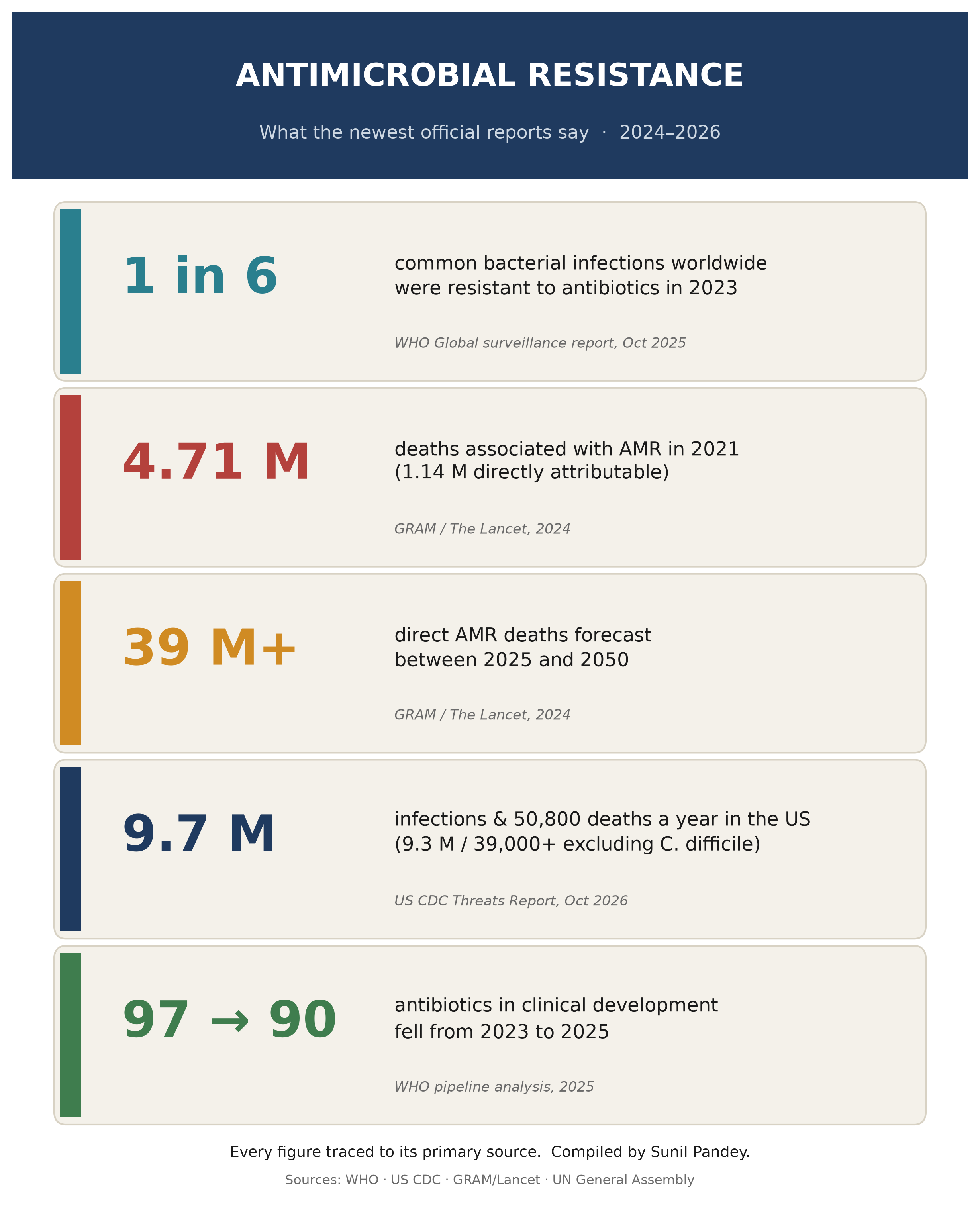
Five figures that frame the AMR challenge, drawn from the latest WHO, US CDC and GRAM/Lancet reports (2024–2026). Compiled by Sunil Pandey
References
WHO. Global antibiotic resistance surveillance report 2025 (GLASS), 13 Oct 2025. Report · news release.
GBD 2021 Antimicrobial Resistance Collaborators. Global burden of bacterial antimicrobial resistance 1990–2021: a systematic analysis with forecasts to 2050. The Lancet 2024;404(10459):1199–1226. Link.
U.S. CDC. Antimicrobial Resistance Threats Report, 27 Oct 2026. Report · summary figures.
WHO. Analysis of antibacterial agents in clinical and preclinical development: overview and analysis 2025, Oct 2025. Link.
U.S. FDA. Zaynich (cefepime and zidebactam) prescribing information, 2026. Label (PDF).
WHO. Global Action Plan on Antimicrobial Resistance (2026–2036), adopted May 2026. News · US$412bn/US$443bn figures: WHO AMR fact sheet.
World Bank. Drug-Resistant Infections: A Threat to Our Economic Future, 2017. Link.
WHO/UN. World leaders commit to decisive action on antimicrobial resistance (UN General Assembly political declaration), 26 Sept 2024. Link.
Disclosure: I am a PhD candidate in Microbiology and Infectious Diseases at George Mason University and the founder of TriAxis Biosciences, The views here are my own, and this post draws only on publicly available reports and peer-reviewed literature.
We use cookies to ensure the functionality of our website, to personalize content and advertising, to provide social media features, and to analyze our traffic. If you allow us to do so, we also inform our social media, advertising and analysis partners about your use of our website. You can decide for yourself which categories you want to deny or allow. Please note that based on your settings not all functionalities of the site are available.