Trump's Trade War & the Karfali-VAR Model: A 2025 Slowdown Foretold
Published in Economics
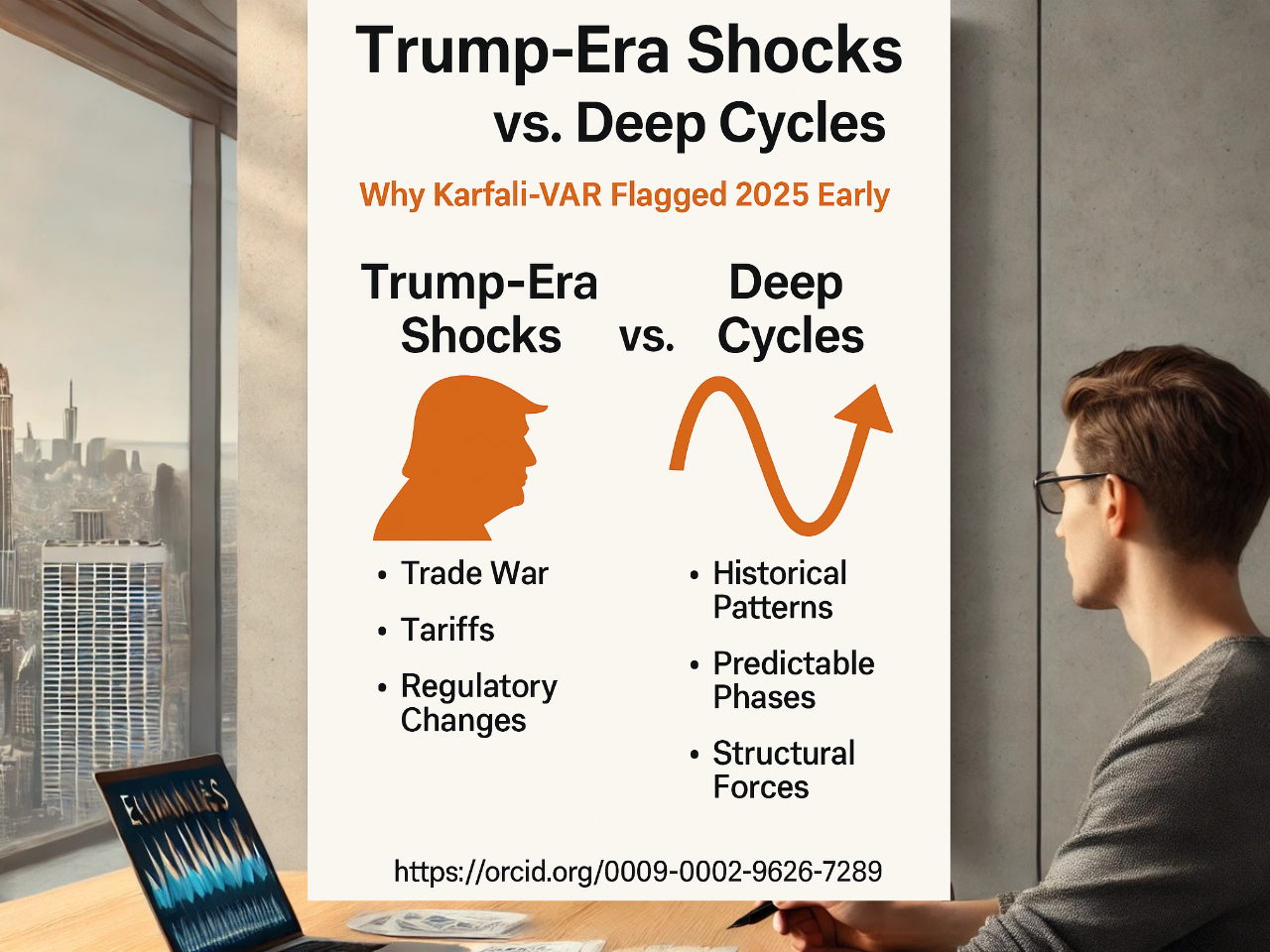
In today's volatile economic landscape, investors, policymakers, and business leaders constantly seek tools to navigate uncertainty and anticipate future shifts. One intriguing approach is the Karfali-VAR Model, which leverages robust statistical analysis to uncover a potentially dominant 9-year economic cycle.
https://orcid.org/0009-0002-9626-7289
The 9-Year Economic Cycle: More Than Just Coincidence?
Based on extensive historical data analysis across seven key economic variables (including GDP Growth, Unemployment, Inflation, Interest Rates, Government Debt-to-GDP, ISM Manufacturing PMI, and Oil Prices), the Karfali-VAR model identifies a recurring 9-year rhythm. As shown in the model's Spectral Analysis, a distinct peak emerges at the 9-year frequency, providing statistical evidence against claims that this cycle is arbitrary or lacks a scientific basis.
Furthermore, statistical tests like the ADF Test (p-value 0.01 - Significant) and Granger Causality Test (p-value 0.03 - CausalityFound) lend further credence to the cycle's numerical significance and predictive potential, particularly in identifying potential turning points.
Recurring Patterns Across Cycles:
The model reveals distinct patterns that tend to repeat within each 9-year cycle:
Years 1-3 (Early Cycle): Often characterized by rising Government Debt-to-GDP as governments stimulate growth, typically followed by strong GDP expansion and falling unemployment. (See chart 1 & observations)
Years 4-6 (Mid-Cycle): Growth may continue, potentially moderating, while unemployment often reaches its lowest point. Inflation and interest rates might begin to rise.
Years 7-8 (Late Cycle): Growth tends to slow more noticeably. Indicators like inflation, interest rates, and ISM PMI might peak or show signs of weakening. (See charts 2-5)
Year 9 (Turning Point): This year frequently marks a significant slowdown, or even the onset of a recession, setting the stage for a new cycle. The model's Out-of-Sample Performance Testing confirms the concentration of slowdowns around 'Year 9' across decades. (See chart 6)
The Current Cycle (2017-2025) and the Prescient Warning:
According to the model's framework, we are currently in the 8th cycle, spanning 2017-2025. What's particularly noteworthy is that the researcher behind this model highlighted 2025 as the pivotal 'Year 9' for this cycle, warning of a potential slowdown, well before the onset of recent major disruptions like the US-led trade wars against numerous countries and other significant global economic shocks.
This early warning, based purely on the historical cyclical pattern identified by the model, raises a crucial question: Is the economy heading towards an anticipated slowdown in 2025 as part of its underlying rhythm, with recent geopolitical and economic events potentially acting as accelerators or amplifiers?
Historical Data Supports the Pattern: Looking at the provided data for previous cycles (1954-1962, 1963-1971, ..., 2008-2016), we observe that the 'Ninth Years' (e.g., 1962, 1971, 1980, 1989, 1998, 2007, 2016) often witnessed significant shifts or slowdowns compared to the mid-cycle years. For instance, 2007 (Year 9 of the 1999-2007 cycle) directly preceded the Global Financial Crisis.
What Does This Mean Moving Forward?
While no model offers perfect foresight – external shocks always play a role – the Karfali-VAR framework provides a valuable perspective:
For Investors: Understanding our potential position within the cycle can inform better investment decisions, asset allocation, and risk management, especially approaching a potential 'Year 9'.
For Policymakers: The model can serve as an additional input for timing monetary and fiscal policy adjustments, considering the potential cyclical slowdown.
For Businesses: Companies can leverage these insights for strategic planning, inventory management, and making informed decisions about expansion or hedging.
In Conclusion: While traditional economic analysis remains essential, understanding long-term economic cycles, like the 9-year pattern highlighted by the Karfali-VAR model, adds a valuable strategic dimension. The early warning regarding 2025, which predated recent crises, makes this a model worth watching and considering as we navigate the complex economic road ahead.

I am Jaouad Karfali, a researcher specializing in the 9-Year Cycle and its influence on economics, history, and societal transformations. My work focuses on identifying cyclical patterns that shape global events, economic trends, and individual life shifts.
Through extensive historical data analysis, I have developed predictive models that highlight the recurring nature of economic cycles and societal changes. My research aims to provide a deeper understanding of time cycles, enabling individuals and institutions to anticipate future trends and make more informed decisions.
Areas of Expertise & Interests:
The 9-Year Cycle and its role in economic and social transformations
Historical pattern recognition and cyclical forecasting
Predictive modeling based on time cycles
Economic cycle analysis and long-term forecasting
By uncovering the rhythm of time, my goal is to offer a unique perspective on the patterns that govern beginnings and endings in various domains.

Please sign in or register for FREE
If you are a registered user on Research Communities by Springer Nature, please sign in