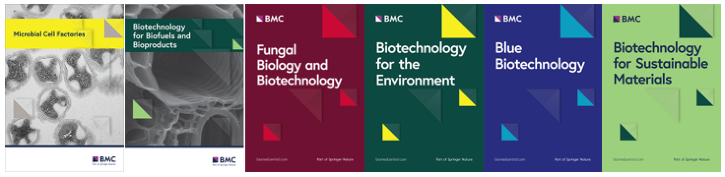




We at BMC have been very excited about the growth of our new Biotechnology family of journals. The six journals represent a step forward in expanding the reach of Biotechnology research within Springer Nature by creating a unique community of researchers who provide cross-journal support.
Because of the expanding utility of biotechnology, rather than having one or two general or catch-all Biotech journals, the six family journals take a closer and more nuanced look at the various fields within the biotechnology discipline. This provides researchers with greater opportunities to be recognized for their respective accomplishments and adds visibility to the expanding sub-fields of biotech research.
The Biotech family was created around the two well established journals Microbial Cell Factories and Biotechnology for Biofuels and Bioproducts. With the inclusion of Fungal Biology and Biotechnology, editorial board members of the three journals were recruited to help launch Blue Biotechnology, Biotechnology for the Environment, and Biotechnology for Sustainable Materials. The Editors-in-Chief of all three journals as well as members of their boards were and still are established and vital members of the three larger biotech journals.
The Biotech family also creates more opportunities for cross-journal collaboration whether through cross-journal collections, like Engineering Microbiomes for Green Technologies, or allowing Editors-in-Chief to find suitable guest editors for new collections from within the greater biotechnology community (several of which launch this month and next!).
The broad overlap of scopes between the journals is also providing an opportunity for the journals to test having a dedicated reviewer board. Currently, ‘trusted’ or dedicated reviewers are being recruited to support both Fungal Biology and Biotechnology as well as Biotechnology for Biofuels and Bioproducts. The goal is to eventually have a pool of reviewers able to support the peer review process across all six journals, to help build a sense of community between those working on the journal.
Finally, we are happy to be able to announce the first publications in two of our newest journals: Biotechnology for the Environment and Biotechnology for Sustainable Materials. The respective Editors-in-Chief, Evangelos Topakas and Shashi Bhatia, have worked hard to attract high quality papers for the journals and it is exciting to see the first accepted papers be published. Take a look and explore the widening world of Biotechnology at BMC!

Follow the Topic
-
Fungal Biology and Biotechnology
-
Biotechnology for the Environment
Biotechnology for the Environment is an open access, peer-reviewed journal featuring studies that explore the advancements and applications of biotechnology for environmental management, protection, and sustainability.
-
Blue Biotechnology
Blue Biotechnology is an open access, peer-reviewed journal featuring studies that cover all areas of applied research and biotechnology involving marine microorganisms (microalgae, bacteria and fungi), algae and invertebrates.
-
Biotechnology for Sustainable Materials
Biotechnology for Sustainable Materials is an open access, peer-reviewed journal featuring all aspects of biotechnology aimed at the production of sustainable and renewable materials
-
Biotechnology for Biofuels and Bioproducts
-
Microbial Cell Factories






Related Collections
With Collections, you can get published faster and increase your visibility.
Engineered Microbial Cell Factories for Future Industrial Applications
The topics that we welcome, but not limited to, are:
- Metabolic engineering of microbes for production of biofuels, bulk and specialty chemicals, enzymes, etc.
-Metabolic engineering of microbes for food and feed, and agriculture.
- Metabolic engineering of microbes for medical applications.
- Engineering of microbes for utilization of various feedstocks, such as lignocellulose, plastics, side streams, waste, etc.
-Development of genome editing, metabolic modeling, and other tools for cell factory development.
- Systems metabolic engineering, automation, AI, and other approaches.
- Optimization of fermentation and downstream processes, as well as up-scaling.
All submissions in this collection undergo the journal’s standard peer review process. Similarly, all manuscripts authored by a Guest Editor(s) will be handled by the Editor-in-Chief. As an open access publication, this journal levies an article processing fee (details here). We recognize that many key stakeholders may not have access to such resources and are committed to supporting participation in this issue wherever resources are a barrier. For more information about what support may be available, please visit OA funding and support, or email OAfundingpolicy@springernature.com or the Editor-in-Chief.
Publishing Model: Open Access
Deadline: Ongoing
Next-Generation Enzyme Biocatalysis for Integrated Lignocellulosic Biorefineries
The transition toward sustainable, second-generation biorefineries critically depends on advanced enzyme biocatalysis for the efficient conversion of lignocellulosic biomass into fuels and value-added bioproducts. Recent advances in microbial systems biology, enzyme discovery, engineering, and process integration have enabled increasingly robust and selective biocatalytic systems capable of operating under industrially relevant conditions. This Special Collection aims to showcase cutting-edge research on next-generation enzymatic technologies supporting integrated lignocellulosic biorefineries, from biomass deconstruction to fraction valorization and downstream bioprocessing. Contributions addressing microbial and enzymatic systems, data-driven or functional screening for biocatalyst discovery, and scalable bioprocess integration are welcome, with an emphasis on economically viable, sustainable, and multi-product biorefinery concepts beyond single-fuel platforms.
Suggested Subtopics:
- Microbial systems biology and omics-driven discovery of lignocellulose-active biocatalysts
- Enzyme discovery and engineering for lignocellulosic biomass deconstruction
- Advanced cellulase, hemicellulase, and auxiliary enzyme systems
- Enzymatic valorization of cellulose, hemicellulose, and lignin fractions
- Biocatalytic upgrading of lignin-derived and sugar-based intermediates
- Enzyme performance under industrial biorefinery conditions (high solids, inhibitors, temperature, pH)
- Integrated enzymatic–microbial and hybrid bioprocesses
- Enzyme-assisted process intensification and biorefinery integration
- Enzyme recycling, immobilization, and cost-reduction strategies
- Techno-economic and life-cycle assessment of enzyme-enabled biorefineries
- Case studies and scale-up of enzyme-based lignocellulosic bioprocesses
This Collection supports and amplifies research related to SDG 7, Affordable and Clean Energy, SDG 9, Industry, Innovation and Infrastructure, SDG 12, Responsible Consumption and Production, and SDG 13, Climate Action.
All submissions in this Collection undergo the journal’s standard peer review process. Similarly, all manuscripts authored by a Guest Editor(s) will be handled by the Editor-in-Chief and the journal editorial board. As an open access publication, this journal levies an article processing fee (details here). We recognize that many key stakeholders may not have access to such resources and are committed to supporting participation in this issue wherever resources are a barrier. For more information about what support may be available, please visit OA funding and support, or email OAfundingpolicy@springernature.com or the Editor-in-Chief.
Publishing Model: Open Access
Deadline: Nov 17, 2026

Please sign in or register for FREE
If you are a registered user on Research Communities by Springer Nature, please sign in