Why are publications not “everything” for graduate school interview calls?
Published in Healthcare & Nursing
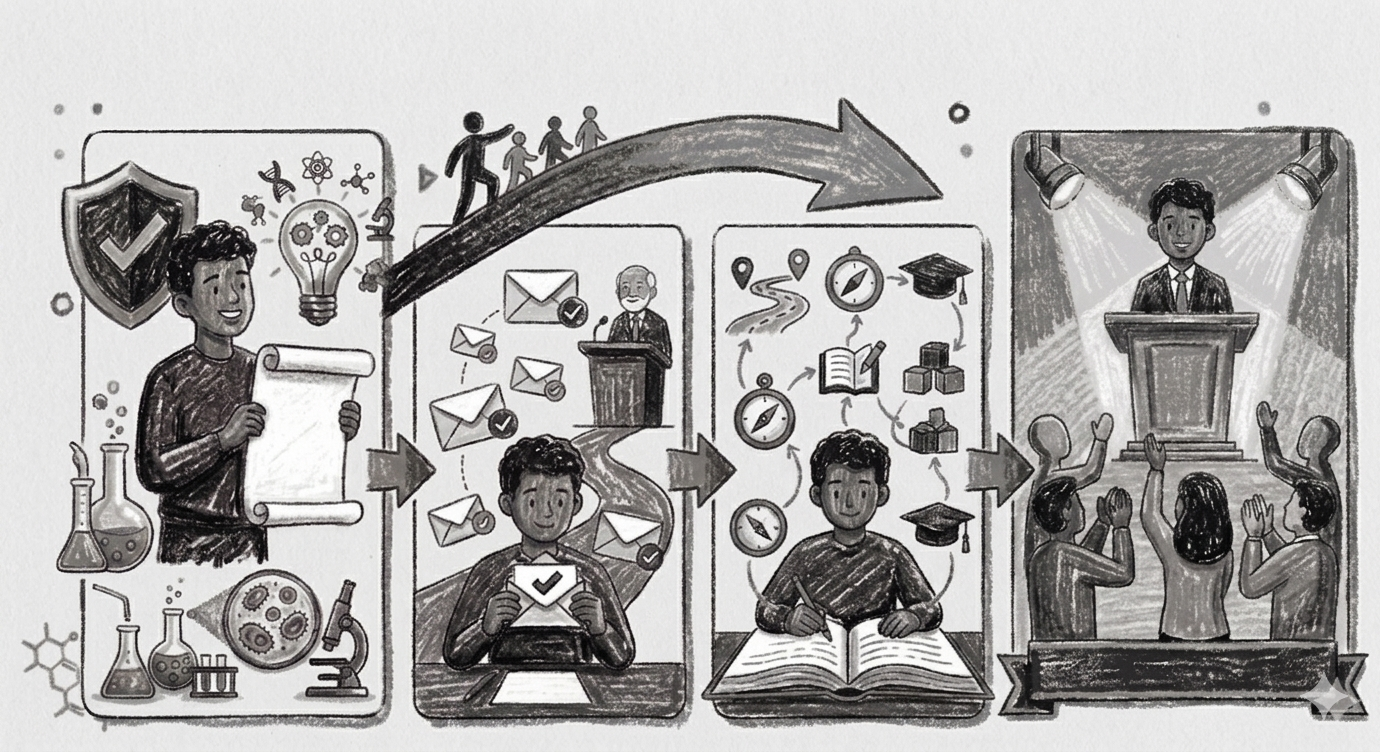
I remember the night I left a section about research publication empty in the graduate school application. I was anxious and afraid about not having a publication from my master’s thesis. I was told that to get an interview from top-tier institutes, publications do add value to your application. Despite this, I was the first to establish an infectious disease model in the lab and obtained good results with an 8 CGPA in my thesis.
Different journeys, yet unique and the best
I have partly realized that there is a stark difference in academic curricula across different parts of the world.
Currently, I am pursuing a PhD in the Faculty of Biology at the Technion – Israel Institute of Technology (Technion-IIT). Here, I see that master’s students spend most of their time in the lab, learning techniques like RT-PCR and flow cytometry from the beginning of their degree programs. They contribute significantly to PhD projects and often end up with strong publications.
In my case, things were different. During my master’s, I had an extensive curriculum with almost seven courses per semester, each had term paper submissions, presentations, and both written and practical exams. At that time, my focus was less on publishing papers and more on building a strong foundation. However, as I approached the end of my degree, the desire to pursue a PhD abroad made me worry about how I would compete with students who already had publications.
A small push
Still, I decided to give it a shot!
In the beginning, I started sending cold emails. I started approaching professors whose research matched my interests. Some professors honestly praised my motivation letter, even when I was not the right fit for their lab and encouraged me to keep applying. I remember one moment when a professor read my letter to his lab and appreciated the honesty in it. That was such an elating and driving moment for me. I did receive a few Zoom meeting invites through cold emails, and one of them landed me at Technion-IIT. However, others didn’t work out because of expensive application fees or limited positions for domestic people.
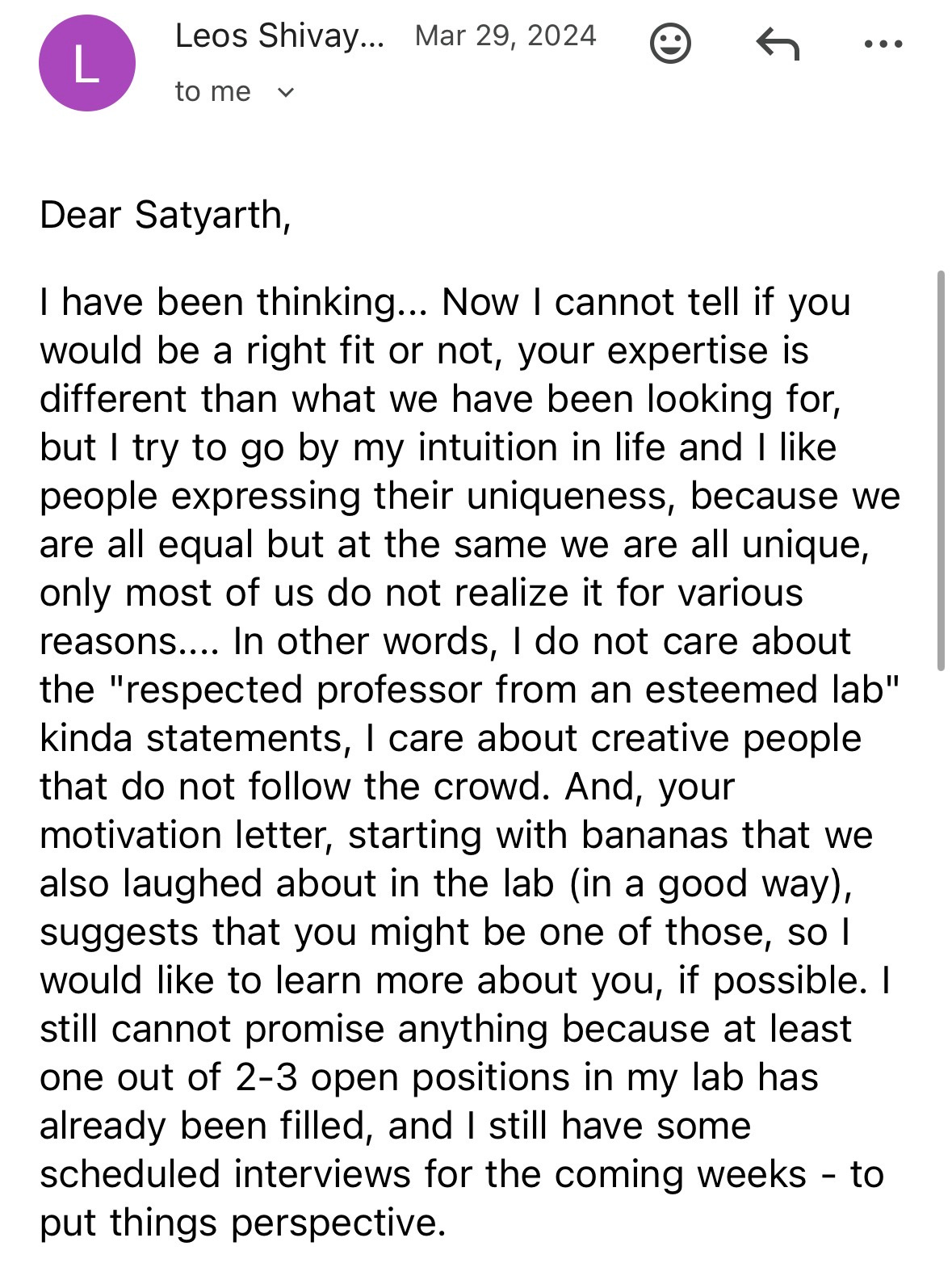
A kind reply from a professor made my day back then (Shared with permission)
Mistakes reflect improvement and progress
While most of the professors advised me to apply through the official application portals. So, simultaneously with cold emails, I started applying to graduate school programs related to immunology. When I opened the applications, the first impression was of a daunting, long list of questions about past research experience, motivation for joining the institute, future research ideas, and many more related to them.
The mistake I made in the first round was caring less about answering these questions thoughtfully and stressing more about not having a publication. In that round, I did not get any interview calls through applications.
After going through the first round of applications, I realized that I needed to have more research experience to make my CV stand out.
I decided to join good labs in India to gain more research experience. I also worked as an unpaid intern for a few months and honed several biological techniques, such as Western Blotting, RT-PCR, flow cytometry, targeted proteomics, and mouse handling. Although I did not get a publication, with time, I became more confident and had more meaningful experiences to discuss in my applications.
Alongside this, I reached out to PhD students abroad to review my essays through non-profit communities like Project SHORT and MAP Program, which provides free mentorship to graduate school applicants.
Science is an art-concluding remarks
These experiences transformed my graduate school applications. I became proactive and paid attention to the amount of information available online.
I believe that research articles are the best way to demonstrate your scientific skills, but they are not the only way to showcase scientific thinking, atleast for graduate school applications or in cold emails to professors.
I began treating every answer in my application as a craft, as if I were a storyteller.
Committees want to see whether you can demonstrate and apply your research skills to their projects through a comprehensive understanding and lucid writing. I learned this the hard way, but I eventually succeeded in getting interview calls from institutions like the IMPRS International Max Planck Research School, Medical University of Vienna, my current institute, Technion – IIT, and several others, despite not having any publications.
So, next time, if you do not have a publication but have a strong story to tell in your application, I would say be kind to yourself and get proper sleep without feeling anxious. If I could do it, you can too.

Satyarth Pandey is a PhD candidate in the Faculty of Biology at the Technion–Israel Institute of Technology, where he investigates the mechanisms underlying mitochondrial dysfunction in aged T cells.



Please sign in or register for FREE
If you are a registered user on Research Communities by Springer Nature, please sign in