Peer review is the backbone of scientific publishing, but even the strongest backbone can bend under pressure. With deadlines looming and inboxes overflowing, reviewers often look for ways to make their process more efficient. One of the many ways to do so is by using reviewer templates: structured outlines that help organize feedback and ensure completeness. Yet, as with many shortcuts, there’s a fine line between streamlining and oversimplifying. This month’s Researcher Riddle explores when templates are a reviewer’s best friend, and when they risk becoming a boilerplate trap.
Templates can be powerful tools for consistency and clarity. They help reviewers remember to address all key aspects of a manuscript (from methodology to clarity of presentation) and can improve fairness across submissions. But problems arise when templates become copy-paste reviews: generic, vague, and detached from the actual paper. These “boilerplate reviews” can signal disengagement, and in some cases, even raise red flags for paper mill activity, where fraudulent reviews are generated en masse to simulate legitimate peer review.
AI has added another layer to this conversation. As shown in the figure from the recent article on AI in peer review (The Scholarly Kitchen, 2024), automation can assist with grammar checks, plagiarism detection, and formatting consistency, but it must never replace human judgment.
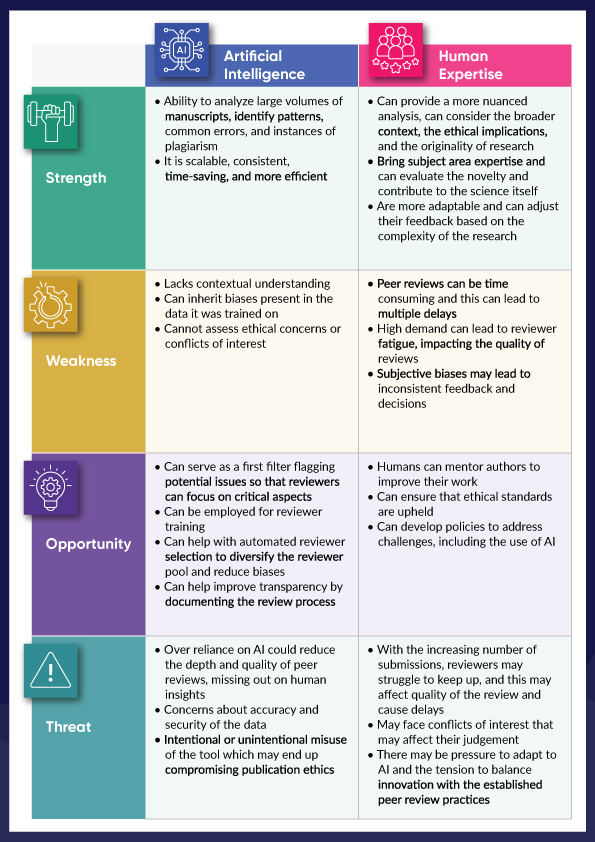
Springer Nature’s AI policy is clear: manuscripts must not be uploaded. However, we recognise the benefits they can bring and are actively exploring safe AI tools for reviewers to use. Reviewers remain accountable for the accuracy and integrity of their reports. AI can support efficiency, but only human expertise can ensure rigour, fairness, and ethical oversight.
Now that we have covered our basics, it’s time to test yourself with the following scenario. You’re reviewing a manuscript in your field. You’ve just discovered a handy online template that promises to “generate a full review report” based on your notes. Tempting, right? What do you do?
A. Use the tool to generate the entire review, it’ll save time.
B. Use the template only to structure your own comments and ensure completeness.
C. Copy‑paste your previous review for a similar paper, it’s basically the same topic.
D. Upload the manuscript into a public AI tool to get feedback suggestions.
[image description: a set of documents with check marks leading up to the final check mark]
The correct option is B! Using templates to organize your feedback is perfectly acceptable, it helps maintain structure and clarity. According to COPE’s Ethical Guidelines for Peer Reviewers, reviewers must provide objective, constructive, manuscript-specific feedback and respect confidentiality. Templates can support these goals by guiding reviewers through each section systematically.
Why the other choices miss the mark:
- Generating a full review report via AI crosses the line from assistance to substitution. As the table shows, automation should never make final judgments on content or novelty.
- Copy‑pasting previous reviews (boilerplate reviewing) undermines integrity and can be interpreted as a sign of paper‑mill activity. Each manuscript deserves its own evaluation.
- Uploading confidential manuscripts into public AI tools violates both Springer Nature’s policy and COPE’s confidentiality principles.
In summary, the main points to remember are the following:
- Templates are tools, not substitutes: Using templates is perfectly fine, as long as you take accountability for what you write. Always finish by reviewing your own comments carefully; the final judgment must come from you, not the template.
- Reuse responsibly: It’s acceptable to use the same template structure across different reviews, but each report must be tailored to the specific manuscript. Copy‑pasting identical feedback signals disengagement and can even raise concerns about paper mill activity.
- AI can assist, not decide: You may use AI to brainstorm, check grammar, or organize feedback, but never upload manuscripts into public AI tools. That violates confidentiality and publisher policy.
- Human oversight is non-negotiable: Whether AI helped or not, you are fully responsible for the content of your review. Always verify accuracy, tone, and fairness before submission.
- Your expertise is irreplaceable: AI can’t replicate your subject matter insight or ethical judgment. Use it to support your thinking, not replace it. The scientific record depends on your critical evaluation, not on generic algorithmic commentary.
-
Transparency builds trust: If you used AI tools at any stage, declare it openly in your review report. Transparency strengthens integrity and aligns with COPE’s ethical guidelines.
Peer review thrives on expertise, transparency, and trust. Templates and AI can help, but only when used responsibly. Finally, remember, your expertise is the one that is truly needed.
Additional Resources
Springer Nature Journals Editorial Policies on Peer Review:
BMC; Nature; Palgrave; Springer; Springer Nature Support Solutions: Peer Review
Springer Nature Author Tutorials: How to Peer Review