A Planet-Friendly Diet and Breast Cancer Risk: What We Found in a 30-Year Study
Published in Healthcare & Nursing, Cancer, and Sustainability


Explore the Research

 Nature Publishing Group UK
Planetary Health Diet Index and breast cancer risk - British Journal of Cancer
British Journal of Cancer - Planetary Health Diet Index and breast cancer risk
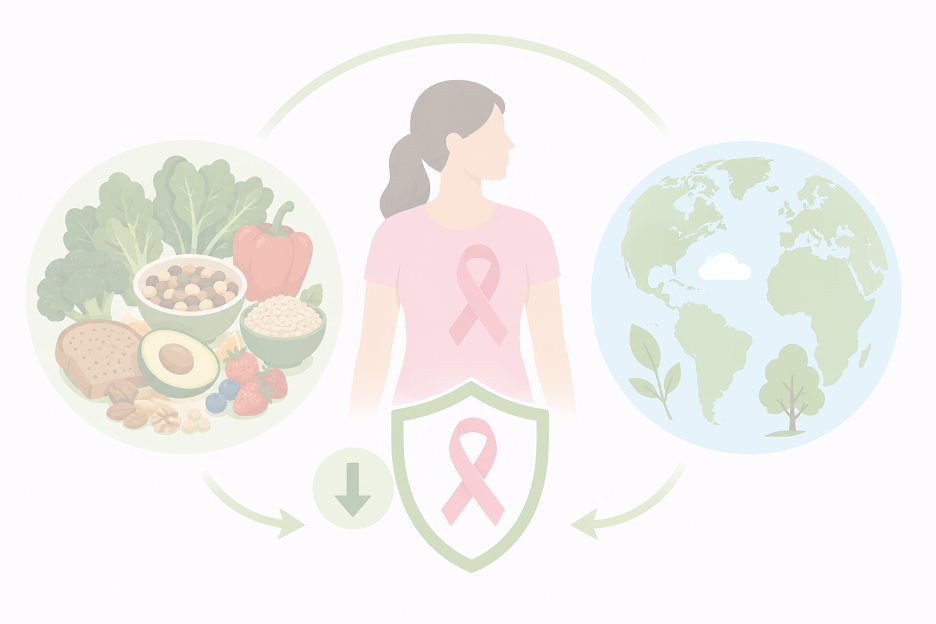
To address this question, we evaluated adherence to the Planetary Health Diet Index (PHDI)—a dietary score designed to reflect the EAT-Lancet planetary health diet—and its association with breast cancer incidence, and by tumor subtype, in two large U.S. cohorts of women followed for more than three decades.
Why we studied a Planetary Health Diet
The idea of a planetary health diet was introduced by the EAT-Lancet Commission (Lancet. 2019; 393:447-492). It proposes a dietary pattern that can support both human health and environmental sustainability. The planetary health diet emphasizes a shift toward plant-based eating: more fruits, vegetables, whole grains, legumes, and nuts, with moderate amounts of fish and poultry, and lower intake of red and processed meats, added sugars, and refined grains. While there is some evidence on the relationship between environmentally sustainable diets and prevention of chronic diseases, evidence for breast cancer, particularly by tumor subtype, is limited. We therefore aimed to fill this gap using long-term prospective data and repeated dietary assessments.
How this study was done
We drew on two of the most established prospective cohort studies in chronic disease research, the Nurses’ Health Study (NHS) and the Nurses’ Health Study II (NHSII). Together, these cohorts include more than 160,000 women followed for up to >30 years. This long follow-up is particularly important because breast cancer develops over decades, and prospective tracking allows us to observe dietary patterns long before diagnosis, strengthening our ability to evaluate long-term associations.
Diet was assessed every four years using validated food frequency questionnaires covering more than 130 food items. These instruments capture habitual intake and allow us to construct long-term dietary patterns rather than relying on a single point-in-time or baseline measurement. From these data, we calculated the Planetary Health Diet Index (PHDI) every four years (starting in 1986 in NHS and 1990 in NHSII), which scores adherence across 15 food groups, with higher scores reflecting closer alignment with the planetary health diet. Importantly, we used repeated dietary measurements and calculated cumulative averages over time, an approach that reduces random measurement error and better reflects sustained eating habits that are most relevant for chronic disease development, including breast cancer.
Over the study period, we documented more than 10,000 cases of invasive breast cancer. Because detailed tumor data were available, we were able to go beyond overall incidence and examine whether associations differed by tumor subtype. In particular, we evaluated estrogen receptor (ER)-positive and ER-negative tumors, as well as molecular subtypes where data were available. This distinction matters because breast cancer is not a single disease but instead a heterogenous disease, with a group of biologically distinct subtypes with different underlying pathways and potentially different relationships with lifestyle factors.
What we found: the planetary diet–breast cancer link varies by subtype
Women with the highest adherence to the planetary health diet had about an 11% lower risk of breast cancer overall compared with those with the lowest adherence. This association became even more pronounced when looking at tumor subtypes: risk was approximately 21% lower for ER-negative breast cancer, while associations for ER-positive disease were weaker and less consistent. These patterns remained robust after accounting for key breast cancer risk factors, including body mass index, lifestyle behaviors, reproductive history, and hormonal factors.
When we dug deeper into dietary components, higher vegetable intake stood out as the most consistent contributor to lower risk, particularly for ER-negative disease. More broadly, the dietary pattern reflects a shift toward plant-based foods and away from red and processed meats, added sugars, and refined carbohydrates, reinforcing the idea that overall dietary patterns may matter more than any single food. Biologically, these associations are consistent with pathways involving reduced chronic inflammation, improved insulin sensitivity, and lower oxidative stress. The stronger link for ER-negative tumors also aligns with the hypothesis that these cancers may be more driven by metabolic and inflammatory mechanisms, while ER-positive tumors are more hormonally driven.
Beyond breast cancer risk alone, these dietary patterns also carry environmental relevance. The same eating pattern associated with lower risk is also linked in prior research to reduced greenhouse gas emissions and lower demands on land, water, and other resources (Am J Clin Nutr. 2024 Jul;120(1):80-91). Although these findings are observational and cannot establish causality, they suggest a potential convergence between dietary choices that support human health and those that support planetary sustainability.
Limitations we considered
As with all observational studies, there are important limitations. Diet was self-reported and may include measurement error, and residual confounding cannot be fully excluded. In addition, the study population consisted mostly of health professionals of European ancestry, which may limit generalizability. Importantly, we cannot establish causality, only association. However, the long follow-up period, repeated dietary assessments, and detailed covariate data strengthen confidence in the observed patterns.
What this means overall
Taken together, our findings suggest that a dietary pattern aligned with planetary health principles may be associated with a lower risk of breast cancer, particularly for more aggressive ER-negative tumors. Diet appears to be one potentially modifiable component within a broader risk landscape, rather than a sole determinant of risk, as breast cancer is influenced by multiple factors including genetics, reproductive history, and hormonal exposures.
A potential win–win for health and the planet
Perhaps the most important message is one of alignment, that a dietary pattern that maximizes both human and planetary health may confer benefits for breast cancer prevention. In practical terms, this is not about strict restriction but about shifting proportions—more plant-based foods, fewer animal-based and highly processed products. In a time of rising breast cancer burden and increasing environmental pressures from food systems, these findings point toward a potential win–win opportunity where every day dietary choices may contribute to both breast cancer prevention and planetary sustainability.
Follow the Topic
-
British Journal of Cancer
This journal is devoted to publishing cutting edge discovery, translational and clinical cancer research across the broad spectrum of oncology.

What are SDG Topics?
An introduction to Sustainable Development Goals (SDGs) Topics and their role in highlighting sustainable development research.
Continue reading announcement