A ten-stage hierarchy of bioelectromagnetic organization by phi and electromuscular efficiency by reach alfa (electromagnetic fields)
Published in Arts & Humanities
Human physiology exhibits a structured gradient of bioelectromagnetic activity extending from slow systemic oscillations to fast localized motor coordination. We propose a ten-stage hierarchy describing progressive coupling between internal regulation and external electromagnetic interaction. Using a φ-based iterative angular operator, we model this transition as a shift from mechanically dominated regulation toward increasingly efficient electromuscular organization. Anchoring the cascade to the electromagnetic coupling scale defined by the fine-structure constant α introduces small deviations (360/phin) hat decay toward an intrinsic 1/φ-scaling attractor. This framework suggests that physiological mastery in motor and artistic performance reflects increasing neuromuscular coherence and electreomagnetic efficiency influenced by a ten factor.
1.Core Idea
The body is not only biochemical.
It is bioelectrical.
And its organization follows a gradient:
|
Low tones (slow) → |
Hight tones (fast) |
|
Global → |
Local |
|
Mechanical→ |
Eléctrical |
2.Ten physiological stages
These are ten functional domains:
1–3: visceral regulation
4–5: cardio–neural integration
6-7: cephalic integration
8 Dermal and peripheral conduction
9: cardiac field coherence
10: extracorporeal field propagation
Magnetocardiography confirms the existence of extracorporeal cardiac fields, extend beyond the skin surface..
3.Mathematical structure
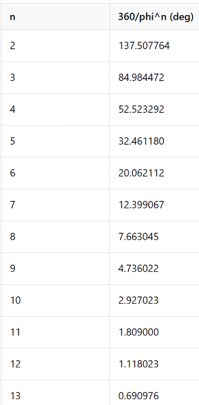
Table 1
4 . Link to electromagnetic coupling
The inverse fine-structure constant:
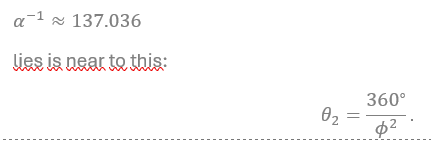
This cascade maps:
- coarse global modes
→ fine localized structures.
The interval:
n=2 to n=12
spans ten iterations:
Anchoring the cascade here introduces deviations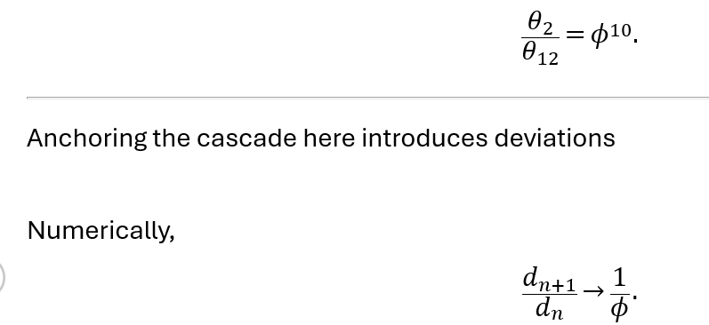
Thus, even when empirically anchored, the cascade converges toward intrinsic φ-scaling.
Link to electromagnetic scale 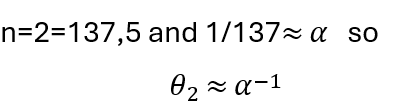
When n=13= 0,69 it means that 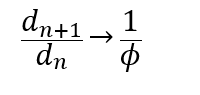
Showing convergence from phi to 1/phi in an autoreflexive scaling. Physiologically, this may be interpreted as a gradual alignment of bioelectromagnetic organization toward a regime increasingly governed by electromagnetic coherence.
- other ten factor and phi coincidences
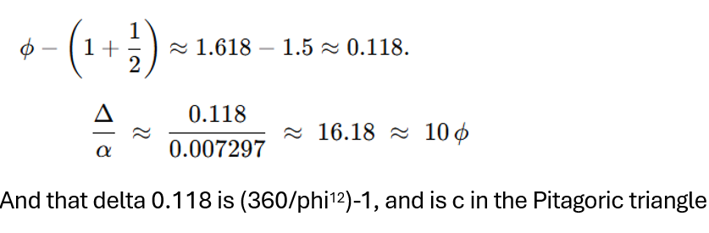

1,1180339 also is C/2 in the Pitagoric triangle if C is 5 scuared and
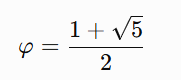
1/phi is like 360° (the unity)/phi Showing convergence from phi to 1/phi in an autoreflexive scaling. It is posible to think that 0,0073 (1/alfa) come back here as 0,073 1 later of 10 cycles in the table 1. Physiologically, this may be interpreted as a gradual alignment of bioelectromagnetic organization toward a regime increasingly governed by electromagnetic coherence.
- Skill Interpretation
Mastery in:
- tennis
- music
- dance
shows:
reduced muscular noise
increased synchronization
energetic efficiency
This reflects:
mechanical and geometric control transformed in in electrical coordination.
The ten-stage model describes a gradual shift:
Mechanical regulation → Electrical dominance
Low-frequency control → High-frequency coordination
The fine-structure constant α represents the natural strength of electromagnetic coupling in physics. While this model does not claim biological systems converge to α, it suggests that increasing physiological coherence may be described using an angular scaling framework referenced to electromagnetic interaction.
From phi to alfa: angular quantization and musical structure of the universe. Enrique A. Ramírez. https://orcid.org/0009-0005-4995-8599
Becker, R. O., & Selden, G. (1985). The Body Electric. William Morrow.
McCraty, R., Atkinson, M., Tomasino, D. (2001). Science of the heart. HeartMath Research Center.
Buzsáki, G. (2006). Rhythms of the Brain. Oxford University Press.
Hari, R., & Salmelin, R. (2012). Magnetoencephalography: From SQUIDs to neuroscience. NeuroImage, 20, 2–17.
Cohen, D. (1972). Magnetocardiography: Detection of the magnetic field of the heart. Science, 175(4022), 664–666.
Haken, H. (1983). Synergetics. Springer.
Kandel, E., Schwartz, J., Jessell, T. (2013). Principles of Neural Science. McGraw-Hill.
Jackson, J. D. (1999). Classical Electrodynamics. Wiley.

Enrique A. Ramírez Z.
Introduction
The mystery of the fine-structure constant (α ≈ 1/137) has long fascinated Nobel laureates and theoretical physicists. At the same time, the golden ratio (φ) has been recognized as a universal constant of beauty, growth, and biological form. What happens when these two constants—α and φ—are understood as part of the same harmonic code?
This work proposes that consciousness, memory, and biological organization are not random processes, but follow a quantized musical scale derived from the geometry of the circle and the golden ratio
The Central Equation
The equation
360\phi^2=\1/alpha
suggests that the angular subdivisions of the circle, when scaled by the golden ratio, generate resonant values that approximate α. This links geometry (circle), biology (φ), and quantum physics (α) in a single structural framework.
Harmonic Memory
- Binary memory: logical, sequential, 2ⁿ.
- Phyllotactic memory: spiral-based, organized by φ.
These two memory systems coexist in living organisms. Music provides the bridge: intervals such as 3/2, (1,618-1,5=0,118 emerge naturally from angular quantization, making perception itself a function of harmonic resonance. Born of 360/phi a la n.
Biological and Physical Implications
- Biology: φ organizes spirals, DNA helices, and plant phyllotaxis.
- Physics: α governs electromagnetic interaction.
- Consciousness: emerges from the resonance between binary logic and phyllotactic harmony.
This framework suggests that entropy and perception are not products of disorder, but of deeper harmonic coherence.
Why This Matters
This articules proposes a unifying perspective:
- It explains why 137 (α) is so special in physics.
- It shows that music is not only art but the structural code of perception.
- It offers biology and physics a common harmonic foundation.
Conclusion
Sooner or later, the equation 360/φ² = 1/α will be recognized as a turning point in the search for unity between physics, biology, and consciousness. What began as intuition in music reveals itself as a universal code shaping both matter and mind.
I invite the community of Academia to engage with this work: critique, refine, and expand it. If alternative explanations for α as a frequency exist, I would be eager to learn from them.
Follow the Topic
Introducing the Palgrave Macmillan Campaign for the Humanities
At Palgrave Macmillan we publish cutting-edge humanities research that has real-world impact. This research community brings together the voices of our authors and editorial team to highlight and publicize the value of the humanities and humanities research in our world today.
Continue reading announcement
Please sign in or register for FREE
If you are a registered user on Research Communities by Springer Nature, please sign in