Aggregation‑Induced‑Emission Luminogens Functionalized MXene Nanosheets for Stimuli‑Responsive Hydrogel in Pyroptosis‑Mediated Choroidal Melanoma Therapy
Published in Bioengineering & Biotechnology, Cancer, and Materials
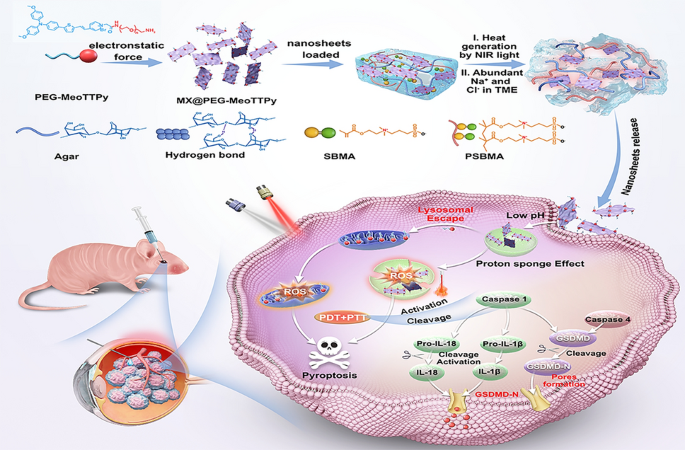


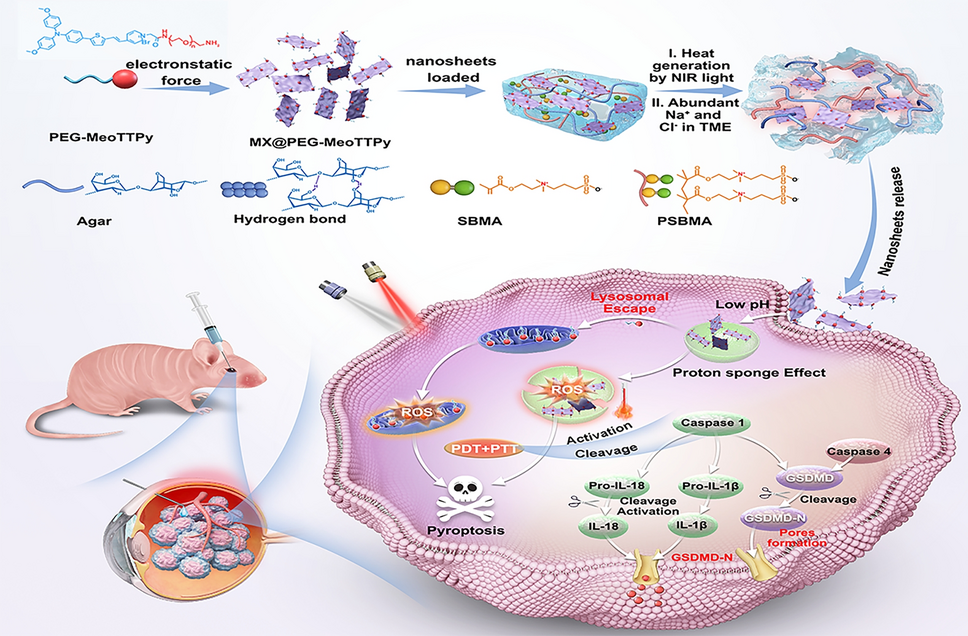

As the clinical management of choroidal melanoma faces critical challenges in sensitive imaging diagnostics and effective therapeutic modalities, conventional photodynamic therapy and radiotherapy suffer from limited efficacy and severe side effects. Now, researchers from The Hong Kong University of Science and Technology, South China University of Technology, and Sun Yat-Sen University, led by Professor Ben Zhong Tang, Professor Li Ren, Professor Xuan Zhao, and Professor Jin Yuan, have presented a breakthrough AIEgen-functionalized MXene nanoplatform that enables pyroptosis-mediated precise theranostics for this aggressive intraocular malignancy.
Why This Nanoplatform Matters
Traditional photothermal/photodynamic therapies typically trigger heat-shock resistance and apoptosis-mediated cell death with limited immunogenicity. The novel MX@PEG-MeoTTPy nanosheets overcome these limitations by integrating aggregation-induced emission luminogens with MXene nanosheets—enabling type-I ROS generation for hypoxia-resistant photodynamic therapy, while inducing immunogenic pyroptosis through dual-organelle targeting. This represents a paradigm shift from conventional apoptosis to inflammatory cell death for enhanced anti-tumor immunity.
Innovative Design and Mechanism
The nanoplatform employs electrostatic assembly of cationic AIE photosensitizer PEG-MeoTTPy onto Nb2C MXene nanosheets, encapsulated within an Agar/PSBMA thermosensitive hydrogel. Upon cellular internalization, the nanosheets undergo lysosomal escape via proton sponge effect and specifically target mitochondria through electrostatic interactions. Under dual NIR/white light irradiation, the platform generates both hyperthermia and type-I ROS (superoxide radicals and hydroxyl radicals), activating caspase-1/GSDMD-mediated pyroptosis with membrane pore formation and inflammatory cytokine release.
Outstanding Performance
MX@PEG-MeoTTPy demonstrates exceptional cancer cell selectivity with ~3-fold higher fluorescence intensity in MUM-2B cells versus normal cells, enabling precise tumor discrimination. The nanosheets achieve superior ROS generation (380-fold DCF enhancement) outperforming clinical photosensitizer Ce6, and maintain photothermal stability across five heating cycles. The stimuli-responsive hydrogel enables controlled nanosheet release over 72 hours with NIR-triggered "on-off" capability, achieving single-injection multiple-treatment convenience. In vivo studies demonstrate complete tumor ablation with normal eyeball preservation, validated by bioluminescence imaging and histopathological analysis.
Applications and Future Outlook
This work establishes a multifunctional theranostic strategy combining NIR fluorescence-photothermal dual imaging, mild photothermal-photodynamic synergistic therapy, and pyroptosis-mediated immunogenic cell death. The platform addresses critical unmet needs in choroidal melanoma management—offering sensitive noninvasive detection, precise drug delivery bypassing the blood-ocular barrier, and effective tumor eradication without enucleation—opening promising avenues for clinical translation in ocular oncology.
Stay tuned for more groundbreaking research from this collaborative team at HKUST, SCUT, Sun Yat-Sen University, and Beijing Tongren Hospital!

Editor of Nano-Micro Letters, which is an Open-Access, peer-reviewed journal reported papers that have at least one dimension ranging from a few sub-nanometers to a few hundreds of micrometers. The journal is published by Springer Nature and indexed by SCI, EI, SCOPUS, Pubmed, etc. The 2024 JCR Impact Factor is 36.3. The 2024 CiteScore is 53.1.
Follow the Topic
-
Nano-Micro Letters
Nano-Micro Letters is a peer-reviewed, international, interdisciplinary and open-access journal that focus on science, experiments, engineering, technologies and applications of nano- or microscale structure and system in physics, chemistry, biology, material science, and pharmacy.

Please sign in or register for FREE
If you are a registered user on Research Communities by Springer Nature, please sign in