Air‑Breakdown Triboelectric Nanogenerator Inspired by Transistor Architecture for Low‑Force Human–Machine Interfaces
Published in Bioengineering & Biotechnology and Materials
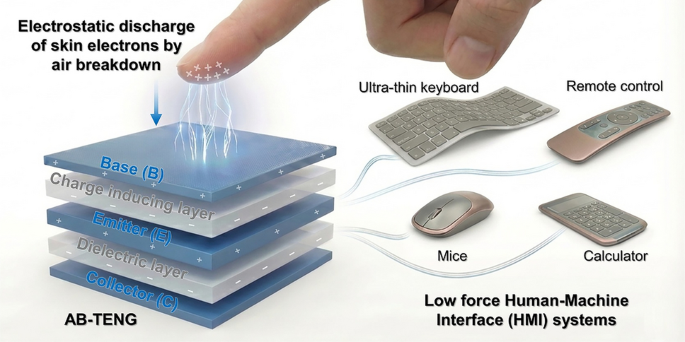
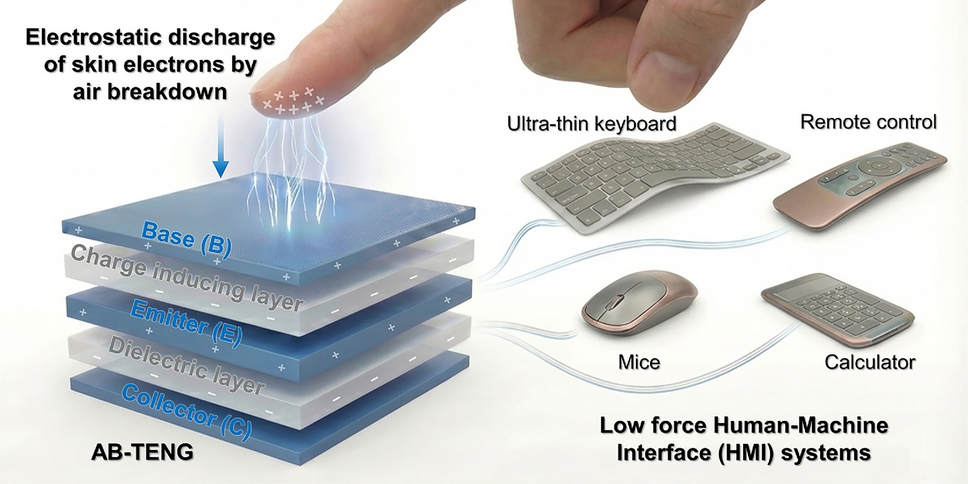

As advances in micro/nanotechnology drive human–machine interface (HMI) systems toward miniaturized, intelligent, and autonomous platforms, most current HMI devices remain passive and dependent on external power sources, restricting their potential for truly self-sustained operation. Now, researchers from the MEMS and Nanotechnology Laboratory at Chonnam National University, led by Professor Dong-Weon Lee, in collaboration with Kyungpook National University, have presented a breakthrough study on an air-breakdown triboelectric nanogenerator (AB-TENG) with a transistor-inspired architecture. This work establishes a new design paradigm that transforms air breakdown from a limitation into a functional mechanism, advancing skin-electricity-enhanced thin-film TENGs toward next-generation self-sustaining HMI systems.
Why Air-Breakdown TENGs Matter
- Low-Force Operation: The AB-TENG achieves high electrical output from the electrostatic discharge of skin electrons at a low contact force compatible with day-to-day human–machine interface systems.
- Overcoming Conventional Limitations: Conventional tactile TENGs suffer from low surface charge density and unstable output due to air breakdown effects, which waste skin electrons in the air rather than converting them into electricity.
- Self-Powered HMI Systems: The device enables the fabrication of next-generation thin electronics without external power sources, suitable for keyboards, mice, remote controls, and other frequently touched interfaces.
Innovative Design and Features
- Transistor-Inspired Architecture: The AB-TENG employs a base terminal to collect electrons from human skin via an ionized air channel formed by air breakdown, featuring five layers (base, emitter, charge-inducing layer, dielectric layer, and collector).
- Dual Operational Modes: The device operates in indirect mode (accumulated output through electrostatic induction) and direct mode (instant high output through direct electron flow), ensuring efficient charge transfer even at low contact force.
- High Electrical Output: In direct mode, the AB-TENG delivers 165 V at 2 N and 290 V at 24 N, with a peak power of 22 mW—22 times higher than conventional tactile TENGs.
Applications and Future Outlook
- Self-Powered Infrared Remote Control: A practical demonstration shows the AB-TENG powering a wireless LED operation system with four integrated devices, achieving over 80% success rate at 15 N contact force.
- Ultrathin Self-Powered Keyboard: A 600 μm-thick keyboard with 30 keys (4 rows × 8 columns) demonstrates both wired and wireless communication capabilities, converting typing motion into both data signals and power.
- Environmental Adaptability: The device maintains stable performance under varying temperature conditions (20–80°C) and operates effectively at low humidity levels, with output decreasing at high humidity due to charge dissipation.
- Non-Contact Operation: The AB-TENG generates electricity through arc discharge without physical contact, producing 6–16 V across 0.5–2 mm air gaps, enabling touchless sensing applications.
- Challenges and Opportunities: The study highlights the need for further optimization in large-area, flexible, and wearable electronics. Future research will focus on extending the AB-TENG concept to IoT devices and improving performance in high-humidity environments.
This comprehensive study provides a roadmap for developing self-sustaining next-generation HMI and IoT devices. It highlights the importance of innovative energy harvesting strategies that transform physical limitations into functional advantages. Stay tuned for more groundbreaking work from Professor Dong-Weon Lee at Chonnam National University!

Editor of Nano-Micro Letters, which is an Open-Access, peer-reviewed journal reported papers that have at least one dimension ranging from a few sub-nanometers to a few hundreds of micrometers. The journal is published by Springer Nature and indexed by SCI, EI, SCOPUS, Pubmed, etc. The 2024 JCR Impact Factor is 36.3. The 2024 CiteScore is 53.1.
Follow the Topic
-
Nano-Micro Letters
Nano-Micro Letters is a peer-reviewed, international, interdisciplinary and open-access journal that focus on science, experiments, engineering, technologies and applications of nano- or microscale structure and system in physics, chemistry, biology, material science, and pharmacy.

Please sign in or register for FREE
If you are a registered user on Research Communities by Springer Nature, please sign in