All-metal aromaticity. III. σ- and π-double aromaticity
Published in Chemistry

In 1990, Martin and Schaad discovered that two ring currents exist in C6I6++, as shown in Figure 1. They suggested that the 6 iodines should be 10-electron σ-delocalized aromatic species, while the 6 carbons should be 6-electron π-delocalized aromatic species. This leads to the σ-π double aromaticity.
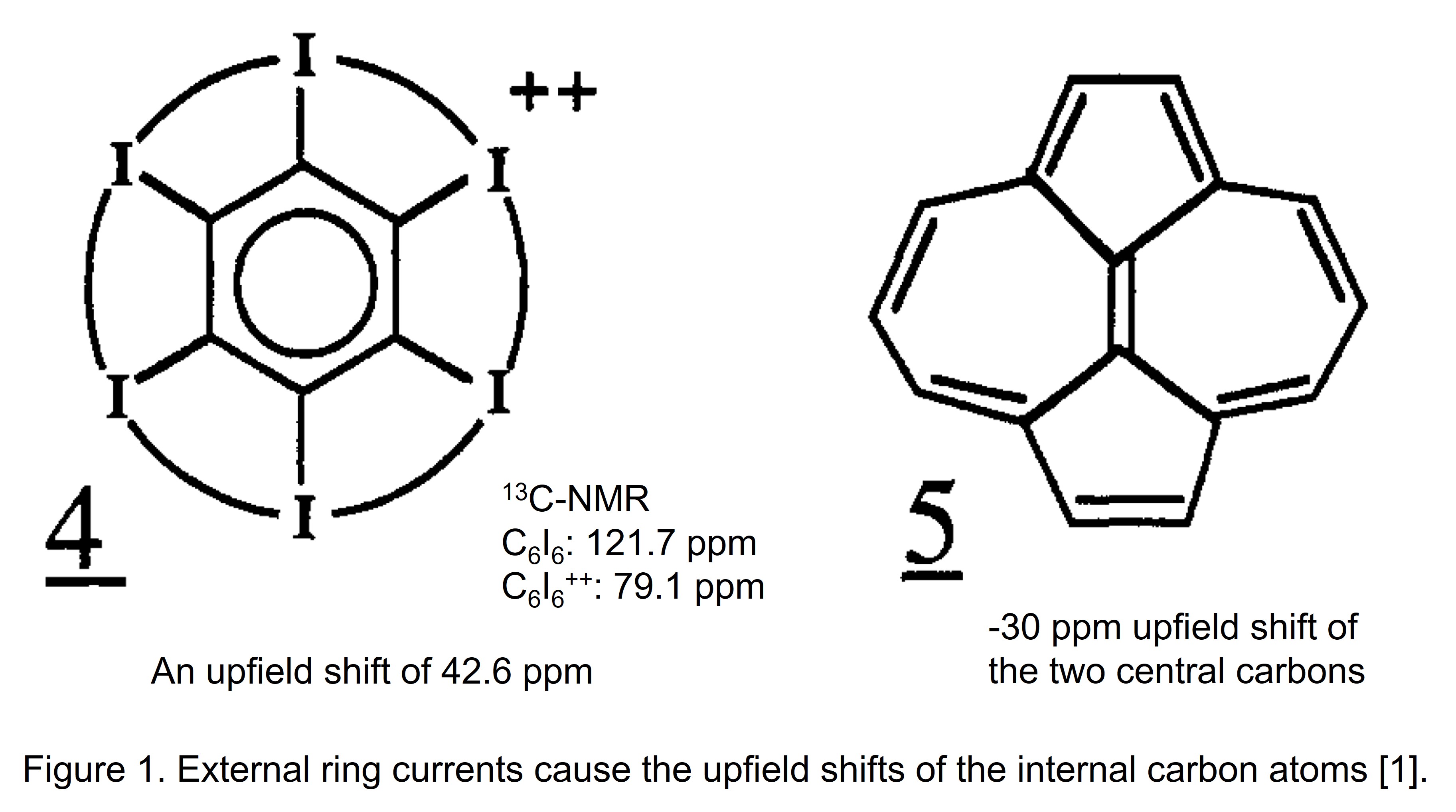
The C6I6++ structure maintains high co-planar symmetry. 13C NMR singlet of C6I6 at 121.7 ppm and singlet at 71.9 ppm for C6I6++. This indicates that 6I++ generates a ring current, analogues to the two central carbons of dicylopenta[ef,kl]heptalene to have upfield shifts in their 13C NMR spectrum, interpreted as a -30 ppm upfield shift for the 14-electron π-aromatic ring current of the external π-delocalized cycle. Replacements of iodine atoms of C6I6 by other large atoms (such as Te, Se, etc.) provide compounds which can be oxidized to species related to (C6I6)++ [1].
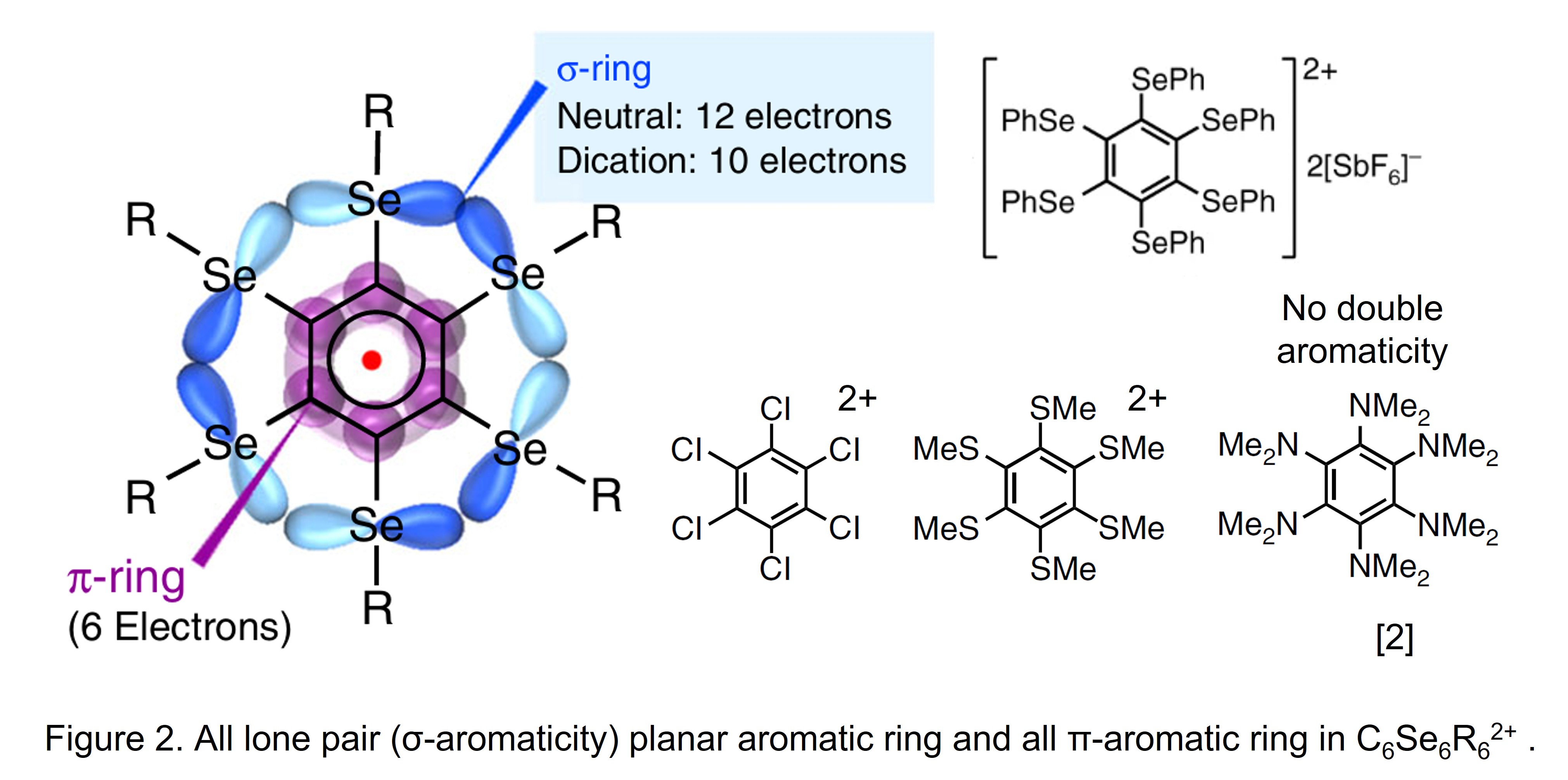
In 2018, Furukawa et al. reported that C6Se6Ph6++ was indeed synthesized, a bench-stable hexakis(phenylselenyl)benzene dication. The C6Se6++ core is highly planar and symmetry. The distances between adjacent selenium atoms fall into a relatively narrow range [3.240(1)–3.338(1) Å], and are much longer than standard Se−Se single bonds (2.29 Å) [2]. There is no chemical bond between Se-Se in C6Se6Ph6++. Furukawa pointed out that the introduction of 6 lone-pair-bearing heteroatom functionalities onto the benzene ring carbon atoms is of crucial importance for the creation of compounds that exhibit double σ aromaticity and π-aromaticity, as shown in Figure 2.
In 2025, Solá’s group showed that the C-I and I-I distances in neutral C6I6 are 1.405 Å and 3.470 Å, and 1.389 Å and 3.475 Å in C6I6++ respectively [6]. The I-I single bond length is 2.67 Å. Therefore, no chemical bonds are formed between the iodine atoms in C6I6 and C6I6++. Solá also mentioned the lone pairs in the σ- and π-double aromaticity [7]. However, influenced by molecular orbital theory, they all place the lone pair in a dumbbell-shaped p-orbital, as shown in Figure 3.
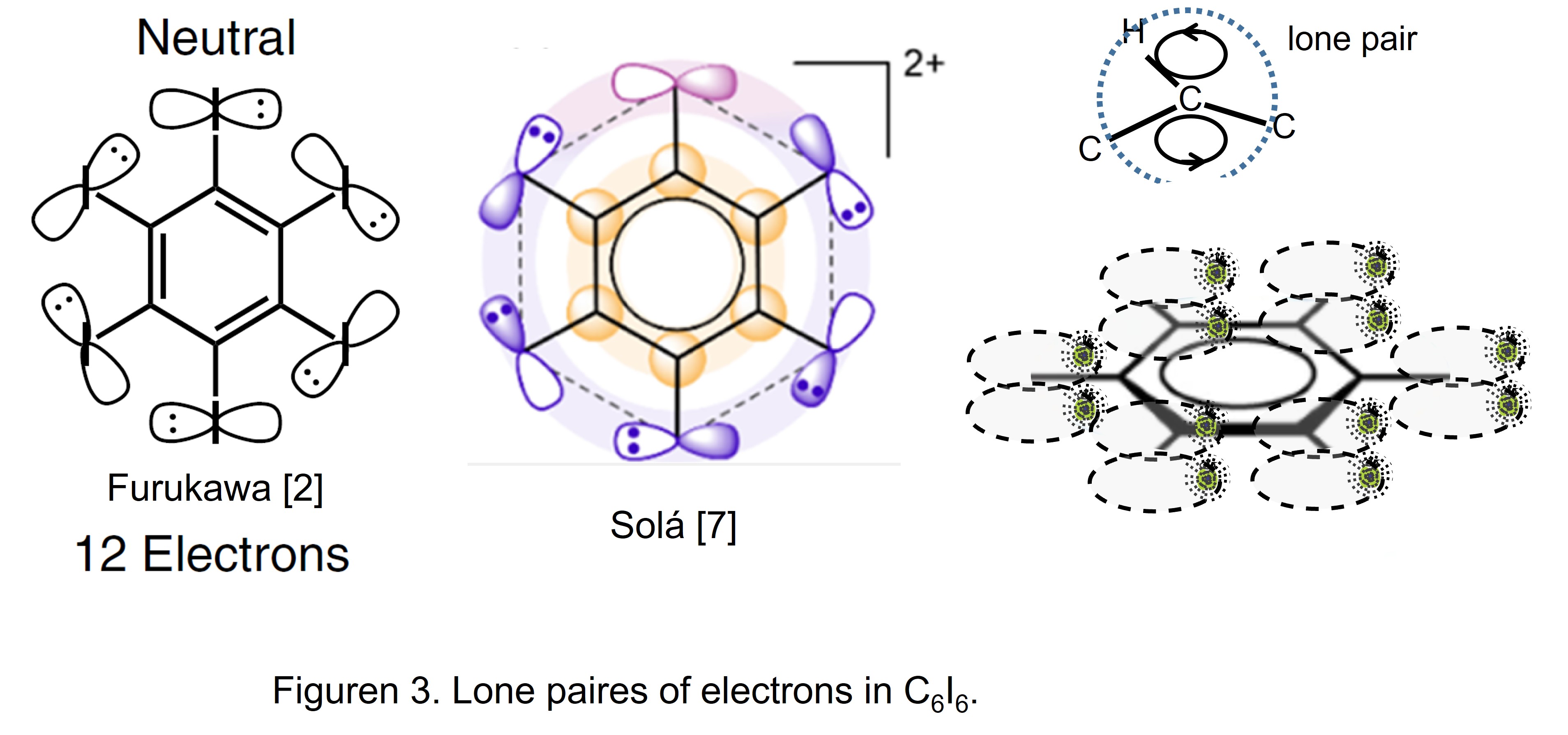
It is obviously highly unreasonable for the electron's moving path to intersect with the positively charged atomic nucleus. Furthermore, they attribute lone pairs in p-orbitals directly to σ-aromaticity rather than π-aromaticity. This conflicts with the correspondence where σ-aromaticity relates to s-orbitals and π-aromaticity relates to p-orbitals. Substantial experimental evidence suggests a link between σ-aromaticity and lone pairs participating in ring currents. This is a special form of electron motion that has been overlooked or unrecognized by the scientific community; similar to π-electrons, two unpaired electrons with parallel spins orbit together to form a pair. The participation of lone-pair electrons in ring currents is frequently observed in organic aromatic compounds; I discussed this in detail in the paper "The movement of two parallel unpaired electrons in benzene and aromatic compounds," published at the end of 2025 [8]. The electron configuration of a lone pair should be two unpaired electrons with parallel spins circle around one atom. The arrangement of electrons outside the atomic core does not preserve the characteristics of the orbitals found within the atom itself; instead, the arrangement is determined by the natural orientation dictated by the environment. It typically follows natural principles such as symmetry, minimization of energy, and minimization of motion.
Figure 4 shows the electron configurations of C6Se6++, C6I6++, and C6S6++.
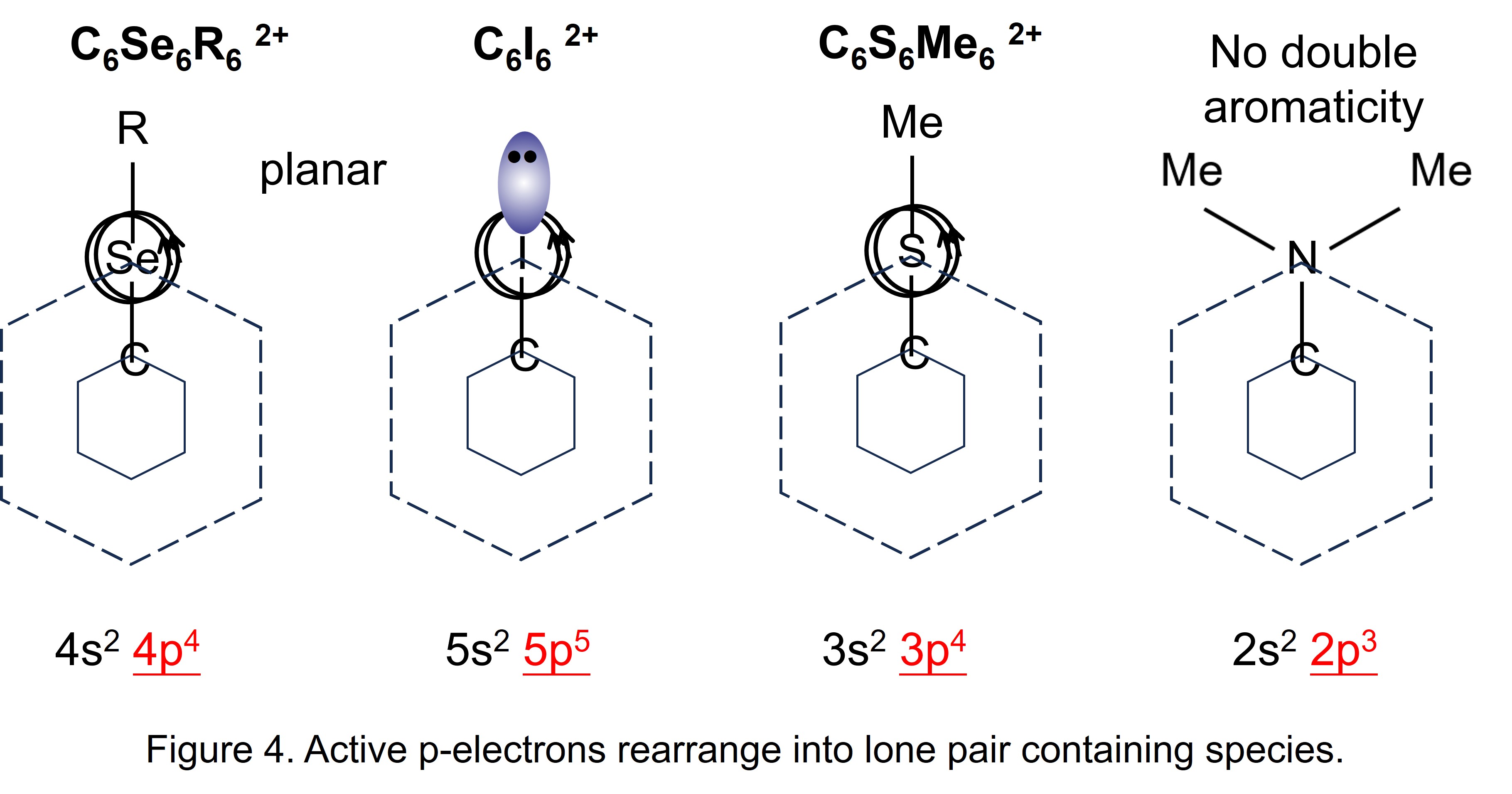
Since these species are highly planar and there is no chemical bond along the second ring, the Se 4p4 electrons combine with carbon and R to form two covalent bonds, leaving a lone pair (two unpaired electrons with parallel spins). The S 3p4 forms a lone pair in the same way. The I 5p5 electrons divide one electron for covalent bond with carbon, and four electrons for two lone pairs. Based on the electronic structure of aromatic furan (Figure 5), the lone pair involved in the ring current transforms into two circular paths, while the other lone pair remains in an ellipsoidal orbit.
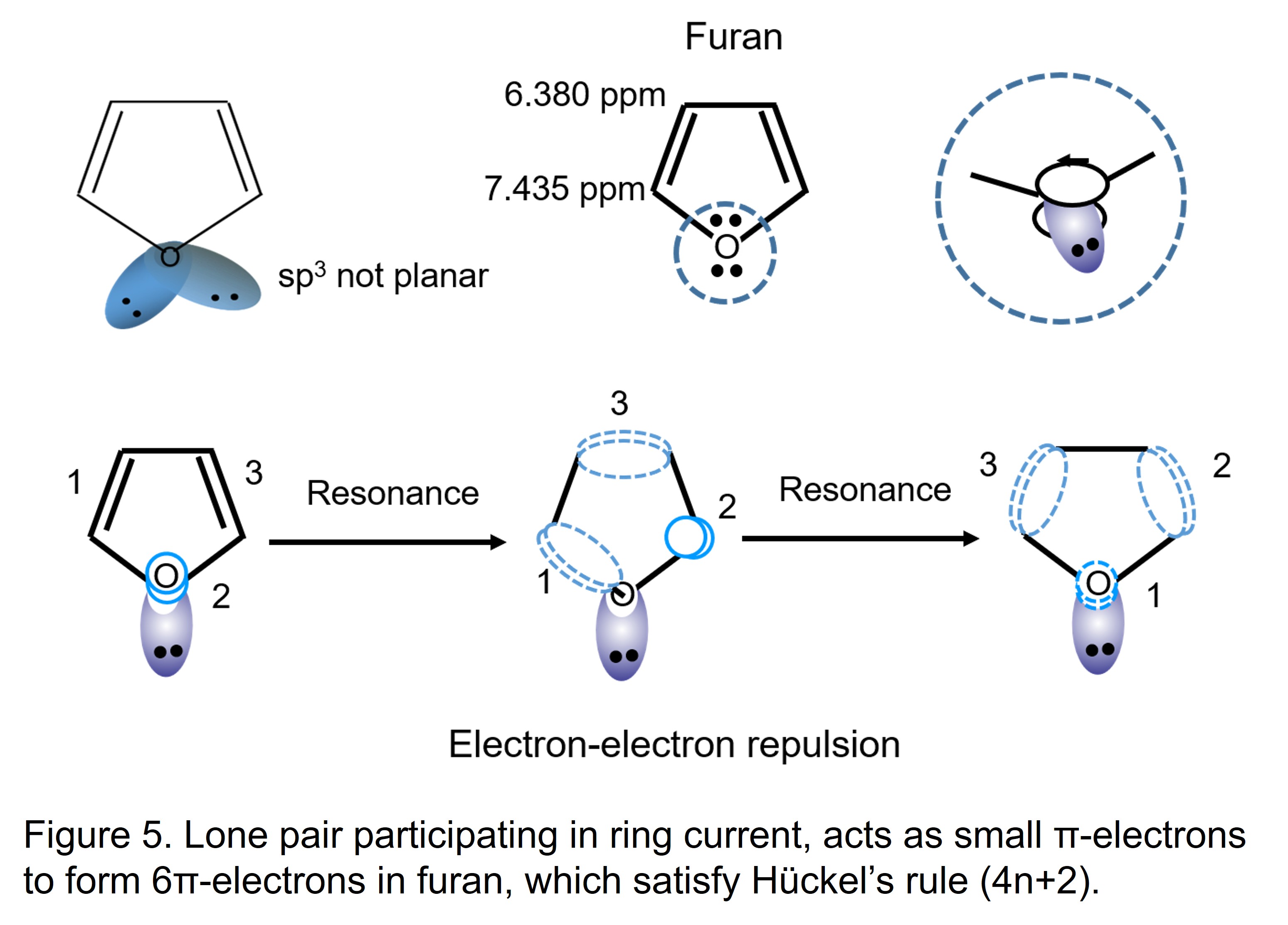
Lone pairs are a necessary condition for ring currents, but not a sufficient one. For example, C6N6(Me6)2 lacks lone pairs and therefore does not generate a ring current, whereas C6Se6R6 possesses six lone pairs but likewise lacks aromaticity. C6Se6R6++ exhibits aromaticity only after the removal of two electrons. Solá proposed that the removal of two electrons via oxidation occurs not at two iodine atoms, but rather involves a lone pair of electrons on a single atom; this insight significantly advances the understanding of σ- and π-double aromaticity. The active electrons participating in the ring current must satisfy Hückel’s electron counting rule of 4n+2. Fundamentally, it involves an odd number of π-electrons and lone pairs. Five lone pairs on C6Se6R6++-ring are odd number for aromaticity, while C6Se6R6 has six lone pairs, which are even number (4n) for antiaromaticity. Therefore, one lone pair must be removed from C6Se6R6 to obey the Hückel’s rule.
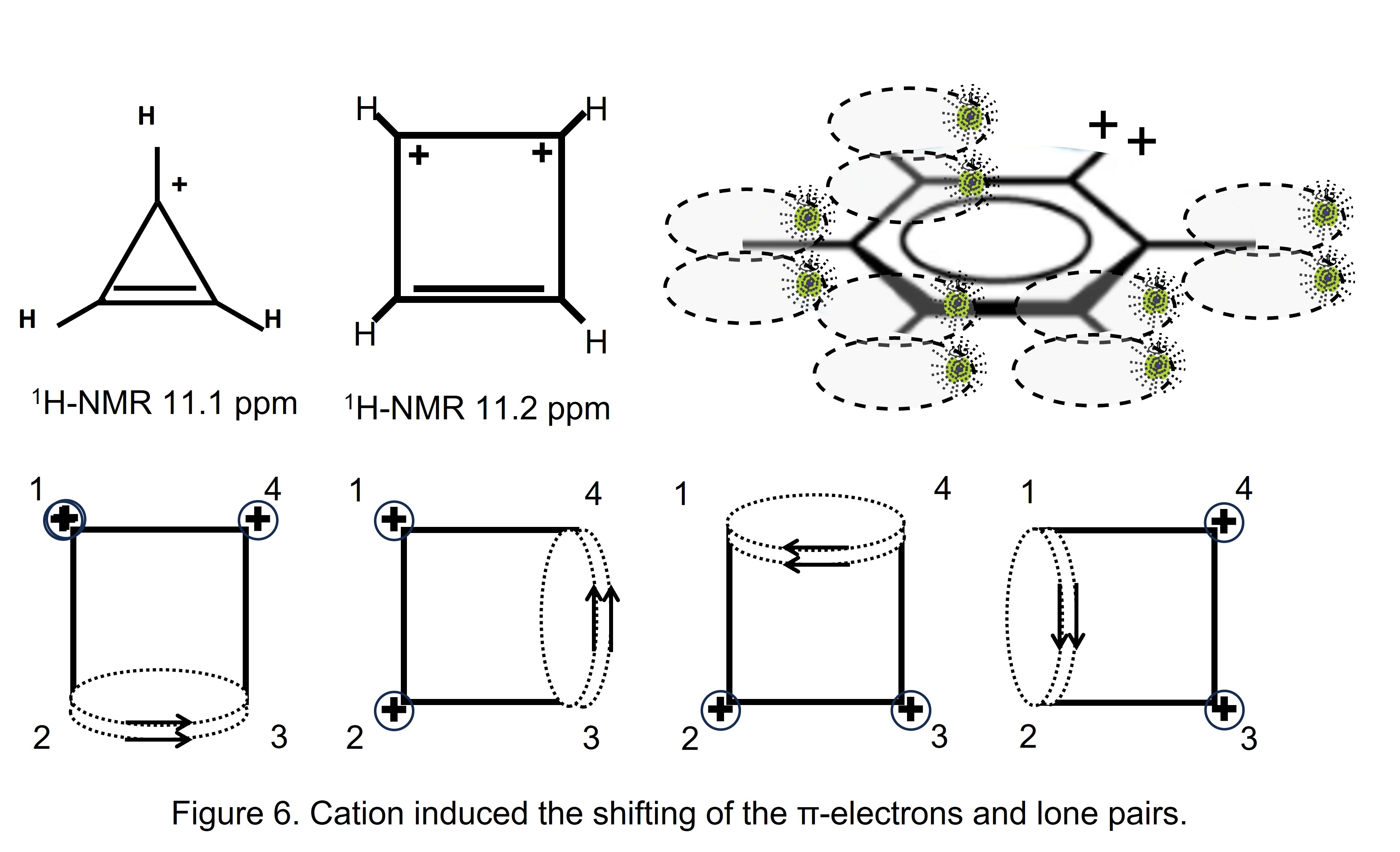
A driving force is also required to establish a ring current. Under thermal vibration, electrostatic repulsion between adjacent electron orbits promotes orbital shifting, or electrostatic attraction exerted by positive charges on negatively charged orbits facilitates such shifting. C6Se6R6++ is the same as C3H3+ and C4H4++ aromatic clusters shown in Figure 6. The attraction seems more effective than repulsion for ring current. The 1H NMR chemical shifts of C3H3+ and C4H4++ are both at 11.2 ppm, stronger than that of benzene at 7.26 ppm.
A further example of all-lone-pair aromaticity (σ-aromaticity) is shown in Figure 7. The PtZnH5− cluster anion exhibited an unprecedented planar pentagonal coordination for Pt and an unusual stability and high intensity in the mass spectrum. These are due to the σ-aromaticity found in the H5-cycle supported by the 5d orbitals on the Pt atom [9]. The cluster binds atomic H5. For PtZnH5−, there are two isomers relatively close in energy. Isomer I has aromatic stability, while isomer II hasn’t. In Isomer II, two of the H atoms bridge between Pt and Zn and the remain two bounds to Pt. This indicates that Zn is not merely a spectator in the system, but participates in the formation of the aromatic cluster. Importantly, removal of Zn from the cluster results in the PtH5− species, which is a planar D5h structure, and the bonding within this fragment is analogous to that in the PtH5− unit within the PtZnH5−hydride. Thus, Zhang et al. believed that Zn is merely a spectator in the system where Pt exhibits an unusual coordination [9].
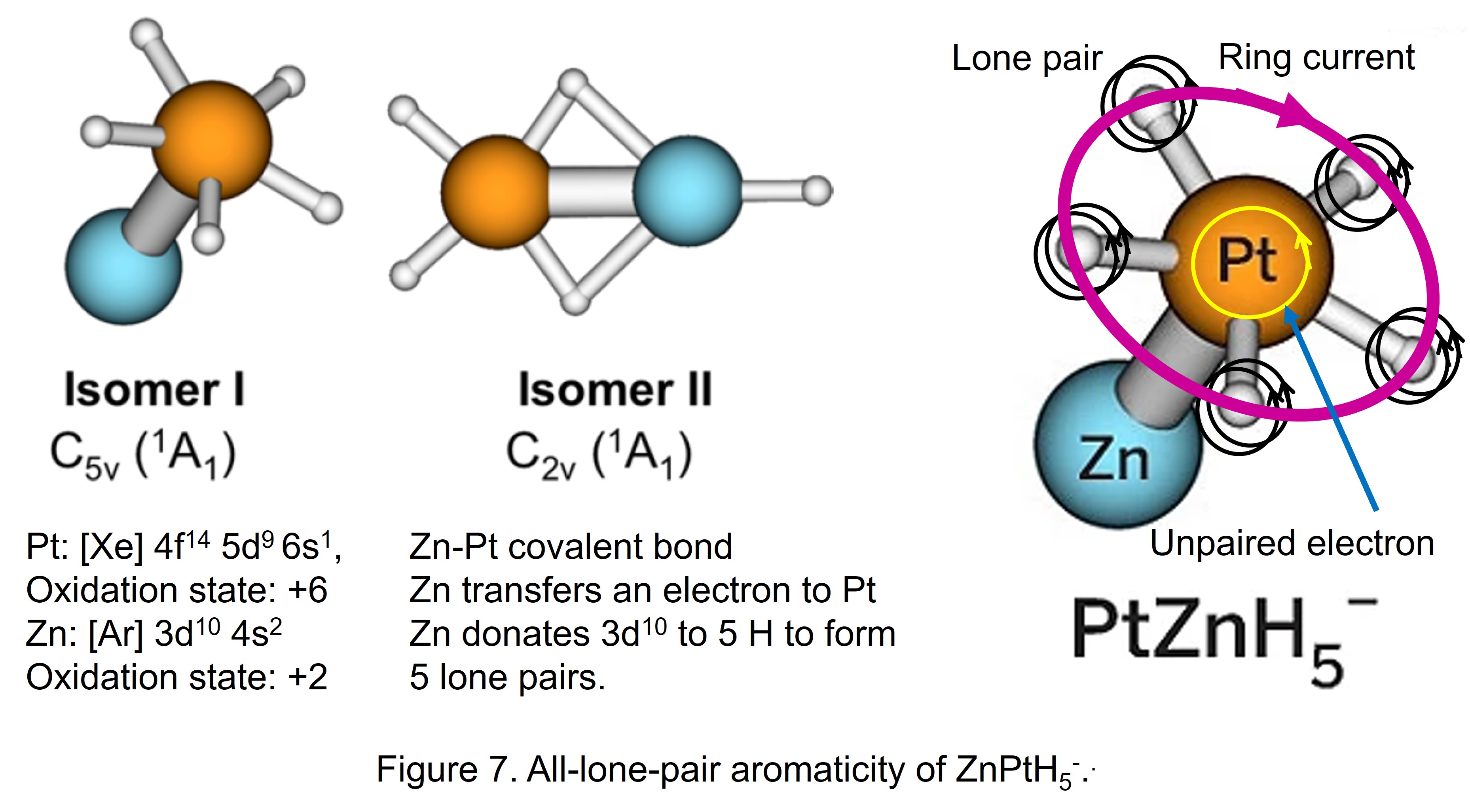
Based on the experimental results of Zhang’s work in 2014, this paper proposes the electron configuration for this cluster formation process. The active valence electrons of Pt are 5d⁹6s¹ on the atomic outermost shell, and its highest oxidation state is +6; this means Pt can contribute a maximum of six valence electrons to bond formation. Zn has 3d104s2 electrons on its atomic outermost surface, and its oxidation state is +2. First, Zn and Pt each contribute one electron for sharing, forming a covalent bond. Pt further contributes five valence electrons to share with the valence electrons provided by five hydrogen atoms, forming five Pt-H covalent bonds. At this stage, the positive electric field of the hydrogen is exposed, which can attract the 3d¹⁰ electrons of the Zn atom. Isomer II appears at this stage. When Zn donates all its 3d electrons to five hydrogens and transfers the last 4s electron to Pt, the high symmetry, high stable ZnPtH5- cluster is formed. The five lone pairs of electrons can shift position to generate ring current, just like the case in C6I6++. The extra 4s electron from Zn can participate the 5d5 orbits on Pt, a metastable half-filled 5d orbits. At the last stage, removal of Zn from the cluster results in the PtH5− species. The fragment is analogous to that in the PtH5− unit within the PtZnH5−hydride. This is the "all-lone-pair aromaticity" (or "all-σ-aromaticity"). It is better to use the term "lone-pair electrons" rather than "σ," because "σ-bond" specifically refers to a covalent bond. Without ring currents, the molecular structure of this five-pronged molecule would by no means be so stable.
In 1979, Schleyer et al. reported that 3,5-dehydrophenyl cation (C₆H₃⁺) was doubly aromatic ion, a standard 6π-electron aromatic system circulating around the perimeter of the carbon ring and an embedded 2σ-electron aromatic system [3]. Figure 8(a) shows the common structure of C6H3+, which contains two radicals or unpaired electrons.
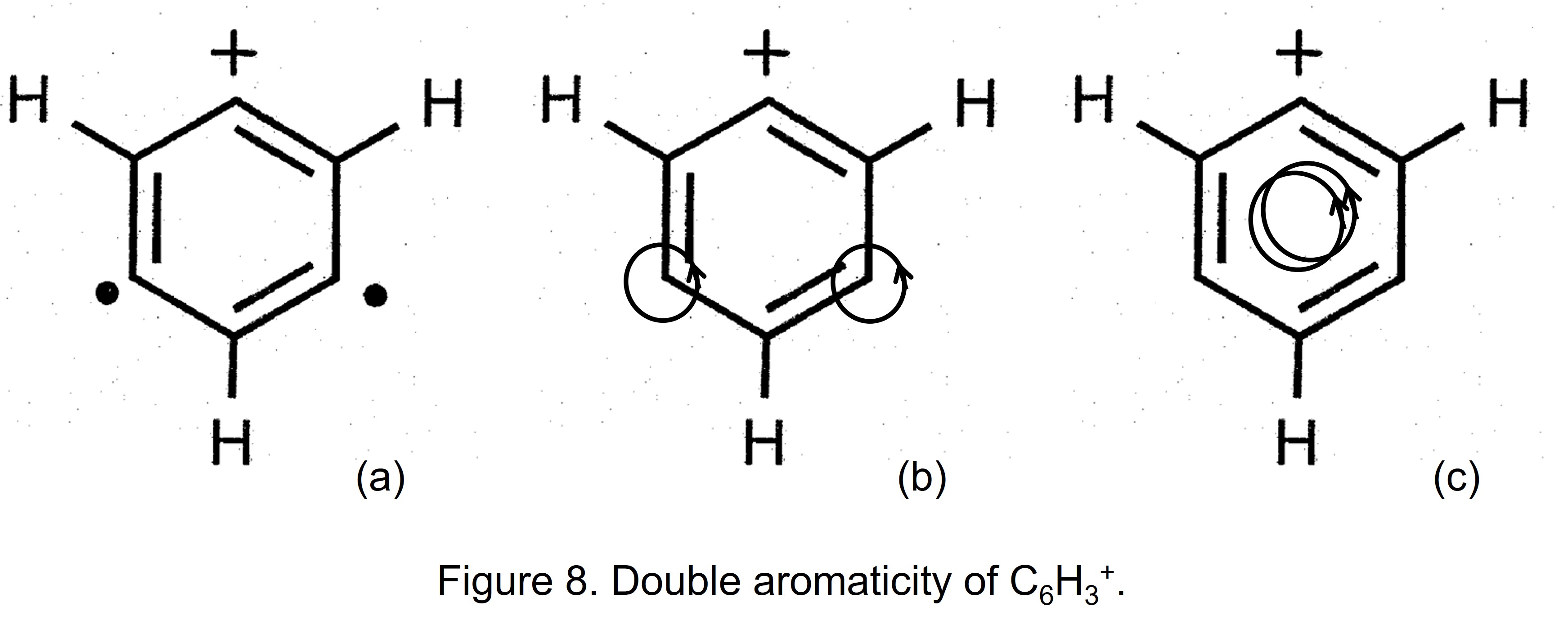
If, instead of viewing a free radical as a single point, we regard it as being in continuous, high-speed orbital motion, that is the structure of Figure 8(b). Electrons within a molecule must undergo high-speed orbital motion; otherwise, they would be drawn into the atomic nucleus. This fact has also been overlooked by the scientific community. When these two unpaired electrons with parallel spins are embedded into the ring, a relatively stable lone pair is formed, as shown in Figure 8(c), this is the Schleyer’s double aromaticity of C6H3+.
In 2025, Dhara et al. reported the aromaticity in the neutral Al4 four-membered core [10]. Similar to C6H3+, the two unpaired electrons in the ring are forced into the ring, forming a lone pair, as shown in Figure 9. Lone pairs and π-orbitals are magnetic and are often confused with aromaticity. True aromaticity stems from the stability conferred by ring currents and ring magnetic fields, which arise from the continuous shifting of π-orbits and lone pairs.
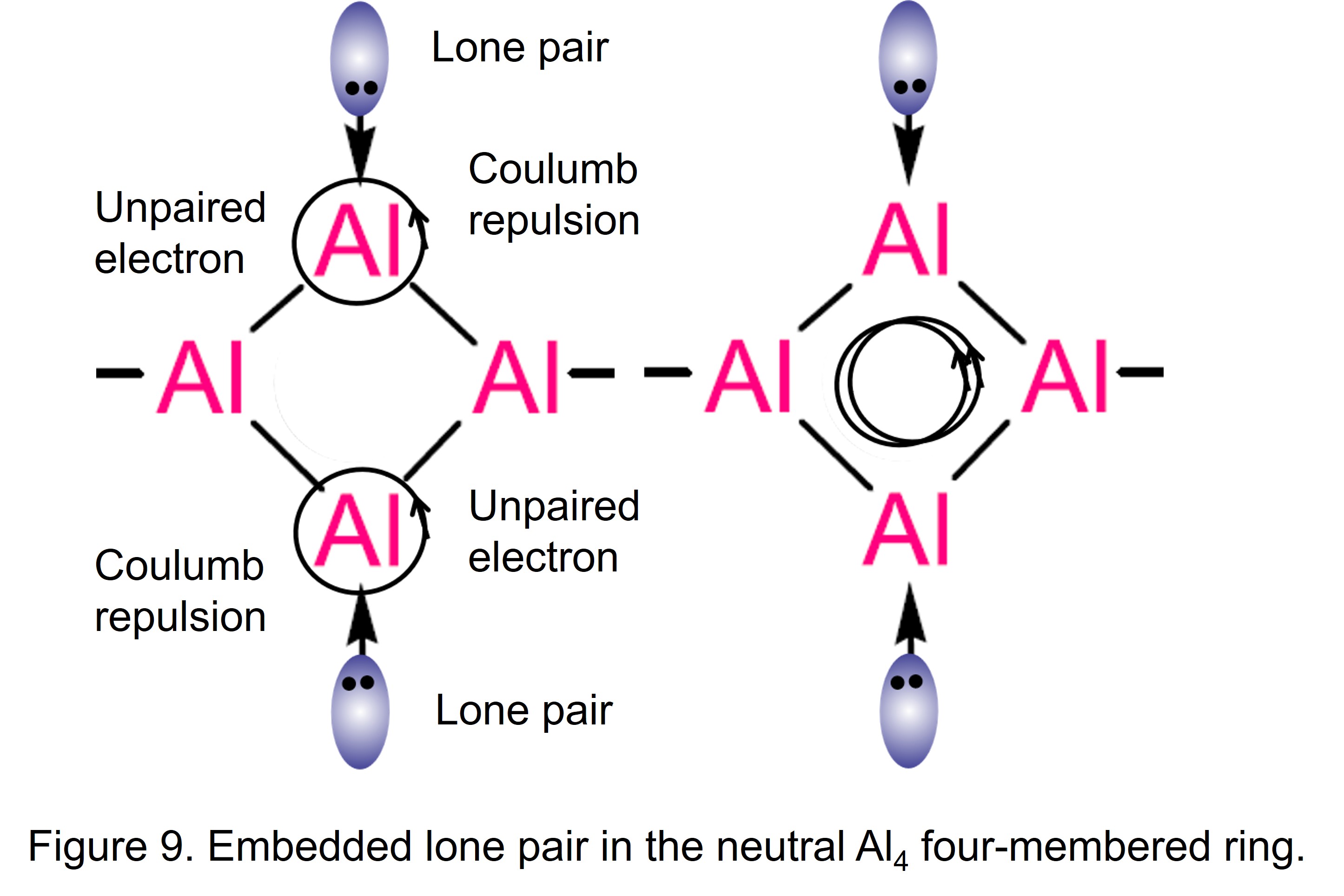
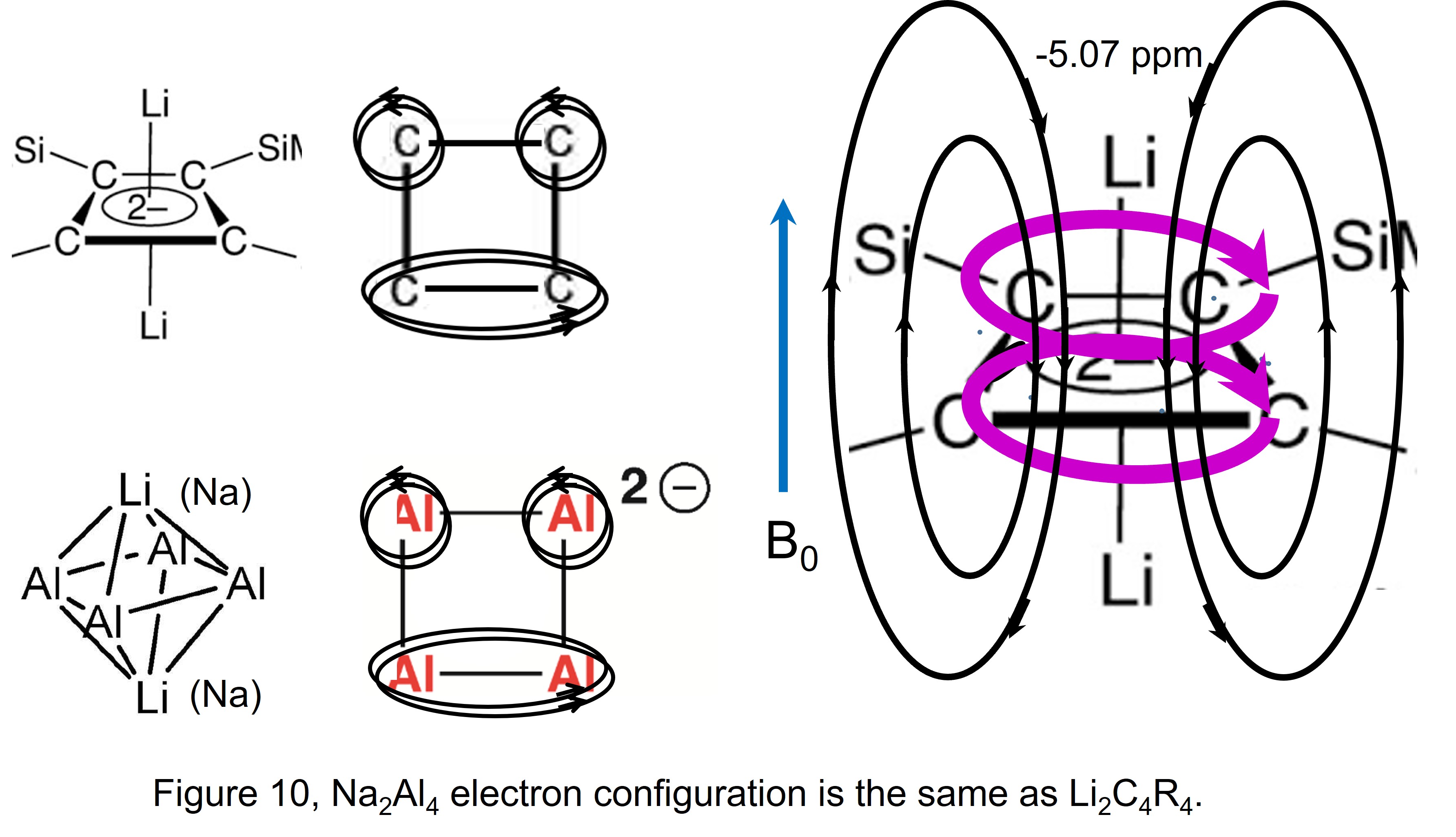
We now turn to the σ- and π-double aromaticity proposed by Boldyrev et al. In 2002, they reported that Na2Al4 and Na2Ga4 are due to the presence of three completely delocalized bonds, one π-bond and two σ-bonds, thus confirming the presence of π- and σ-double aromaticity [4]. How are the delocalized π-bonds and σ-bonds arranged on these square bases? Unlike C6I6++, C6Se6R6++, and C6H3+, they do not exhibit two distinct circulating currents. Figure 10 shows the electronic configuration of Al42- with “one π-bond and two σ-bonds”. This is exactly same as C4R42-. Li NMR chemical shift verified the ring current and the associated magnetic field. If the lone pair is treated as small π-electrons, the system contains 4n+2 active electrons (with n=1), which is exactly the same as in benzene. Therefore, it is inappropriate to classify the aromaticity of Al₄²⁻ into σ-aromaticity and π-aromaticity. Boldyrev’s definition of "doubly aromatic" led to considerable confusion in the interpretation of subsequent research.
In 2012, Boldyrev et al. claimed that the neutral Rh@B9 and Ir@B9 rings are doubly aromatic, each featuring six fully delocalized π and σ electrons (three σ and three π) that characterize the bonding between the central metal atom and the boron ring. These complexes possess high D9h symmetry, forming a flat, monocyclic wheel configuration and possess closed-shell electronic structures, as shown in Figure 11.
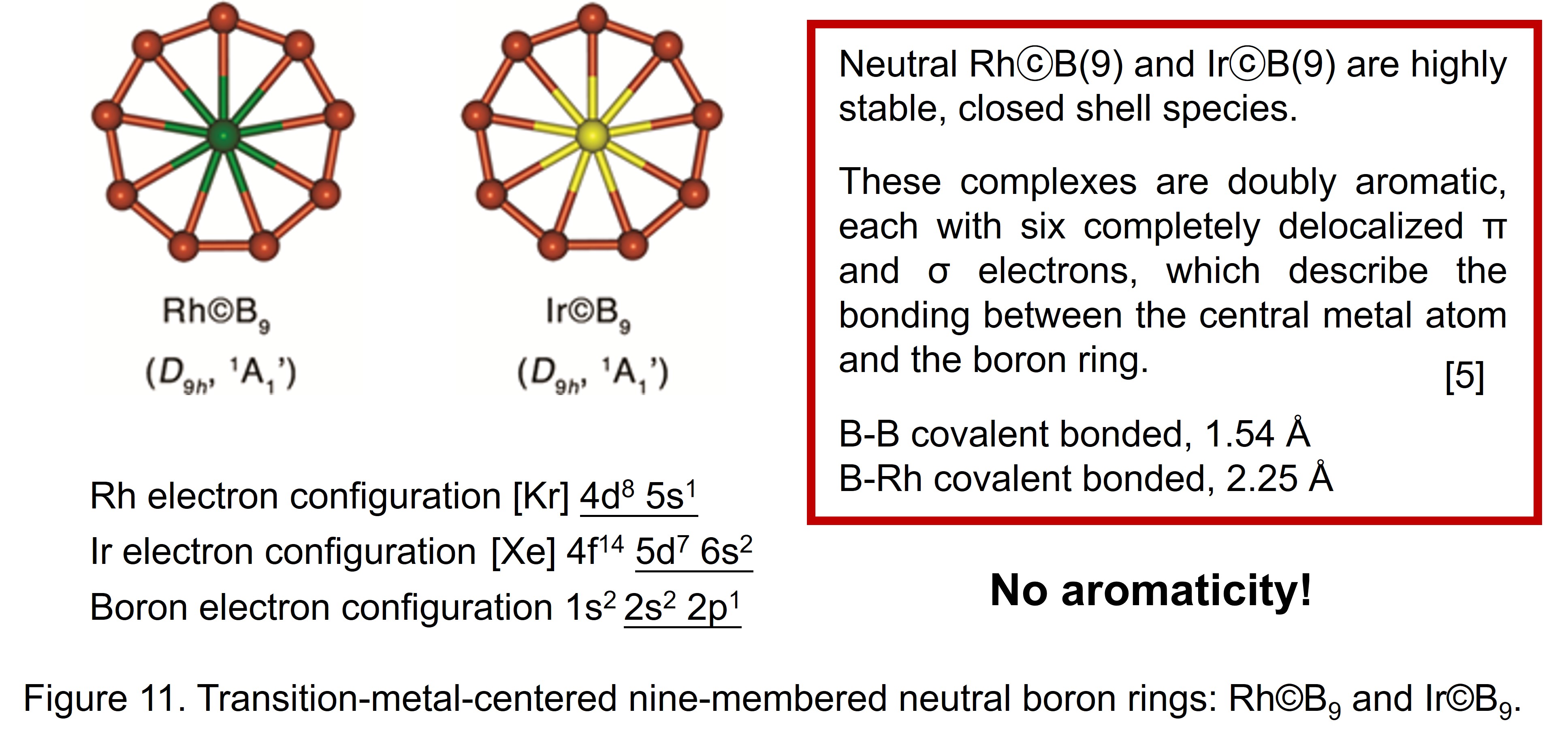
They believed that the high stability was attributed to this σ-π double aromaticity. The first question: how can three σ and three π bonds be arranged in a highly symmetric 9-membered ring? The second question: what means closed shell electronic structure of Rh@B9? Closed-shell species is an atom, ion, or molecule in which all available low-lying energy levels or electron orbitals are completely filled with pairs of electrons, leaving no unpaired electrons. This indicates that there is absolutely no possibility for Rh@B9 and Ir@B9 to form ring currents, as ring currents rely on unpaired electrons. Aromaticity is a magnetic property. Paired electrons cancel out the orbital magnetism and enter the lower energy state. Boldyrev asserted: "This work firmly establishes metal-doped B rings as a new class of novel aromatic molecular wheels."
In fact, the high stability of these wheel rings is entirely attributed to the linkages formed by purely covalent bonds. Central Rh atom possesses 4s8 5s1 active electrons, which combine with 9 B atoms. The boron atoms are linked to each other by covalent bonds to form a nine-membered ring. This leaves a pair of electrons with opposite spins in the 1s orbital on the boron atoms; they are too low in energy to bond.
In 2015, Nobel Prize laureate, professor Roald Hoffmann published a paper “The Many Guises of Aromaticity. Is hype debasing a core chemical concept?”. “Today, an inflation of hype threatens this beautiful concept. Molecules constructed in silico are extolled as possessing surfeits of aromaticity-“doubly aromatic” is a favorite descriptor. Yet the molecules so dubbed have precious little chance of being made in bulk in the laboratory. One can smile at the hype, a gas of sorts, were it not for its volume. A century and a half after the remarkable suggestion of the cyclic structure of benzene, the conceptual value of aromaticity—so useful, so chemical—is in a way dissolving in that hype. Or so it seems to me.” He also mentioned another example of hype: C6. “The molecule known for decades exists in cyclic form (benzene denuded of hydrogens). C6 is observed in the interstellar medium and in the laboratory in a molecular beam. Not one of the good spectroscopists working on these carbon “clusters” (there are other Cn species) has made a claim of multiple aromaticity for them. Yet there are theoretical papers claiming just such double aromaticity for C6. Carbon clusters, of which C6 is a small example, are patently reactive in a laboratory flask, moving on with a vengeance to graphite or, if oxygen is present, to CO2”. [11].
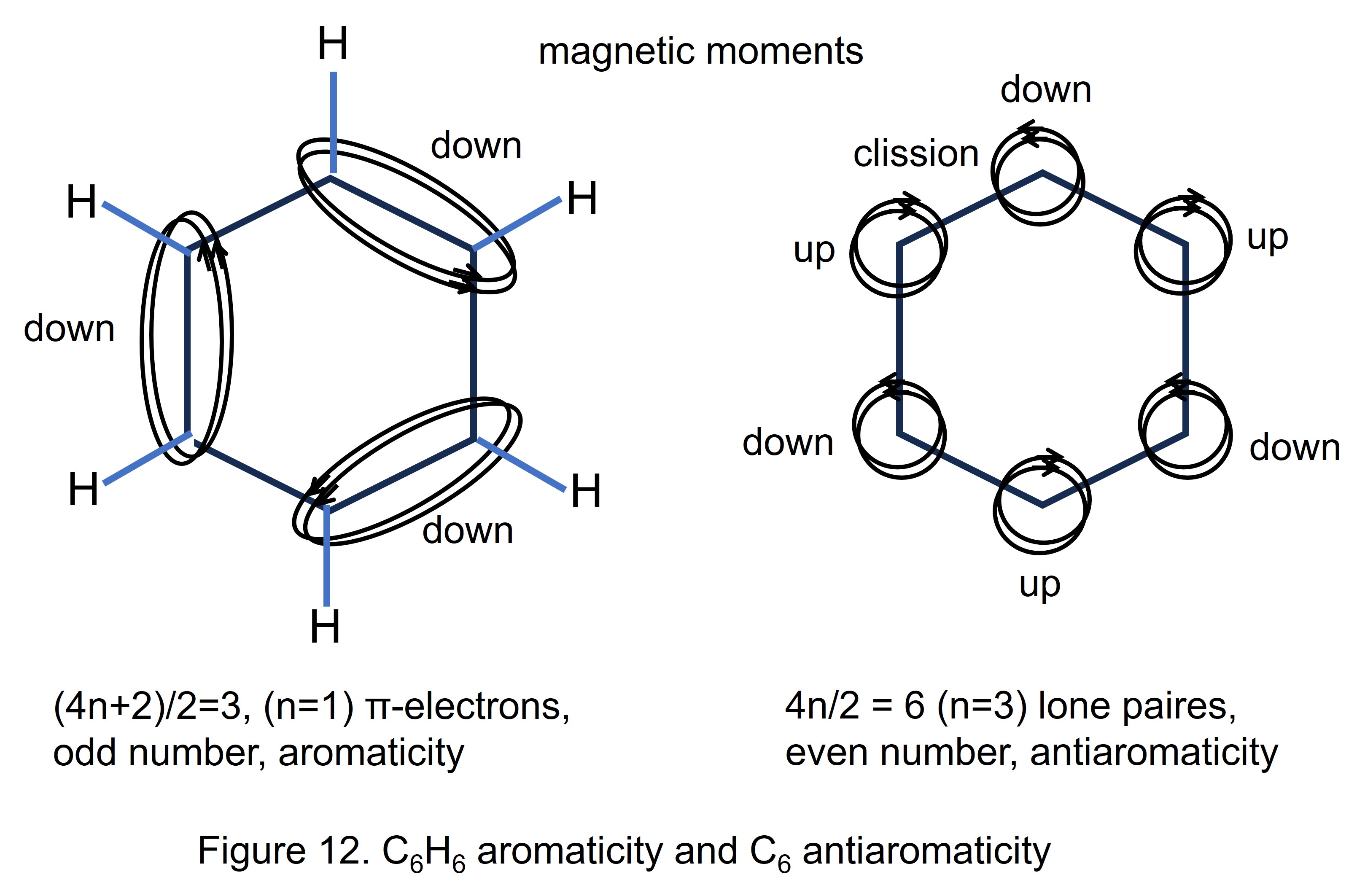
Figure 12 compares H6C6 (benzene) and C6. From the perspective of valence electrons, each carbon atom in benzene possesses one unpaired electron; the rearrangement of adjacent electrons forms three π-orbits. These six reactive electrons satisfy Hückel’s rule (4n + 2). In contrast, each carbon atom in the C6 ring possesses two unpaired electrons, forming six lone pairs. This configuration satisfies the antiaromatic electron count rule (4n) and C6 is extremely reactive. Why does the 4n+2 rule confer aromaticity upon a molecule, whereas the 4n rule results in highly unstable anti-aromaticity? Fundamentally, this is a question concerning electromagnetic properties—a fascinating fact, given that Michael Faraday, who first discovered benzene, made his greatest contributions to humanity in the field of electromagnetism. It is as if history has come full circle; two centuries later, our understanding of benzene has returned to its very origins—a truly remarkable coincidence of fate.
Both aromaticity and anti-aromaticity involve electron pairs with parallel spins (π-electrons or lone pairs of electrons). So, 4n+2 means odd number pairs and 4n means even number pairs. Two unpaired electrons with parallel spins rotating in π orbits, or lone pairs, can be thought of as tiny coils of wire. With an even number of double bonds, the magnetic moments of the tiny coils alternate in an antiparallel fashion to lower the energy of the system. At the same time, the magnetic field lines of all the tiny coils form a closed loop. Such an arrangement should be stable for small magnets and normal coils. However, the alternating arranged electron coils are very unstable. The spins and direction of the motion of the electrons in the orbits remain unchanged. Therefore, the adjacent π-electrons will collide during the stretching and compressing vibration of the atoms, making the system unstable. This is the origin of so-called antiaromaticity. With an odd number of electron pairs, tiny parallel coils always dominate, forcing adjacent coils to accept the same orientation. Magnetically speaking, this arrangement is metastable. But when a ring current and ring magnetic field are formed, the molecule is stable because the electron spins all point in the same direction and the electrons move in their respective orbits in a consistent manner.
Facit:
Aromaticity is related tightly with ring current and ring magnetic field. The paired electrons with anti-parallel spins are non-magnetic, for example, the covalent bond, usually called σ-bond. The σ-aromaticity reported in extensive literature likely refers to the ring current by solely lone pairs of electrons, (consisting of two parallel unpaired electrons with orbital magnetism). A lone pair of electrons is similar to π electrons, the difference being that they revolve around either one atomic core or two atomic cores. Ring currents arise from the continuous shifting of lone pairs and π-electrons, consistent with Kekulé theory. Aromaticity must satisfy Hückel’s 4n+2 rule. In this scenario, the magnetic moments of lone pairs and π-electrons align in the same direction, favoring the formation of a ring current. The σ-delocalization does not exist. Experimental evidence has never shown the numerous unpaired electrons in aromatic compounds undergoing delocalized motion; neither logic nor theory supports the concept of delocalization. When a group of electrons passes by positively charged atomic cores, the system becomes highly disordered and energetically unstable. This is a misconception within the theory of aromaticity that must be corrected.
References:
[1] Martin, J. C. and Schaad, L. J. (1990), Sigma-delocalized aromatic species formed from cyclic arrays of hypervalent main-group element species. Pure & Appl. Chem., 62(3), 547-550.
[2] Furukawa, S., Fujita, M., Kanatomi, Y. et al. (2018). Double aromaticity arising from σ- and π-rings. Commun. Chem., 1(60), 1-7.
[3] Chandrasekhar, J., Eluvathingal, D., Jemmis, E. D. and Schleyer, P. (1979). Double aromaticity: aromaticity in orthogonal planes. The 3,5-dehydrophenyl cation. Tetrahedron Letters, 20(39), 3707-3710.
[4] Boldyrev, A. I. and Kuznetsov, A. E. (2002). On the Resonance Energy in New All-Metal Aromatic Molecules. Inorg. Chem., 41(3), 532–537.
[5] Li, W. L., et al. (2012). Transition-Metal-Centered Nine-Membered Boron Rings: MⓒB9 and MⓒB9– (M = Rh, Ir). J. Am. Chem. Soc., 134(1),165-168.
[6] Đorđević, S., Poater, J., Solà, M., Radenković, S. (2025). Oxidation-induced double aromaticity in periodo-polycyclic hydrocarbons. Chem Sci., 16(22), 9920-9933.
[7] Poater, J., et al. (2023). Single-Not Double-3D-Aromaticity in an Oxidized Closo Icosahedral Dodecaiodo-Dodecaborate Cluster. J. Am. Chem. Soc., 145, 22527-22538.
[8] Wang, C. (2025). The Movement of Two Parallel Unpaired Electrons in Benzene and Aromatic Compounds. Adv Envi Man Rec, 8(3), 01-26.
[9] Zhang, X., Liu, G., Ganteför, G., Bowen, K. H., and Alexandrova, A. N. (2014). PtZnH5−, A σ‑Aromatic Cluster. J. Phys. Chem. Lett., 5, 1596-1601.
[10] Dhara, D., Endres, L., Souza, C., et al. (2025). A Neutral All-Aluminum Aromatic. ChemRxiv. https://doi.org/10.26434/chemrxiv-2025-hxz3v. Preprint.
[11] Hoffmann, R. (2015). The Many Guises of Aromaticity. Is hype debasing a core chemical concept? Am. Sci. 103(1),18-22.
Special focus on explaining properties in physics, chemistry and materials science from the perspective of electron behavior. Attach importance to experimental facts and strict chain of reasoning. Provide new insights into atomic structure and electrical and thermal conductivity. Discovered the nature of superconductivity. Found the root cause of the Hall effect. Proposed new structures for single bonds, double bonds and lone pairs of electrons. Re-understood the wave-particle duality. In-depth exploration of the roots of quantum phenomena.
My interest is to be a teacher and explain complex scientific knowledge in the simplest and most understandable way.
I have been doing instrumental analysis for many years, so I am familiar with various scientific analytical instruments both theoretically and practically. (TEM, SEM, AFM, STM, XPS, IR, NMR, WAXS, SAXS, EDX and so on.
