Amine‑Salt‑Assisted Solution Crystallization of Inorganic Perovskite Single Crystals for High‑Performance X‑Ray Detection
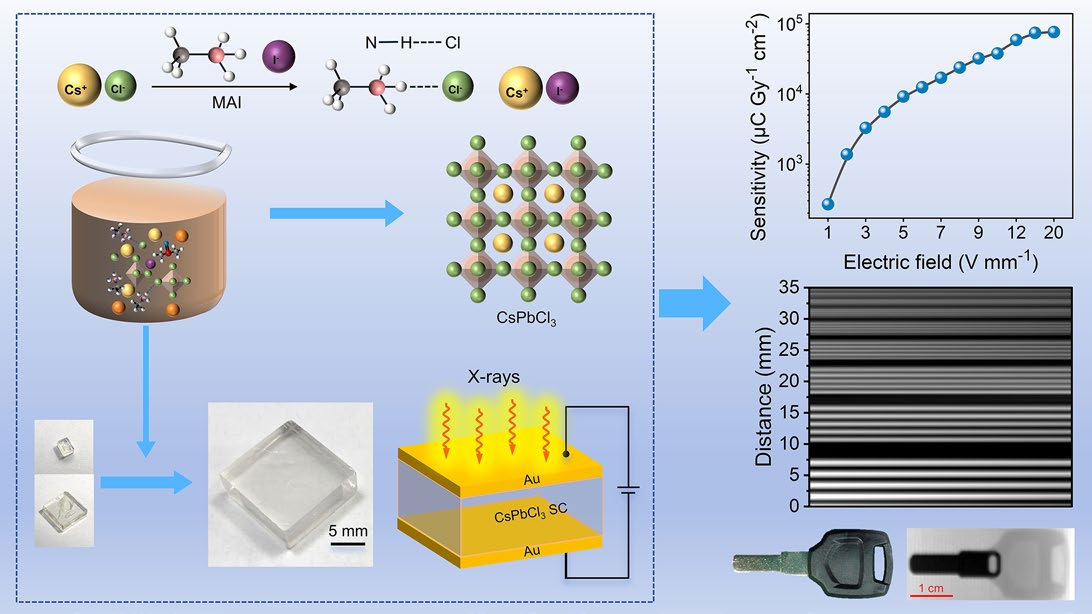

As the demand for high-resolution, low-dose X-ray imaging continues to grow, conventional scintillator-based detectors face limitations in sensitivity, stability, and spatial resolution. Now, researchers from Shaanxi Normal University, Soochow University, and the Dalian Institute of Chemical Physics (Chinese Academy of Sciences), led by Professor Yucheng Liu, Professor Yihui He, and Professor Shengzhong Frank Liu, have presented a breakthrough all-inorganic perovskite single crystal that bridges the gap between solution-processable materials and high-performance radiation detection.
Why This Single Crystal Matters
Traditional CsPbCl3 single crystals have been limited to sub-millimeter sizes due to the inherently low solubility of raw materials in organic solvents, preventing their practical application in X-ray detection. The novel amine-salt-assisted solution crystallization strategy overcomes this limitation by enabling the first-ever growth of centimeter-sized CsPbCl3 single crystals (up to 15 mm) at low temperatures (<120°C), combining solution-processable scalability with single-crystal-grade optoelectronic performance.
Innovative Design and Mechanism
The material is grown through an electrochemically induced transformation leveraging hydrogen bond interactions between organic amine salts (e.g., methylammonium iodide, MAI) and insoluble chloride inorganic salts. Molecular dynamics simulations reveal that its exceptional crystal quality originates from a unique 13-fold increase in precursor solubility—achieved by weakening the lattice energy of CsCl via N–H···Cl hydrogen bonding. The introduced I⁻ ions undergo anion exchange with Cl⁻, forming more soluble Cs⁺–I⁻ ion pairs, while the solvation effect of DMSO creates a high-concentration supersaturated solution that drives controlled crystallization. Notably, the externally introduced MA⁺ and I⁻ ions do not enter the final CsPbCl3 lattice, ensuring phase-pure crystal formation.
Outstanding Performance
The CsPbCl3 single crystals deliver a high carrier mobility-lifetime (μτ) product of 6.3 × 10⁻³ cm2 V-1, a low trap density of 2.9 × 1010 cm-3, and a large resistivity of 1.7 × 10⁹ Ω·cm. The material exhibits characteristic high-quality signatures: an XRD rocking curve FWHM of 0.052°, high optical transmittance, and a sharp photoluminescence peak at 421 nm with an FWHM of 6.72 nm. Notably, the crystals demonstrate superior thermal stability, with no decomposition until 880 K.
Applications and Future Outlook
When fabricated into X-ray detectors, the device achieves exceptional metrics: a record-high detection sensitivity of 76,624 μC Gy-1 cm-2 under low electric fields (20 V mm-1), a low detection limit of 47.9 nGy s-1, a short response time of 700 μs, and a spatial resolution of 5.78 lp mm-1. The detector maintains stable response output over 1000 seconds of continuous operation and retains 85% of its performance after 35 days in ambient air. This work establishes a new family of low-temperature solution-grown inorganic perovskite single crystals, opening promising avenues for next-generation radiation detection systems combining high safety, low-cost fabrication, and high-resolution imaging.
Stay tuned for more groundbreaking research from this collaborative team at Shaanxi Normal University, Soochow University, and the Dalian Institute of Chemical Physics!

Editor of Nano-Micro Letters, which is an Open-Access, peer-reviewed journal reported papers that have at least one dimension ranging from a few sub-nanometers to a few hundreds of micrometers. The journal is published by Springer Nature and indexed by SCI, EI, SCOPUS, Pubmed, etc. The 2025 JCR Impact Factor is 38.5. The 2025 CiteScore is 58.9.
Follow the Topic
-
Nano-Micro Letters
Nano-Micro Letters is a peer-reviewed, international, interdisciplinary and open-access journal that focus on science, experiments, engineering, technologies and applications of nano- or microscale structure and system in physics, chemistry, biology, material science, and pharmacy.



Please sign in or register for FREE
If you are a registered user on Research Communities by Springer Nature, please sign in