An Interdisciplinary ML Approach to Predict Corn Yield Under Biofertilizer Use: Uncovering Ecophysiological Secrets for Sustainable Farming
Published in Sustainability, Agricultural & Food Science, and Statistics
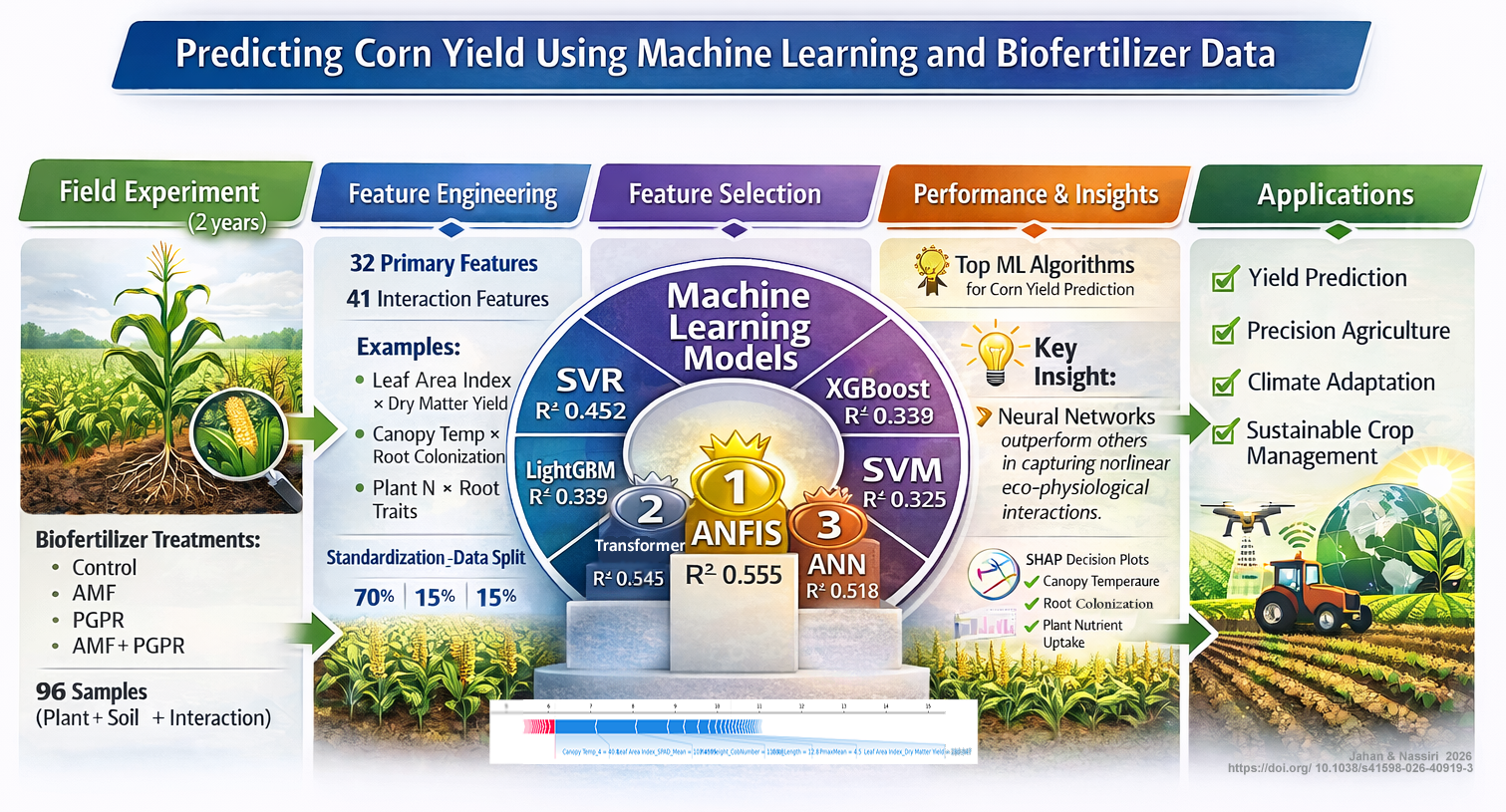
In the face of climate change, soil degradation, and rising food demand, optimizing corn production with sustainable inputs like arbuscular mycorrhizal fungi (AMF) and plant growth-promoting rhizobacteria (PGPR) is essential. This study integrates 73 plant-soil features—including 41 engineered interaction terms—with advanced machine learning to predict grain yield more accurately than traditional methods.
We compared eight algorithms and found that ANFIS (R² = 0.555), Transformer (R² = 0.545), and ANN (R² = 0.518) outperformed others, highlighting the power of neural networks and attention mechanisms in capturing nonlinear ecophysiological relationships. Key drivers include canopy temperature during critical stages, interactions like Leaf Area Index × Dry Matter Yield, and root colonization effects—revealing how biofertilizers enhance nutrient uptake, stress tolerance, and yield formation.
Using SHAP interpretations, partial dependence plots, and feature clustering, we uncover hidden pathways linking microbial symbiosis, photosynthesis efficiency, and final yield. This work advances precision agriculture, supports climate-resilient practices, and promotes input-efficient systems toward sustainable food security.
The full article is available here: https://doi.org/10.1038/s41598-026-40919-3

I focus on tackling unsustainability in food systems using ecosophy & ML for sustainable solutions. My work promotes a sociocultural-ecological shift, leveraging AI for predictive modeling and precision agriculture to enhance food security and resilience. Methods and Techniques: I integrate ecological knowledge & Python programming for optimized farming, and biodiversity. Ongoing Projects: I develop AI models to predict climate impacts on crops, optimize resource use via ML.
Follow the Topic
What are SDG Topics?
An introduction to Sustainable Development Goals (SDGs) Topics and their role in highlighting sustainable development research.
Continue reading announcement
Please sign in or register for FREE
If you are a registered user on Research Communities by Springer Nature, please sign in