Anion Chemistry: Structure, Electrochemistry and Stability of NASICON Cathodes
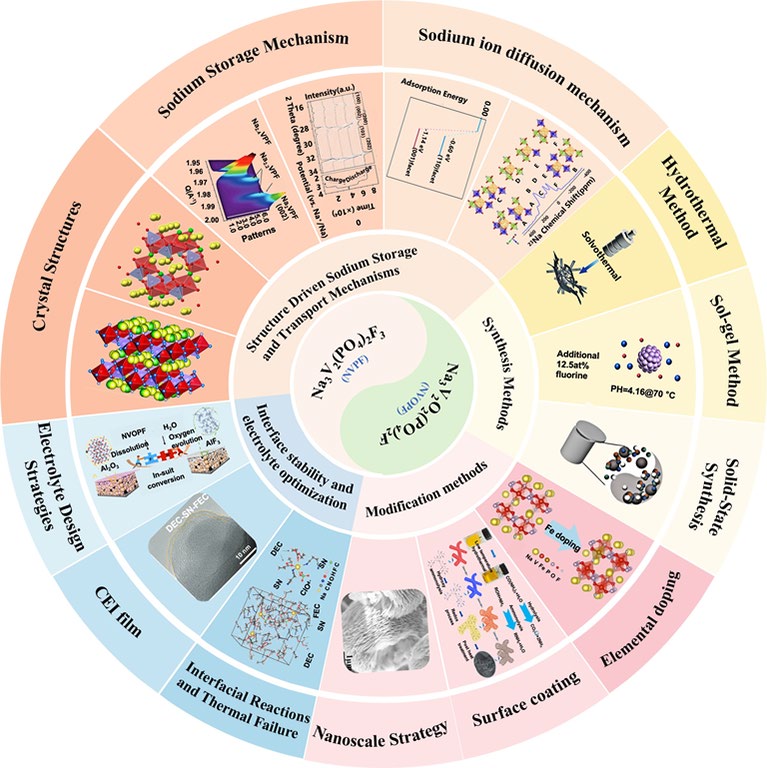

As the demand for large-scale energy storage driven by renewable energy integration continues to grow, sodium-ion batteries have emerged as a promising alternative to lithium-ion systems owing to the natural abundance, low cost, and wide geographical distribution of sodium resources. However, developing high-performance cathode materials that simultaneously achieve high operating voltages, rapid Na⁺ transport, and long-term structural stability remains a central challenge. Now, researchers from Zhejiang University, South China Normal University, and Zhejiang University-Quzhou, led by Professor Dongxu Yu, Professor Xueyan Zhang, Professor Shuangshuang Zhao, and Professor Liguang Wang, have presented a comprehensive review that decodes the anion chemistry of fluorophosphate NASICON cathodes—specifically Na3V2(PO4)2F3 (NVPF) and Na3V2O2(PO4)2F (NVOPF)—providing critical design guidelines for next-generation sodium-ion batteries.
Why This Comparison Matters
Traditional studies on fluorophosphate NASICON cathodes have typically investigated NVPF and NVOPF in isolation, leaving the fundamental structure–property relationships governed by subtle anion chemistry differences poorly understood. Although both materials share robust three-dimensional frameworks composed of corner-sharing MO6 octahedra and PO4 tetrahedra, the partial substitution of F⁻ by O2- in NVOPF fundamentally alters the vanadium coordination environment, electronic conductivity, and Na⁺ diffusion kinetics. This review overcomes this knowledge gap by systematically comparing their crystal structures, sodium storage mechanisms, synthesis strategies, and interfacial degradation pathways, establishing a unified framework for rational cathode design.
Innovative Design and Mechanism
The review reveals that NVPF crystallizes in the P42/mnm space group with [V2O8F3] dioctahedra, where the strong inductive effect of highly electronegative F⁻ elevates the V³⁺/V⁴⁺ redox potential to ~4.1 V. However, the ordered Na⁺ arrangement induces multiple phase transitions and limits diffusion kinetics. In contrast, NVOPF adopts the I4/mmm space group with [VO5F] mixed-coordinated octahedra; partial O2- substitution lowers the operating voltage to ~3.8 V but enhances electronic conductivity via π-electron delocalization of the V=O bond and suppresses intermediate-phase transitions through Na⁺ site disorder, transforming the sodium storage mechanism from a multiphase reaction to a solid-solution behavior. Monte Carlo simulations and DFT calculations further elucidate that NVPF relies on anisotropic (002) plane-mediated Na⁺ diffusion with a migration barrier of 0.43 eV, whereas NVOPF features an intrinsic "ion highway" within the ab-plane with exceptionally low barriers of 0.15–0.31 eV. These mechanistic insights demonstrate that anion chemistry is not merely structural scaffolding but a pivotal regulator of bulk electronic structure, ionic transport channels, and surface/interface reaction kinetics.
Outstanding Performance and Synthesis Strategies
The review critically evaluates synthesis and modification strategies to bridge the gap between laboratory performance and industrial application. Hydrothermal and solvothermal methods enable precise morphological control—from hollow nanospheres to nanoflower architectures—while solid-state mechanochemical synthesis has demonstrated kilogram-scale feasibility for NVOPF at room temperature. Surface carbon coating (amorphous and crystalline) and elemental doping (Na-site, V-site, and anion-site) have proven effective in enhancing electronic conductivity and stabilizing the crystal structure. For instance, Fe-doped NVPF reduces the bandgap and introduces an intermediate-phase buffer layer, while Mn/Cr co-doped NVOPF drastically narrows the bandgap from 2.15 eV to 0.12 eV, delivering 87 mAh g-1 at 20C. Notably, Li-doped NVPF disrupts ordered Na⁺/vacancy arrangements via electrostatic shielding, enabling 64.1% capacity retention over 30,000 cycles at 10C.
Applications and Future Outlook
Beyond bulk property optimization, the review provides the first comprehensive analysis of high-voltage interfacial stability. NVPF's high voltage (~4.1 V) exceeds the thermodynamic stability window of conventional carbonate electrolytes, triggering continuous oxidative CEI growth and impedance rise. Conversely, NVOPF's distinct anion chemistry promotes HF generation through F⁻ dissolution, causing cathode surface corrosion and vanadium loss. The authors analyze voltage-driven interfacial degradation mechanisms and highlight advanced electrolyte design strategies—including high-concentration ether electrolytes, nitrile-functionalized additives, and in-situ AlF₃-rich CEI formation—as transferable solutions for durable high-voltage operation. This work establishes a new paradigm of anion-coordination regulation for NASICON-type cathodes, offering promising avenues for sodium-ion batteries that combine high safety, fast charging, and high energy density.
Stay tuned for more groundbreaking research from this collaborative team at Zhejiang University, South China Normal University, and Zhejiang University-Quzhou!

Editor of Nano-Micro Letters, which is an Open-Access, peer-reviewed journal reported papers that have at least one dimension ranging from a few sub-nanometers to a few hundreds of micrometers. The journal is published by Springer Nature and indexed by SCI, EI, SCOPUS, Pubmed, etc. The 2025 JCR Impact Factor is 38.5. The 2025 CiteScore is 58.9.
Follow the Topic
-
Nano-Micro Letters
Nano-Micro Letters is a peer-reviewed, international, interdisciplinary and open-access journal that focus on science, experiments, engineering, technologies and applications of nano- or microscale structure and system in physics, chemistry, biology, material science, and pharmacy.