Could hedgehogs be the source of the next pandemic?
Published in Microbiology and Cell & Molecular Biology

For the study: Jin and Jefferson et al. 2026
Thousands of coronaviruses have been sequenced from wildlife sources over the past 20 years. Unfortunately, because we still know very little about how to isolate and grow most of these viruses, these discoveries are left as genetic sequences in GenBank. Which of these, if any, are capable of infecting humans, domestic animals, lead to pathological outcomes or can readily transmit between hosts?
Developing "MerbecoType" - a tool to study merbecoviruses
The first step to viral infection is entering the host's cells. Coronviruses are covered with a "spike" protein that binds to host cell receptors, allowing for the virus to enter the cells. More specifically, just a small portion of the spike protein called the "receptor binding domain" (RBD) interacts with the host cell receptor.
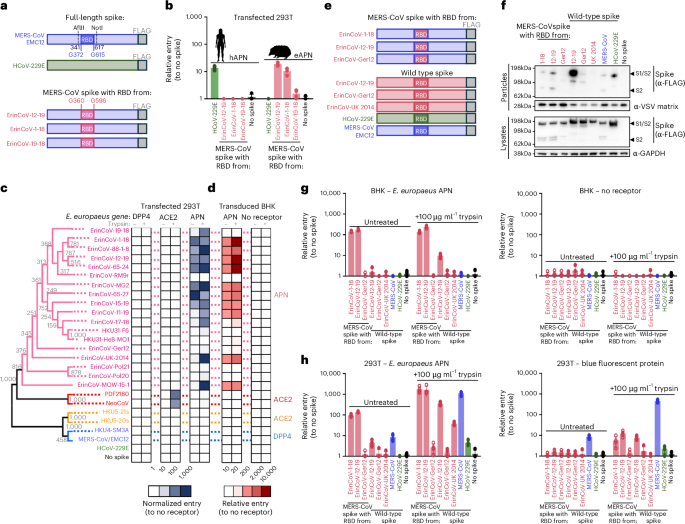
In 2022, we downloaded and compared every published merbecovirus spike sequence, focusing on the RBD region to generate a list of about 30 unique sequences representative of the global diversity of the sub-genus. At the time, another research group had shown the common sarbecovirus receptor, Angiotensin-converting enzyme 2 (ACE2), was also compatible with several merbecovirus spikes from viruses discovered in Africa, so our first merbecovirus entry screens included both ACE2 as well as the canonical receptor for MERS-CoV, Dipeptidyl peptidase-4 (DPP4). The results from these experiments provided an interesting new insight: the majority of wildlife merbecoviruses actually use ACE2 as a receptor, instead of DPP4. Curiously, a large cluster of genetically related merbecoviruses found in hedgehogs across Europe and Asia, we called "clade 4 merbecovirus RBDs," did not seem to use either ACE2 or DPP4. These viruses were first identified in 2012 and had since been largely characterized through ecological studies showing their high prevalence in wild hedgehogs, unusually long duration of viral shedding and - similar to viruses in bats - lack of pathology in their hosts.
Finding a new-old receptor for hedgehog coronaviruses and building a dream team
The list of receptor molecules and other cell entry factors identified, to date, for coronaviruses, is relatively short. ACE2 and DPP4 were the predominant betacoronavirus receptors, while alphacoroanviruses, the genus that includes several common cold viruses, had largely been shown to use ACE2 or Aminopeptidase N (APN). These molecules are all widely conserved across vertebrates and are expressed in a variety of tissues, including the natural infection sites for coronaviruses: respiratory and gastrointestinal tracts.
In June 2024, after completing our first merbecovirus entry study on the HKU5-complex of ACE2-dependent viruses, our focus turned back to the curious "clade 4" merbecoviruses from hedgehogs. Because APN was one of the few known coronavirus receptors, we cloned the ortholog of this gene from hedgehogs and ran it through our assays. Much to our surprise, several of the hedgehog RBDs seemed to infect cells expressing this molecule. We repeated the experiment with spikes from more hedgehog viruses and kept seeing the same phenotype, with multiple viruses clearly entering cells expressing hedgehog APN. Not all of the hedgehog spikes showed an entry phenotype though, which led us on a long series of experiments over several months trying to understand the difference between the hedgehog RBDs that could infect with APN from those that could not. At the same time, we began reaching out to collaborators to help with this project: James Rini's structural biology team at the University of Toronto specializing in APN-coronavirus interactions , Craig Wilen's team at Yale University specializing in "receptor zoos" (large panels of receptor orthologs from different species), Ralph Baric's team at the University of North Carolina for coronavirus replication studies, Ana Moreno's team at the Istituto Zooprofilattico Sperimentale della Lombardia ed Emilia Romagna (ISZLER), who performed many of the ecological studies that identified hedgehog coronaviruses in Italy, and Barbara Han's team at the Cary Institute in New York to help us perform in-depth, machine-learning approaches to sequence analysis. Shortly into the collaboration, the Rini lab informed us of some protein stability issues that were leading to protein aggregation in a few of their experiments. Therefore, we wondered if perhaps spike instability was interfering with our entry assays. To bypass this stability issue, we tried inverting our entry assay: rather than infect cells expressing receptor with particles containing spike, we would infect cells expressing spike with particles containing receptor. We reasoned that the cell membrane undergoes more frequent protein turnover, so potentially misfolded or unstable spikes would have the chance to be replaced with new, fresh spike protein brought to the cell surface. This approach worked surprisingly well and we were able to quickly confirm that ALL of the hedgehog coronaviruses could interact with APN. As it turns out, there were no "APN-independent" hedgehog coronavirus spikes.
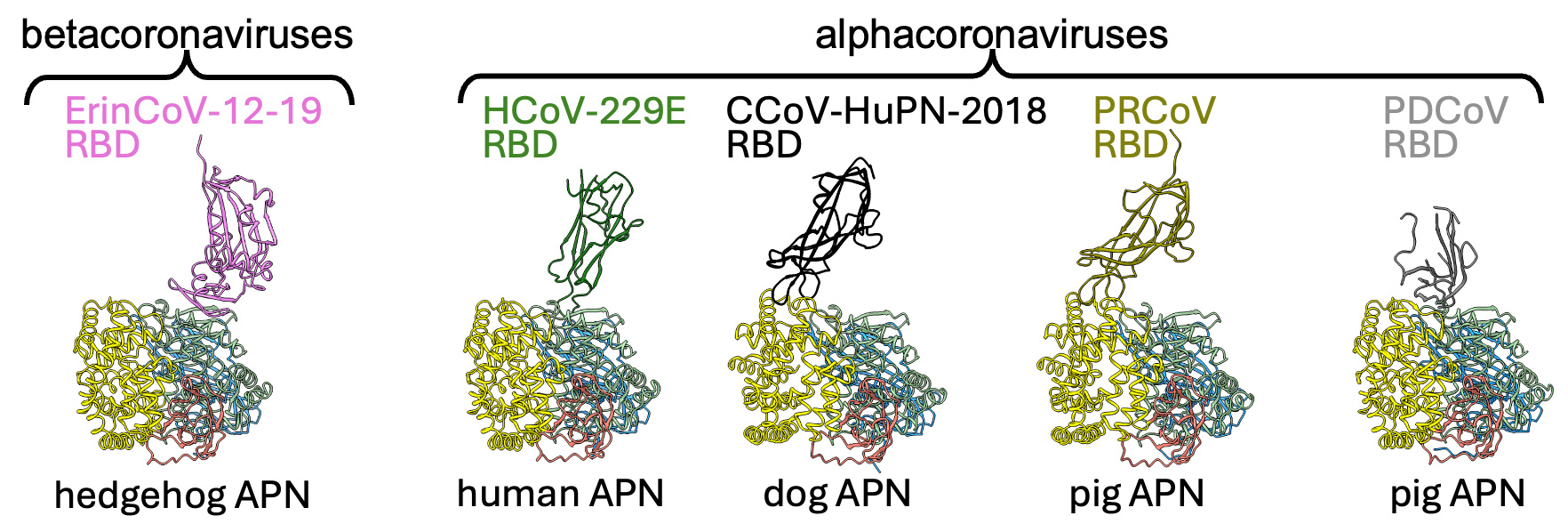
Cryo-EM co-structure data from the Rini lab shows ErinCoVs interact with host APN using a different interface from other coronaviruses, suggesting convergent evolution on this host receptor.
Fun exploration
Besides the "reverse" entry assay, this project allowed for other fun exploratory approaches. The temperature of a hedgehog is never 37ºC, but instead ranges from under 10ºC during hibernation to about 35ºC during the warmer months. Decades of research has shown that coronaviruses can acutely adapt to their environment, with viruses that infect the cooler upper respiratory tract of humans replicating better at cooler temperatures around 33ºC, while viruses that infect the lower respiratory tract replicate more efficiently at higher temperatures closer to 37ºC. In agreement with this notion, we found that that hedgehog coronavirus spikes were also more infectious when produced at 33ºC rather than 37ºC.
Species barriers holding back the hedgehog coronaviruses
When the Wilen lab screened APN from 30 different species, we were surprised to see the hedgehog coronaviruses could only infect cells expressing this receptor from a handful of species: cats, rats and elephant shrews. Thankfully, human APN did not permit viral entry, suggesting the hedgehog coronaviruses discovered across Europe and Asia pose a low risk of transmission to humans. Using our new co-structural data of the hedgehog RBD : APN interface, we were able to determine why so many species from the APN zoo screening experiment were incompatible with hedgehog viruses. APN from different species seemed to have different incompatibilities in the interface with the hedgehog coronavirus spikes. Mutating the APN from some of these species allowed us to experimentally demonstrate a number of barriers at the interface across different species. For now, it seems, the hedgehog coronaviruses are largely confined to their own species, however given the close interactions between many of these species and wild hedgehogs, this may be subject to change.
New transmission events on the horizon
While the hedgehog merbecoviruses currently identified in the literature seem remarkably species restricted. A new study from Ana Moreno and a team of researchers in Italy has identified hedgehog coronaviruses in other wildlife. Another study has also found hedgehog coronaviruses in pet hedgehogs, which are yet another species distinct from wild European and Asian hedgehogs. Thus, while our study allowed us to more confidently assert that current hedgehog viruses are less likely to transmit between species, the environment is always changing, viruses are always adapting and unforeseen transmission events always remain a possibility.
Check out the full manuscript at:

Follow the Topic
-
Nature Microbiology
An online-only monthly journal interested in all aspects of microorganisms, be it their evolution, physiology and cell biology; their interactions with each other, with a host or with an environment; or their societal significance.