Beyond the Naked Eye: 5 Ways AI is Rewriting the Laws of Scientific Discovery
Published in Computational Sciences
1. The End of the "Human Only" Lab: The 80/15/5 Workforce:
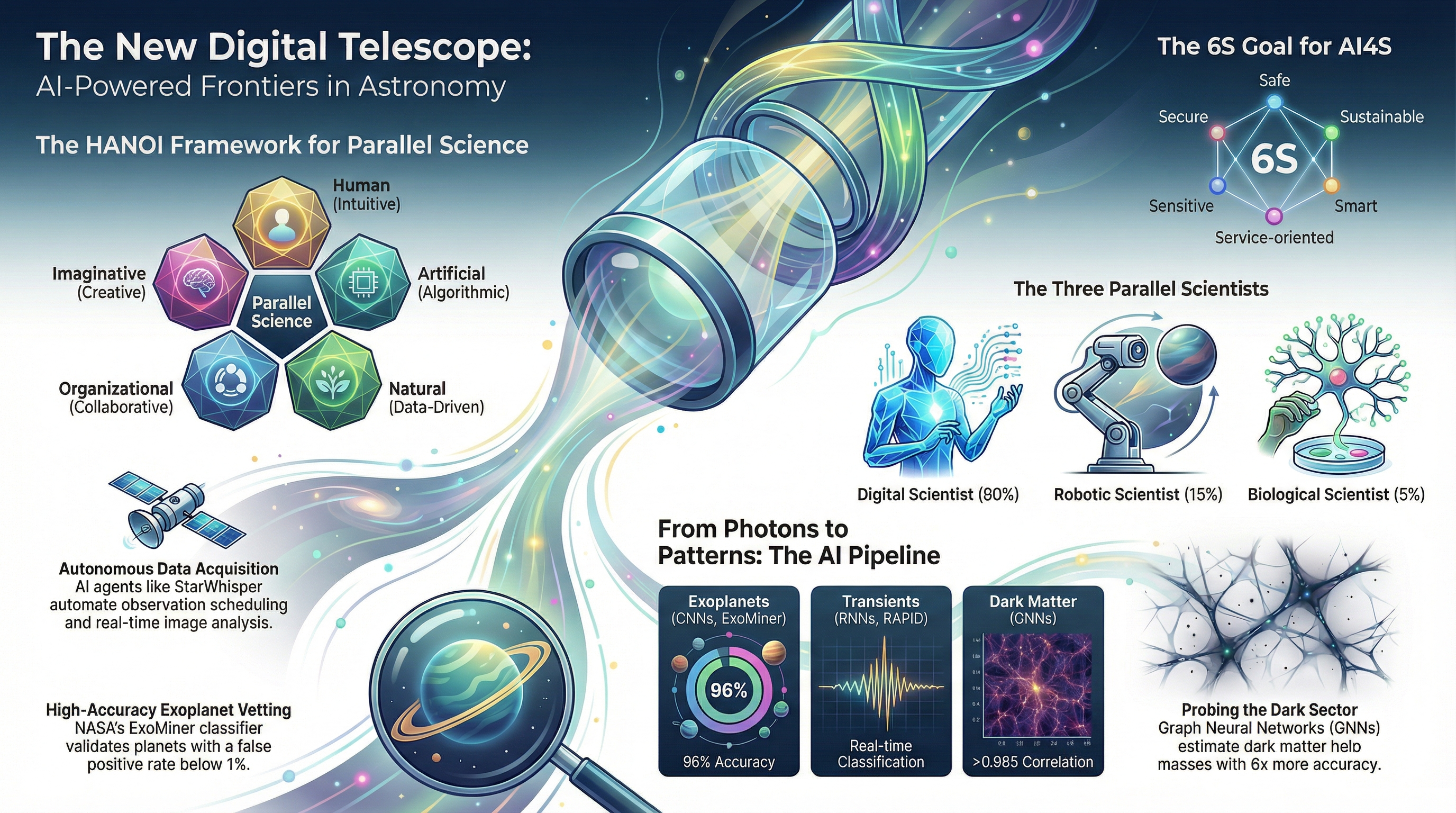
While the technological changes in the contemporary laboratory environment are considerable, the greatest shift has happened at the level of the personnel. We are witnessing the emergence of a new "Three Worlds, Three Scientists" paradigm in which the drudgery of information creation is taken care of by silicon. The future lab works according to an extreme 80/15/5 principle:
- Digital Scientists (80+%): Autonomous agents and big models of machine learning take care of the majority of data processing, experimentation, and information dissemination tasks.
- Robotic Scientists (less than 15%): These beings perform the physical work of the scientists - either risky experiments or the synthesis of materials in an "autonomous driving lab" such as the A-lab.
- Biological Scientists (less than 5%): Human researchers are promoted to the position of high-level supervisors and intuitive guides.
Such an integration of knowledge and capacities forms what researchers call HANOI - a combination of Human, Artificial, Natural, Organizational, and Imaginative intelligence. It is important to highlight the last aspect of intelligence; it means that AI can participate not only in calculating tasks but in human imagination processes as well.
2. The Silicon Mathematician: Cracking Stagnant Equations of the 20th Century
Mathematics and algorithms are advancing today at a speed beyond the capacity of human thinking. The current capabilities of artificial intelligence prove that silicon can do things elegantly which human beings have considered too complicated over decades.
Recently, AlphaDev made a sensational discovery of a sorting algorithm that is 70% more effective than the ones developed by humans throughout half a century. What is more impressive about it, this was possible thanks to AlphaDev discovering new assembly instructions - efficiency in the machine’s "nervous system" not seen before by any human programmer. In a similar way, AlphaTensor discovered new algorithms for matrix multiplication - the foundation stone of contemporary computing through deep reinforcement learning.
In the field of logic, AlphaGeometry is already on the level of an International Mathematical Olympiad (IMO) gold medalist. It uses a neuro-symbolic method – combining neural language model’s intuition and a symbolic engine’s logical reasoning. Without a single demonstration by any human being, AlphaGeometry navigates through infinite branching points and proves its way to the truth.
3. Identifying "Unknown Unknowns" Using Unsupervised Learning Techniques
Conventionally, science had been the process of looking for something particular. AI is revolutionizing this aspect by becoming an engine of "Anomaly Detection," that is, something whose existence we never thought of in the first place.
By using the technique of unsupervised learning to find structures within unlabelled data, AI becomes capable of discovering new structures, such as unknown stellar streams in our galaxy, without the need for a template of "a stream." The famous example of this use is called the ROAD (Radio Observatory Anomaly Detector), which when applied to the data collected from LOFAR telescope, finds solar storms or electronics malfunctions with F-2 score of 0.92.
4. The Parallel Workflow: A “New” Day of Research
The workflow of tomorrow’s scientist is divided into three separate operational modes, according to the daily cycle of 24 hours of automatic and guided activity. This is a “new day” of parallel research.
|
Mode
|
Name
|
Duration/Intensity
|
Role of Biological Scientists
|
|---|---|---|---|
|
AM
|
Autonomous Mode
|
20+ Hours
|
Supervisory Only; Digital/Robotic scientists complete the bulk of R&D.
|
|
PM
|
Parallel Mode
|
< 3 Hours
|
Remote Support; Guidance provided via cloud or virtual interfaces.
|
|
EM
|
Expert/Emergency Mode
|
< 1 Hour
|
On-site physical execution; Humans act as the main body for critical tasks.
|
5. Parallel Intelligence: AI as "World Model"
The transition to AI is shifting away from the use of AI and towards its application in a "World Model" inspired by Karl Popper's Three Worlds model. In his philosophy, World 1 is physical and World 2 is mental, while World 3 is the Artificial World or the objective world of recorded knowledge and theory.
With the help of Cyber-Physical-Social Systems (CPSS), the AI generates a working environment in cyberspace which serves as a test-bed of reality. As a result, the phenomenon of "Parallel Science" is achieved, and it enables us to conduct "counterfactual experiments" which are not possible in the physical realm. One such example is the "Foundation Models" like AstroCLIP, which is trained on a petabyte of data gathered by surveys like DESI and LSST. The model generates a general representation of the Universe which makes it possible to achieve "few-shot learning", wherein a scientist can detect a rare cosmic phenomenon with a few examples.
In other words, the new stage of development will bring about the future of "Science of SCE+": a world which is Slow, Casual, Enjoy, Easy, and Elegant. Delegating 80% of the tedious work to digital scientists frees humans up for more elegant pursuits.
The Crisis of Interpretability and the Way Ahead
Regardless of these advancements, there is an eminent “Black Box” problem ahead of us. Deep Learning models can produce precise outputs, yet not show the reasoning behind them. And when it comes to the field of physics and understanding the laws of the universe, the absence of transparency poses an important problem. In addition to that, the huge carbon footprint of training such models on "Big Data" poses another issue.
The next step is creating Explainable AI models - accurate as well as understandable. With more and more of the process of discovery left to machines, we are facing one crucial philosophical question:
If the AI finds the new physical law yet cannot show the reasoning behind it to us, did we discover anything at all?