Bioenergetic Coherence and Environmental Modulators
Published in Physics, Cell & Molecular Biology, and Anatomy & Physiology
Explore the Research
OSF
Environmental Modulation of Bioenergetic Coherence: Light, Oxygenation and Circadian Regulation
Carlos J. Pérez Pulido
ISHEA Institute · 2026
Data repository: https://doi.org/10.17605/OSF.IO/YSUWD
Summary
Cellular energy systems operate within tightly regulated biochemical constraints. Emerging evidence from chronobiology, photobiology, and mitochondrial physiology suggests that environmental inputs—particularly light exposure, circadian alignment, and oxygen availability—may influence systemic bioenergetic organization.
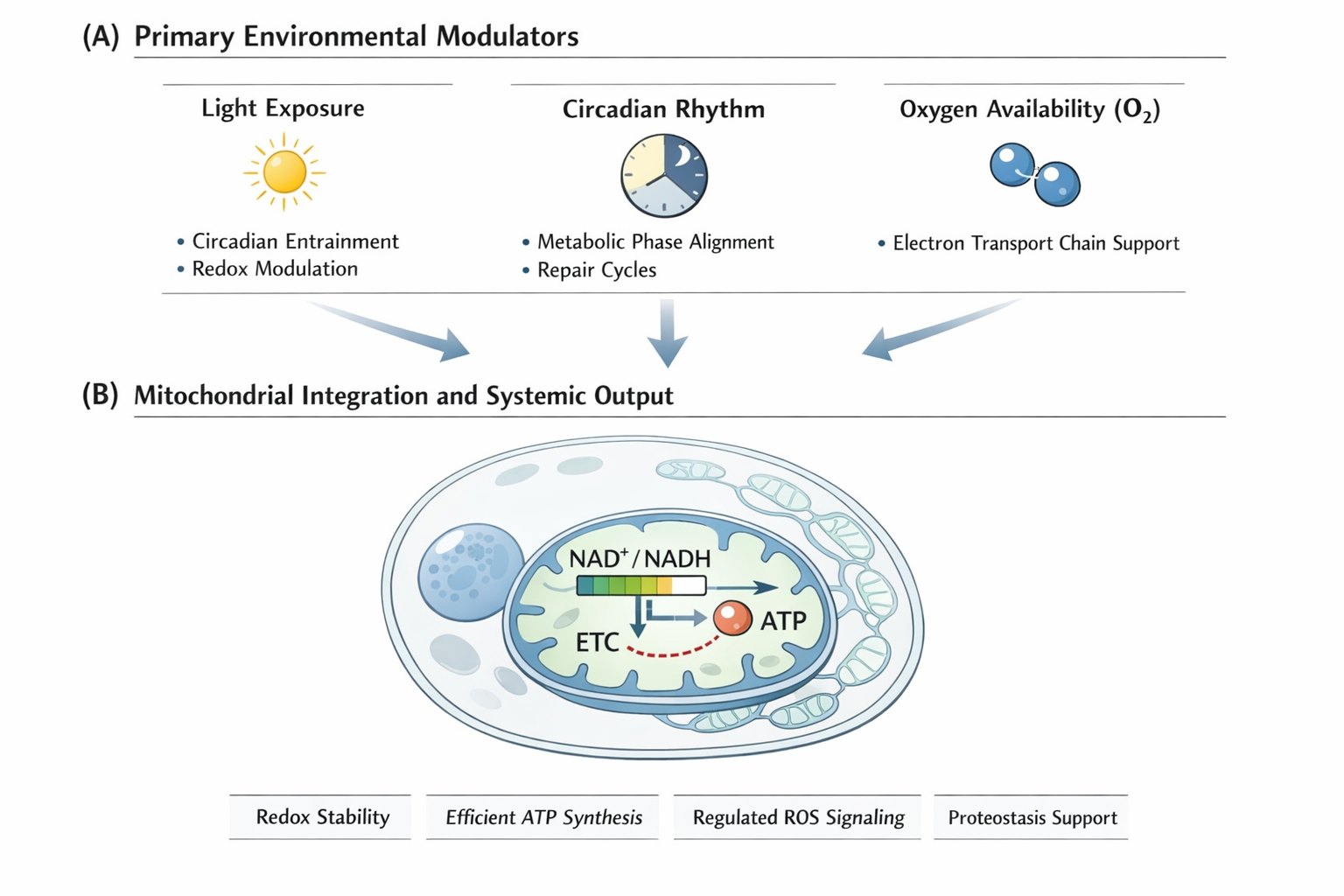
This conceptual framework proposes that these inputs converge on a common functional outcome: bioenergetic coherence, defined as the coordinated regulation of redox balance (NAD⁺/NADH), ATP production, and reactive oxygen species (ROS) signaling.
Main Text
Snowflake symmetry reflects highly ordered molecular interactions within an ice lattice. While structurally distinct from living systems, this phenomenon illustrates how environmental conditions shape organized patterns. In biological systems, cellular function similarly depends on coordinated energetic processes rather than isolated molecular events.
Light and Redox Regulation
Natural light exposure entrains circadian rhythms through retinal and hypothalamic signaling pathways. Circadian regulation influences mitochondrial metabolism, including oscillations in NAD⁺ availability and redox state.
Experimental studies suggest that photobiomodulation (e.g., red-light exposure) may enhance local mitochondrial efficiency under specific conditions. However, localized interventions do not replace systemic circadian entrainment, which integrates hormonal, metabolic, and transcriptional cycles across tissues.
Rather than acting as a direct energy source, environmental light appears to function as a regulatory signal modulating metabolic timing and redox coordination.
Circadian Organization
Circadian rhythms represent a conserved evolutionary adaptation that temporally segregates metabolic activation and cellular repair processes.
Day-phase metabolism generally favors energy production and nutrient processing, whereas nighttime physiology supports repair, autophagy, and mitochondrial quality control. Epidemiological studies have associated circadian disruption—such as chronic exposure to artificial light at night or shift work—with increased risk of metabolic and cardiovascular disorders.
While mechanisms remain under investigation, these associations are consistent with the hypothesis that temporal misalignment may impair coordinated bioenergetic regulation.
Outdoor Exposure and Oxygenation
Time spent outdoors has been associated with improved cardiovascular parameters, reduced stress markers, and lower systemic inflammation in several cohort studies. Multiple mechanisms may contribute, including physical activity, light exposure, psychological effects, and air quality.
Oxygen availability remains central to mitochondrial oxidative phosphorylation. Impaired pulmonary function or chronic exposure to tobacco smoke has been shown to alter mitochondrial dynamics, increase ROS production, and affect ATP synthesis efficiency.
These findings suggest that effective oxygen utilization, rather than mere exposure to outdoor environments, is critical for maintaining metabolic stability.
Integration: The ISHEA-Bio Perspective
Within the ISHEA-Bio framework, environmental inputs are interpreted as modulators of energetic coordination rather than isolated variables.
When light exposure, circadian timing, and oxygen availability are aligned, cellular systems may maintain:
- Balanced NAD⁺/NADH ratios
- Regulated ROS signaling
- Efficient ATP production
- Proper protein folding and repair dynamics
Disruption of one or more inputs may contribute to redox imbalance and metabolic inefficiency. Importantly, this framework does not replace established mechanisms in chronobiology, pulmonology, or mitochondrial physiology; instead, it proposes a unifying energetic lens through which these disciplines can be integrated.
Implications
This perspective generates testable hypotheses:
- Does circadian alignment improve measurable NAD⁺ oscillation amplitude?
- Can combined light-oxygen interventions enhance mitochondrial efficiency more effectively than isolated strategies?
- Are markers of redox balance predictive of systemic resilience?
Future experimental and longitudinal studies are required to evaluate these questions rigorously.
Data Availability
Supporting conceptual documentation and datasets associated with this framework are available at:
https://doi.org/10.17605/OSF.IO/YSUWD

Carlos J. Pérez Pulido (writes as C.J. Pérez Pulido)
Research | ISHEA Institute
Italy
C.J. Pérez Pulido
ISHEA Institute – International System for Human–Ecological Advancement
The ISHEA Institute is an international research center dedicated to developing scientific, economic, and bioenergetic models based on informational coherence, sustainability, and human resilience.
Its mission is to integrate science, technology, and consciousness within a unified framework of civilizational progress known as the ISHEA Unified Framework, which operates across three main levels:
- ISHEA–MACRO: Coherence models applied to nations, economies, and governance systems.
- ISHEA–MESO: Applications in enterprises, energy systems, cognitive economics, and organizational innovation.
- ISHEA–MICRO: Advanced research in biology, physics, AI, and consciousness through modules such as ISHEA–BIO, ISHEA–TOE, and the HALO Reactor System.
The Institute promotes interdisciplinary research connecting quantum physics, neurobiology, behavioral psychology, regenerative energy, and human welfare policy to design new indicators, technologies, and sustainable development models.
Core Research Lines
- ISHEA Index (Expanded Human Satisfaction Index) — a next-generation alternative to GDP.
- ISHEA Unified Principle — a universal model of coherence and informational balance.
- HALO Reactor System — coherent-energy generation and transformation technology.
- ISHEA–BIO Framework — correlation between ATP, FOXP, cortisol, and bioenergetic coherence.
- K-Model — formal system for Knowledge Density & Flow across cognitive and economic structures.
Professional Overview
Carlos J. Pérez Pulido is an internationalist, researcher, and theorist specializing in human–ecological systems, cognitive economics, and coherence-based energy models.
As Director of Research at ISHEA Institute, he leads the integration of scientific and systemic knowledge under the ISHEA Unified Framework, bridging physics, biology, economics, and applied system design.
He is the author of:
- Biophysics: The Limit of Humanity — exploring bioenergetic coherence and systemic limits.
- Inverted Economy — introducing the K-Model for sustainable value creation and post-scarcity dynamics.
His work connects biological, cognitive, and energetic processes to redefine how humanity measures, sustains, and evolves collective progress.
Official Registrations
- DOI (ISHEA–TOE): 10.17605/OSF.IO/BC5JH
- Patamu Registration: N° 272381-132
- Contact: Iinfo@isheainstitute.org
Online Profiles
- Website: isheainstitute.org
- LinkedIn Profile: Carlos J. Pérez Pulido
- ORCID : 0009-0004-1822-4798
Research Focus
- Bioenergetic coherence and neural function (ATP, FOXP, cortisol)
- Human systems strategy and performance optimization
- Cognitive economics and organizational resilience
- Energy-driven multi-scale system modeling
- Economy 5.0 and post-growth frameworks
Mission
“I design frameworks that help leaders understand how human systems function, how they degrade, and how they can be redesigned for stability, resilience, and long-term performance.”
Open to high-level advisory, strategic collaborations, and global initiatives focused on human energy, system design, and sustainable development.


