Integrating Planetary Energy Flows, Solar Cycles, and Biosystem Dynamics
Published in Earth & Environment and Physics

Integrating Planetary Energy Flows, Solar Cycles, and Biosystem Dynamics
Perez Pulido, C.J. · ISHEA Institute · Nature Communities Post · February 2026
DOI: 10.17605/OSF.IO/GY83R
ISHEA Institute – Universal Coherence Division
The Question
How do solar energetic cycles propagate through the planetary system — from the magnetosphere through the stratosphere to biological energy systems — and can a unified index track this cascade?
The Gleissberg Solar Cycle (~80–100 year periodicity) is currently in an elevated phase. Solar Cycle 25 shows higher-than-predicted activity. This sustained energetic perturbation affects the planetary system at all scales, from magnetospheric particle flux to stratospheric chemistry.
The Halo Zone framework bridges these scales using the Planetary Energy Flow Index (PEFI) as an integrative metric.
The Halo Zone Framework
The Halo Zone is the analytical layer connecting planetary-scale energy monitoring to biosystem-level dynamics. It integrates four classes of publicly available satellite data:
| Layer | Variables | Sources |
|---|---|---|
| Space weather | Proton flux (>35, >70, >140 MeV), Electron flux (>30, >100, >300 keV) | NOAA-POES, GOES, CSES |
| Stratospheric chemistry | O3, NOx, HOx concentrations by altitude | Aura/MLS, OMPS |
| Atmospheric dynamics | Stratospheric temperature, jet stream velocity | ERA5 Reanalysis |
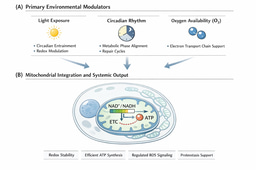
| Biosystem response | Mitochondrial ATP flux, O2 consumption, proton gradient | MIT OpenCell, Human Protein Atlas, NCBI |
The total energetic perturbation is expressed as:
\Delta E_\text{total} = \Delta E_\text{part} + \Delta E_\text{thermal} + \Delta E_\text{chem} + \Delta E_\text{kin}
Transparency: PEFI applies internal weights to these components. Weights are proprietary, but all input variables, formulas, and raw datasets are fully public and replicable up to the weighting stage.
What the Data Shows
-
Proton flux dominates — consistently
Sensitivity analysis (+-10% to +-20%) places proton flux as the dominant driver of PEFI at 48% sensitivity. Electron flux is second at 28%.
| Variable | Sensitivity (% ΔPEFI per % change) |
|---|---|
| Proton Flux (>35 MeV) | 48% |
| Electron Flux | 28% |
| O3 Concentration | 15% |
| Jet Stream Velocity | 9% |
-
The South Atlantic Anomaly (SAA) is contracting
- 2019: 7.25 × 10⁶ km²
- 2024: 6.80 × 10⁶ km²
- Δ: -0.45 × 10⁶ km² over 5 years
This is consistent with ongoing geomagnetic evolution during Solar Cycle 25.
-
Stratospheric chemistry responds to particle flux
- Electron flux >300 keV correlates with Δ−1 events: stratospheric warmings, jet stream undulations, Arctic air descents.
- O3 depletion: −15%; NOx increase: +10%
- Supports literature on energetic particle precipitation effects (Sinnhuber et al., 2012).
-
Exploratory bioenergetic correlation
- BioFlow_index integrates normalized mitochondrial ATP flux, O2 consumption, and proton gradient.
- Shows co-variation with PEFI across 2019–2024.
- Hypothesis-generating; causal direction not established.
Why This Matters
- Atmospheric science: PEFI could complement dynamical models for extreme event detection.
- Biology & medicine: Planetary energetic cycles might modulate cellular energy efficiency; timing interventions with high-coherence periods is testable.
- Planetary management: Interventions should work with natural energy flows, not against them.
The Gleissberg Cycle elevated phase provides a ~50-year window of increased solar energy. The question: restoration or suppression?
Open Questions for the Community
- Which observational proxies best capture energetic particle precipitation effects on stratospheric ozone?
- Can the BioFlow-PEFI correlation be replicated using alternative normalization protocols?
- How does the Halo Zone framework compare to planetary boundary frameworks?
- What prospective validation design is most convincing for the biosystem correlation?
Next Steps
- Prospective validation of PEFI during Solar Cycle 25 peak (2025–2027)
- Independent replication of BioFlow-PEFI correlation using public datasets
- Integration with Vortex prediction framework (DOI)
- Extension to ecosystem respiration data (FLUXNET) for planetary-scale bioenergetic analysis
Resources
- Main paper: DOI 10.17605/OSF.IO/GY83R
- Parent project (Gleissberg Cycle): DOI 10.17605/OSF.IO/7YAV2
- Related – Polar Vortex framework: DOI 10.17605/OSF.IO/NV8ZW
- ISHEA program overview: DOI 10.17605/OSF.IO/JBNGT
Perez Pulido, C.J. · ISHEA Institute · February 2026
DOI: 10.17605/OSF.IO/GY83R
isheainstitute.org@gmail.com

Carlos J. Pérez Pulido (writes as C.J. Pérez Pulido)
Research | ISHEA Institute
Italy
C.J. Pérez Pulido
ISHEA Institute – International System for Human–Ecological Advancement
The ISHEA Institute is an international research center dedicated to developing scientific, economic, and bioenergetic models based on informational coherence, sustainability, and human resilience.
Its mission is to integrate science, technology, and consciousness within a unified framework of civilizational progress known as the ISHEA Unified Framework, which operates across three main levels:
- ISHEA–MACRO: Coherence models applied to nations, economies, and governance systems.
- ISHEA–MESO: Applications in enterprises, energy systems, cognitive economics, and organizational innovation.
- ISHEA–MICRO: Advanced research in biology, physics, AI, and consciousness through modules such as ISHEA–BIO, ISHEA–TOE, and the HALO Reactor System.
The Institute promotes interdisciplinary research connecting quantum physics, neurobiology, behavioral psychology, regenerative energy, and human welfare policy to design new indicators, technologies, and sustainable development models.
Core Research Lines
- ISHEA Index (Expanded Human Satisfaction Index) — a next-generation alternative to GDP.
- ISHEA Unified Principle — a universal model of coherence and informational balance.
- HALO Reactor System — coherent-energy generation and transformation technology.
- ISHEA–BIO Framework — correlation between ATP, FOXP, cortisol, and bioenergetic coherence.
- K-Model — formal system for Knowledge Density & Flow across cognitive and economic structures.
Professional Overview
Carlos J. Pérez Pulido is an internationalist, researcher, and theorist specializing in human–ecological systems, cognitive economics, and coherence-based energy models.
As Director of Research at ISHEA Institute, he leads the integration of scientific and systemic knowledge under the ISHEA Unified Framework, bridging physics, biology, economics, and applied system design.
He is the author of:
- Biophysics: The Limit of Humanity — exploring bioenergetic coherence and systemic limits.
- Inverted Economy — introducing the K-Model for sustainable value creation and post-scarcity dynamics.
His work connects biological, cognitive, and energetic processes to redefine how humanity measures, sustains, and evolves collective progress.
Official Registrations
- DOI (ISHEA–TOE): 10.17605/OSF.IO/BC5JH
- Patamu Registration: N° 272381-132
- Contact: Iinfo@isheainstitute.org
Online Profiles
- Website: isheainstitute.org
- LinkedIn Profile: Carlos J. Pérez Pulido
- ORCID : 0009-0004-1822-4798
Research Focus
- Bioenergetic coherence and neural function (ATP, FOXP, cortisol)
- Human systems strategy and performance optimization
- Cognitive economics and organizational resilience
- Energy-driven multi-scale system modeling
- Economy 5.0 and post-growth frameworks
Mission
“I design frameworks that help leaders understand how human systems function, how they degrade, and how they can be redesigned for stability, resilience, and long-term performance.”
Open to high-level advisory, strategic collaborations, and global initiatives focused on human energy, system design, and sustainable development.