Bioinspired Dual‑Scale Crack Manipulation Enabling 325%‑Stretchable Metal Film Conductors for AI‑Empowered Electronic Skins
Published in Bioengineering & Biotechnology, Materials, and Computational Sciences
Introduction: The Evolution of Flexible Thin-Film Conductors
As the era of the Internet of Things (IoT) and wearable bioelectronics dawns, the demand for electronic skins that can mimic human sensory capabilities has never been greater. While metal films are ideal candidates for flexible conductors due to their excellent physical properties and established manufacturing processes, they have long been plagued by a fundamental flaw: poor intrinsic stretchability.
Typically, metal films suffer from through-film cracks that lead to catastrophic electrical failure at strains as low as 10%. A pioneering study published in Nano-Micro Letters by a collaborative team from Tsinghua University and The Hong Kong Polytechnic University introduces a paradigm shift. By moving from "crack suppression" to "crack manipulation," the researchers have developed a leaf-inspired strategy to create ultra-stretchable metal films that can withstand deformations exceeding 300%.
The Current Benchmark: Reinterpreting the Role of Cracks
For decades, film cracking under strain was universally considered a failure phenomenon to be suppressed through complex engineering like wrinkling or serpentine designs. However, the researchers propose that cracking can instead be used as an effective design parameter for on-demand tailoring of electromechanical properties.
By utilizing physics-based modeling and experimental validation, the team identified that the spatial characteristics of cracks—such as density, length, and width—governed the overall performance. The challenge was to find a multi-scale methodology that could synergistically control these patterns across different dimensions.
The Synergetic Approach: Dual-Scale Crack Manipulation
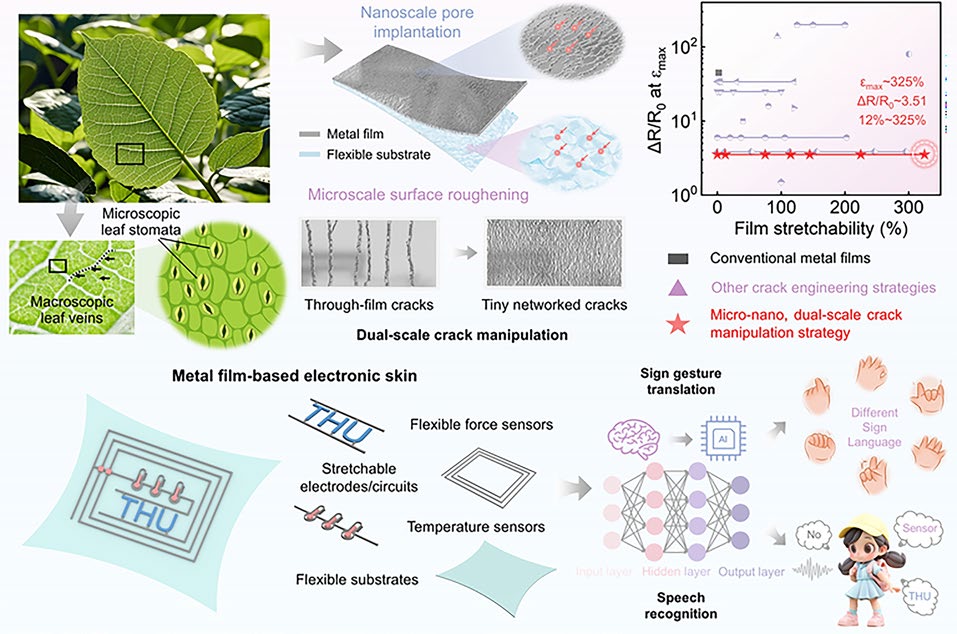
Inspired by the hierarchical architecture of plant leaves—where macroscopic veins redistribute loads and microscopic stomata release localized stress—the team developed a dual-scale architecture:
- Microscale Substrate Roughening: By replicating the microbump structures of common sandpapers onto PDMS substrates, they created "vein-like" sites for stress redistribution. This forces long through-film cracks to evolve into high-density "winding cracks".
- Nanoscale Pore Implantation: Within the metal film itself, the team used pressure-regulated pulsed laser deposition (PLD) to implant nanoscale pores. These pores mimic "stomata," inducing tiny-networked crack patterns that preserve conductive pathways even under extreme strain.
Roadmap to 325% Stretchability: Stepwise Optimization
The researchers demonstrated a nearly 25-fold regulation of stretchability by modulating structural parameters:
- Step 1: Achieving Conductivity under Strain: Moving from smooth substrates to microbump-roughened ones increased stretchability from 12% to approximately 75%.
- Step 2: Networked Crack Engineering: By optimizing microscale features (grit size), they further improved stretchability to 145%, suitable for wide-range force sensors.
- Step 3: Integrating Nanopores for Peak Performance: The final implementation of nanoscale pore implantation (at 1000 Pa deposition pressure) unlocked a record-breaking 325% stretchability. This configuration exhibits "strain-insensitive" behavior comparable to liquid metals, making it perfect for stretchable circuits.
Real-World Impact: AI-Empowered Electronic Skin
The study highlights the practical versatility of this strategy through an all-metal-film-based electronic skin. By selectively depositing different crack-manipulated patterns, the team integrated:
- Temperature & Force Sensors: Capable of monitoring facial activities and joint motions with high linearity and durability.
- AI Integration: The sensors were coupled with deep learning models (CNN) to achieve real-time sign language translation and speech recognition.
Even under complex deformations like bending, twisting, and 200% stretching, the metal film electrodes could charge a smartphone via a Type-C connection without interruption.
Conclusion and Future Outlook
The transformation of film cracking from a "detrimental failure" into a "powerful design tool" marks a significant milestone for stretchable electronics. This multi-scale regulation paradigm is applicable to a variety of metals, including Ag, Cu, Pd, and alloys.
As these bioinspired conductors move toward commercialization, they offer a low-cost, robust, and highly tunable solution for the next generation of AI-integrated healthcare monitors and soft robotic skins.

Editor of Nano-Micro Letters, which is an Open-Access, peer-reviewed journal reported papers that have at least one dimension ranging from a few sub-nanometers to a few hundreds of micrometers. The journal is published by Springer Nature and indexed by SCI, EI, SCOPUS, Pubmed, etc. The 2024 JCR Impact Factor is 36.3. The 2024 CiteScore is 53.1.
Follow the Topic
-
Nano-Micro Letters
Nano-Micro Letters is a peer-reviewed, international, interdisciplinary and open-access journal that focus on science, experiments, engineering, technologies and applications of nano- or microscale structure and system in physics, chemistry, biology, material science, and pharmacy.




Please sign in or register for FREE
If you are a registered user on Research Communities by Springer Nature, please sign in