Bioinspired Hierarchical Hydrogel Electrolyte for Ultralong‑Life Flexible Zinc‑Ion Batteries
Published in Materials
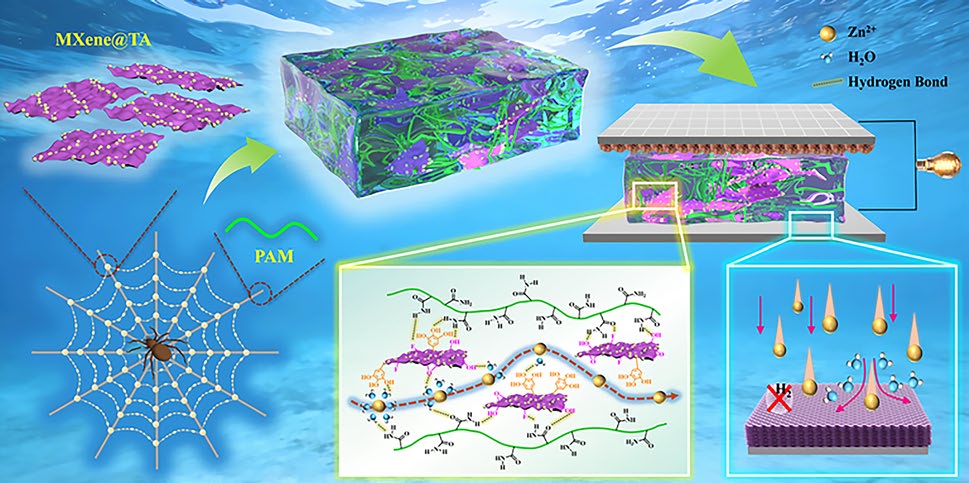

As the demand for flexible and wearable electronics surges, aqueous zinc-ion batteries (ZIBs) have emerged as compelling post-lithium candidates owing to their intrinsic safety, high theoretical capacity, and earth-abundant chemistry. Yet a critical bottleneck persists: hydrogel electrolytes—the key enablers of flexibility—suffer from an intrinsic trade-off between mechanical robustness and ionic conductivity. Conventional designs that aggressively restrict free water to suppress side reactions inadvertently immobilize Zn2+, resulting in sluggish transport kinetics and catastrophic dendrite growth. Now, researchers from Lanzhou University, Nankai University, and Lanzhou Jiaotong University, led by Professor Kefeng Xie, Professor Guankui Long, and Professor Pengcheng Du, have presented a breakthrough bioinspired hydrogel electrolyte that resolves this decades-long dilemma by translating nature's engineering into electrochemical excellence.
Why This Electrolyte Matters
Traditional hydrogel electrolytes face a fundamental paradox. The strong hydrogen-bonding networks required to anchor water molecules and prevent hydrogen evolution simultaneously trap solvated Zn²⁺, causing severe concentration polarization and degraded Coulombic efficiency at high current densities. The novel hierarchical hydrogel electrolyte (MTP) overcomes this limitation by drawing inspiration from the spider web's "adhesion-conduction" architecture—combining a robust structural skeleton with directed ion transport channels to achieve both battery-level stability and supercapacitor-like ion transport.
Innovative Design and Mechanism
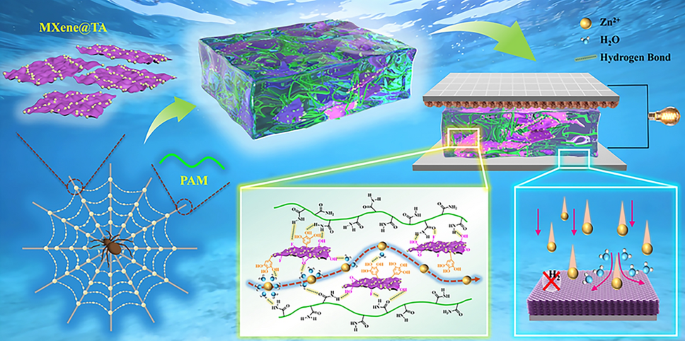
The material is synthesized through a facile one-pot thermal polymerization, incorporating tannic acid (TA)-modified MXene nanosheets (MT) into a polyacrylamide (PAM) matrix. Monte Carlo simulations and density functional theory reveal that its exceptional performance originates from a unique hierarchical synergy: the PAM framework functions as the web's radial threads, ensuring mechanical integrity and structural resilience, while the MT network creates a dense array of "sticky sites"—polar groups on MXene and phenolic hydroxyls on TA—that act as viscid droplets. These sites selectively coordinate with water molecules to suppress interfacial side reactions and hydrogen evolution, while simultaneously accelerating Zn2+ desolvation kinetics and homogenizing ion flux. The resulting three-dimensional percolation network constructs low-energy-barrier transport channels throughout the bulk material, enabling rapid Zn2+ migration without sacrificing mechanical toughness.
Outstanding Performance
The MTP electrolyte achieves an impressive ionic conductivity of 27.69 mS cm-1 and a remarkably high Zn2+ transference number of 0.833—both surpassing conventional aqueous and pristine hydrogel counterparts. Enabled by this design, Zn//Zn symmetric cells demonstrate an ultralong lifespan of 4600 h (>6 months) at 0.5 mA cm-2/0.5 mAh cm-2, and maintain stable operation for 2680 h even at doubled current density. The nucleation overpotential is finely tuned to 68 mV, promoting uniform (002)-textured Zn deposition and completely suppressing dendrite proliferation. Zn//Cu half-cells sustain over 850 cycles with an average Coulombic efficiency of 98.57%, while Zn//Z-VO full cells retain 74.5% capacity after 2000 cycles at 2 A g-1 and endure an exceptional 10,000 cycles at 5 A g-1.
Applications and Future Outlook
When integrated into flexible pouch cells, the MTP electrolyte delivers an ultra-high specific capacity of 234.22 mAh g-1 and maintains 76.16% retention after 1000 cycles at 1 A g-1, with negligible capacity fluctuation across bending angles from 0° to 180°. This work establishes a new biomimetic paradigm for hydrogel electrolyte design, opening promising avenues for next-generation flexible energy storage systems combining high safety, mechanical durability, and ultralong cycling stability.
Stay tuned for more groundbreaking research from this collaborative team at Lanzhou University, Nankai University, and Lanzhou Jiaotong University!

Editor of Nano-Micro Letters, which is an Open-Access, peer-reviewed journal reported papers that have at least one dimension ranging from a few sub-nanometers to a few hundreds of micrometers. The journal is published by Springer Nature and indexed by SCI, EI, SCOPUS, Pubmed, etc. The 2025 JCR Impact Factor is 38.5. The 2025 CiteScore is 58.9.
Follow the Topic
-
Nano-Micro Letters
Nano-Micro Letters is a peer-reviewed, international, interdisciplinary and open-access journal that focus on science, experiments, engineering, technologies and applications of nano- or microscale structure and system in physics, chemistry, biology, material science, and pharmacy.


Please sign in or register for FREE
If you are a registered user on Research Communities by Springer Nature, please sign in