Bioinspired Molecular Magnetic Field-Responsive Catalyst for On-Demand Switching of 2e− and 4e− Oxygen Reduction
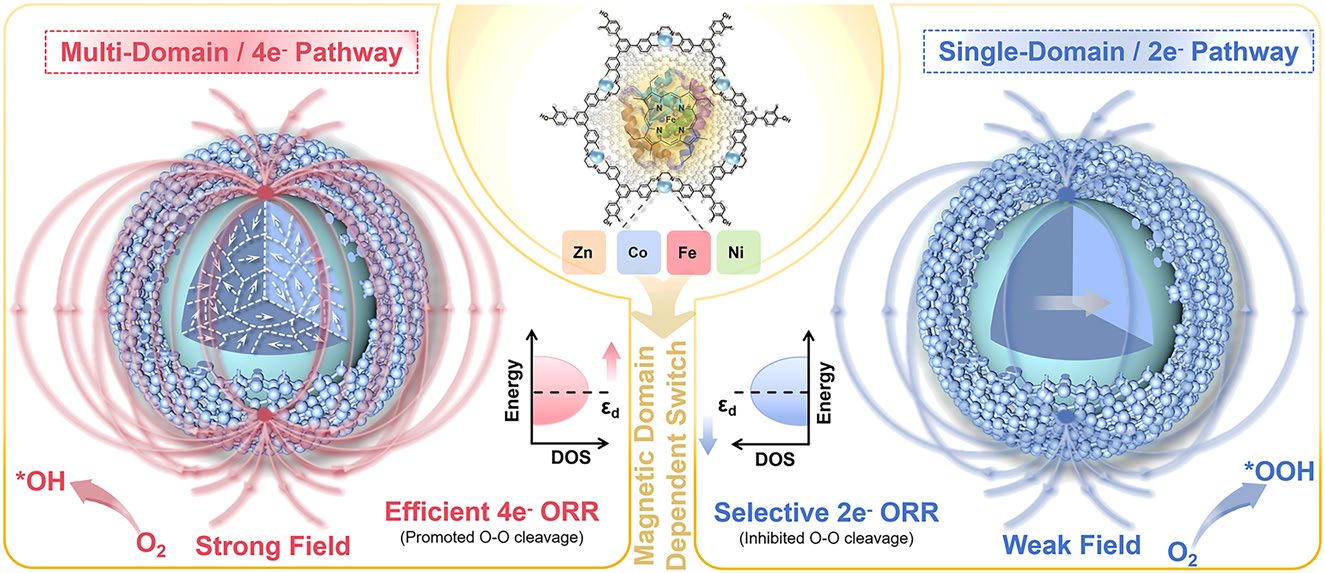

Efficient oxygen reduction reaction (ORR) is essential for energy conversion and environmental technologies, but directing the reaction toward a specific product remains a major challenge. The four-electron (4e⁻) pathway produces water, whereas the two-electron (2e⁻) pathway generates hydrogen peroxide (H2O2), a valuable oxidant for wastewater treatment and chemical processing. Conventional strategies for controlling selectivity often require changes to catalyst composition or structure, limiting the ability to regulate reaction pathways dynamically. Researchers from Hebei University of Science and Technology have developed a bioinspired molecular magnetic field-responsive catalyst that uses built-in magnetic fields to control active-site electronic structures, enabling selective switching between these two oxygen-reduction pathways.
Why This Magnetic Catalyst Matters
The selectivity of ORR depends strongly on whether the oxygen–oxygen (O–O) bond remains intact or undergoes cleavage during the reaction. Preserving this bond favors H2O2 production, while breaking it promotes the four-electron route to water. Achieving precise control over this branching point is difficult because it involves complex interactions among electron transfer, proton transfer, and intermediate adsorption. A catalyst that can regulate these processes without requiring changes to its chemical structure could offer a versatile approach to tailoring electrocatalytic reactions for different applications.
Innovative Design and Mechanism
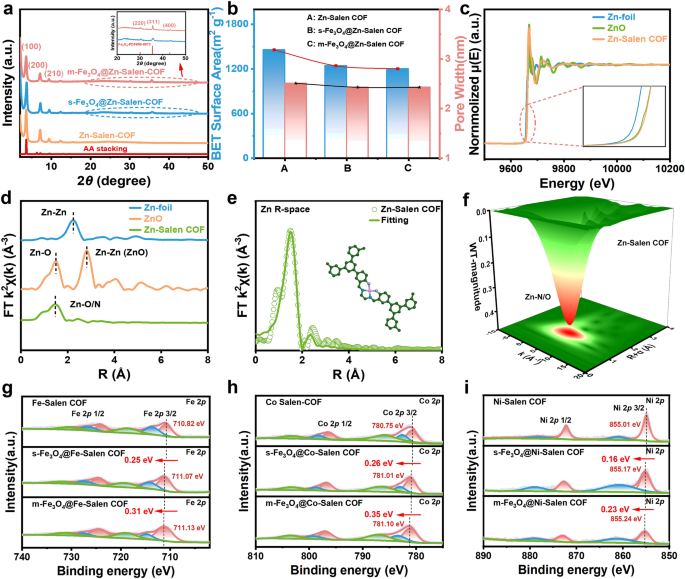
Inspired by the biological enzyme cytochrome c oxidase, the research team constructed molecular magnetic field-responsive catalysts (MMFR-C) by integrating magnetic single-atom-anchored Salen-based covalent organic frameworks (MSA-Salen COFs) with single-domain or multi-domain Fe3O4 nanoparticles. The COFs provide ordered proton-transfer channels and well-defined N2–M–O2 active sites, while Fe3O4 generates a built-in magnetic field that regulates the electronic structure and spin polarization of the metal centers. Single-domain Fe3O4 produces a relatively weak, uniform magnetic field that optimizes the adsorption of the *OOH intermediate and suppresses O–O bond cleavage, favoring H2O2 formation. In contrast, multi-domain Fe3O4 generates stronger magnetic interactions that facilitate O–O bond cleavage and direct the reaction toward the four-electron pathway. This design establishes magnetic-domain engineering as a means of controlling catalytic selectivity.
Outstanding Performance
The catalyst demonstrates substantial improvements in both selectivity and reaction control. For the Co-Salen COF system, incorporating single-domain Fe3O4 increases H2O2 selectivity from 26% to 63.9%, with an electron-transfer number of 2.72. By comparison, the multi-domain Fe3O4 counterpart redirects the reaction toward the four-electron pathway, achieving an electron-transfer number of 3.67. The single-domain Fe3O4–Fe-Salen COF system reaches an H2O2 production rate of 132 mmol g-1 h-1 at 0.3 V versus the reversible hydrogen electrode. Furthermore, the single-domain Fe3O4–Co-Salen COF catalyst maintains stable disk and ring currents during 10 hours of continuous operation. These results demonstrate that magnetic-domain structure can regulate ORR selectivity while supporting efficient and stable catalysis.
Applications and Future Outlook
The team also demonstrated the environmental potential of the system by using electrogenerated H2O2 to degrade Rhodamine B, a model organic pollutant. The dye was completely degraded within one hour, highlighting the promise of selective electrochemical H2O2 production for water-treatment applications. More broadly, this research introduces a strategy for regulating catalytic pathways through internal magnetic fields rather than relying solely on conventional structural modifications. Further development of magnetic field-responsive catalysts could open new opportunities for controllable electrosynthesis, environmental remediation, and energy-related electrochemical processes.

Editor of Nano-Micro Letters, which is an Open-Access, peer-reviewed journal reported papers that have at least one dimension ranging from a few sub-nanometers to a few hundreds of micrometers. The journal is published by Springer Nature and indexed by SCI, EI, SCOPUS, Pubmed, etc. The 2025 JCR Impact Factor is 38.5. The 2025 CiteScore is 58.9.
Follow the Topic
-
Nano-Micro Letters
Nano-Micro Letters is a peer-reviewed, international, interdisciplinary and open-access journal that focus on science, experiments, engineering, technologies and applications of nano- or microscale structure and system in physics, chemistry, biology, material science, and pharmacy.