Biophysical Limits of Human Systems: A Unified Energy–Information–Friction Framework of Wellbeing
Published in Social Sciences, Physics, and Cell & Molecular Biology
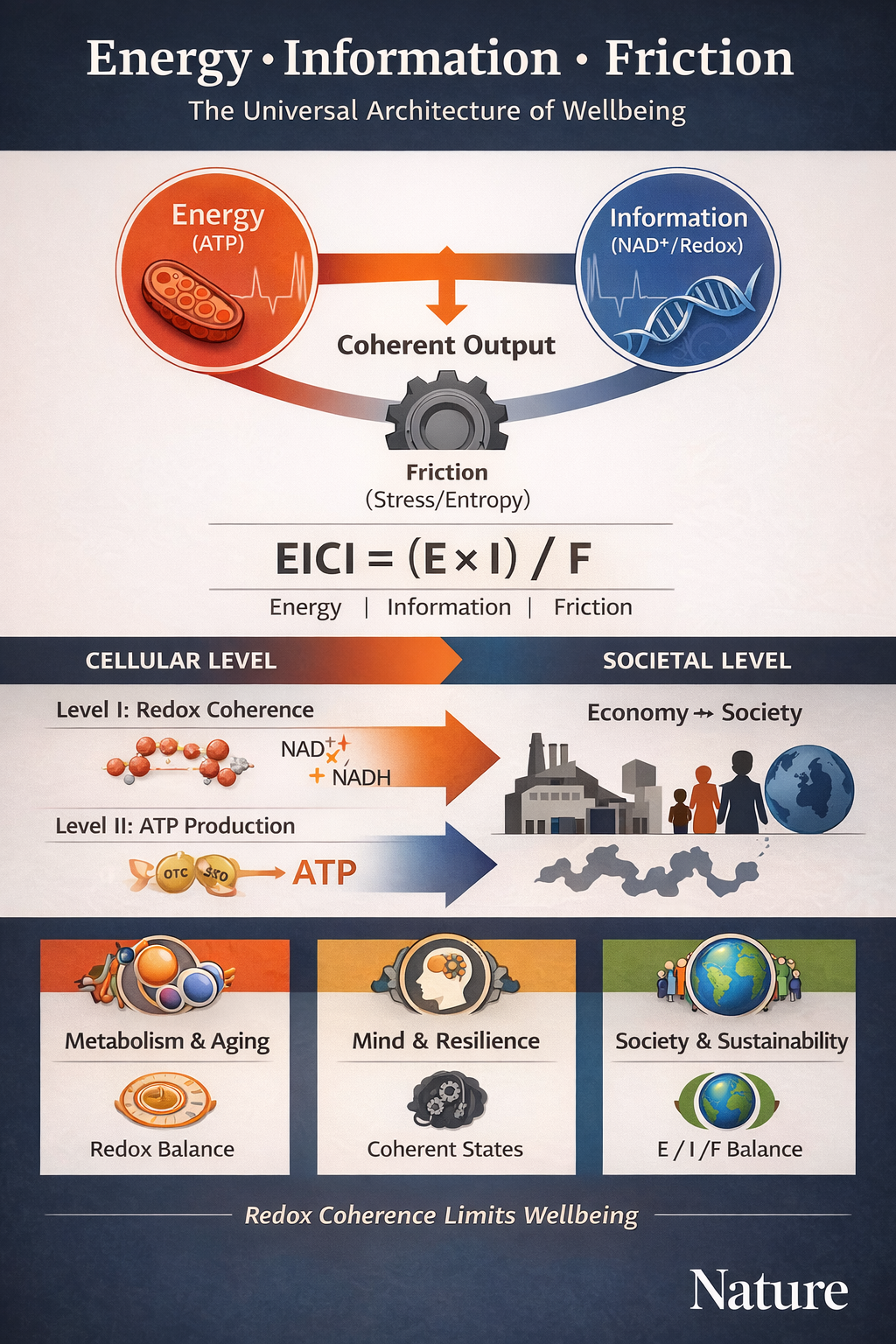
📝 Biophysical Limits of Human Systems: Energy, Information, and Friction as an Integrative Framework of Wellbeing
C.J. Pérez Pulido
Director of Research, ISHEA Institute (Bologna · Rome · Puerto Rico)
ORCID: 0009-0004-1822-4798
🔗 Preprint: https://www.researchsquare.com/article/rs-8899090/latest
🔗 Data & Materials: https://doi.org/10.17605/OSF.IO/FYQGS
🔑 Key Points
• Wellbeing can be approached as a measurable biophysical state:
EICI = (E × I) / F (proposed coherence formulation)
• NAD⁺-mediated redox dynamics (K₁) and ATP-driven processes (K₂) form a hierarchical bioenergetic structure
• Friction (F) is treated as a measurable constraint affecting system efficiency and execution
• The framework integrates indicators such as GDP, HDI, Maslow’s hierarchy, and SDGs as partial representations of a shared underlying structure
• Hypothesis: systemic performance may be constrained more by redox regulation than by ATP availability alone
❓ The Question Underlying This Work
Across existing frameworks—from GDP to HDI, from Maslow’s hierarchy to the UN SDGs—human wellbeing is typically quantified through fragmented indicators.
This work explores the hypothesis that these may reflect a deeper underlying biophysical structure that has not yet been explicitly formalized.
⚡ Core Proposition: Three Governing Variables
Across biological and social systems, performance can be interpreted through three interacting variables:
- Energy (E): capacity to perform work
- Information (I): structural organization that directs energy
- Friction (F): constraints that reduce efficiency and execution
From this perspective, a coherence index can be expressed as:
EICI = (E × I) / F (proposed formulation)
Higher E and I with lower F correspond to higher system coherence, while increased friction leads to reduced efficiency and stability.
🧬 Two-Level Bioenergetic Structure
Within the accompanying preprint:
A Two-Level Bioenergetic Coherence Model Integrating NAD⁺, ROS, and ATP within the ISHEA Δ±1 Framework
We propose a hierarchical organization:
| Level | Controller | Function |
|---|---|---|
| I | NAD⁺ / ROS | Redox regulation and coherence control |
| II | ATP | Energy execution and biochemical work |
We explore the relation:
K = K₁ × K₂^(1/2)
where ATP amplifies output within constraints defined by redox regulation.
📊 Preliminary Computational Results
Methods applied:
- Sobol–Saltelli global sensitivity analysis
- Monte Carlo simulations
- Partial correlation analysis
Indicative findings:
| Variable | Sensitivity | Interpretation |
|---|---|---|
| NAD⁺ | 0.42 | Primary regulatory driver |
| ROS | 0.28 | Modulatory redox signal |
| ATP | 0.12 | Execution-level amplifier |
These results suggest that system-level performance may be more strongly associated with redox regulation than with energy availability alone.
🌍 Cross-Scale Interpretation
The same structural pattern may be partially reflected across different domains:
- GDP → captures economic energy flow
- HDI → partial informational structure
- Maslow → hierarchical needs organization
- SDGs → distributed constraint reduction targets
This suggests that existing frameworks may represent partial projections of a more general structure of system organization.
📖 From Biology to Systems Theory
The cellular model is extended as a conceptual hypothesis toward broader systems:
- Biological systems: metabolic and redox regulation
- Social systems: economic and institutional organization
From this perspective:
E · I / F → candidate expression of systemic coherence and wellbeing (hypothesis)
🔬 Testable Hypotheses
This framework generates several testable predictions:
• Increasing ATP without restoring redox balance yields limited systemic improvement
• Redox stabilization may improve efficiency independently of ATP levels
• Chronic stress is associated with reduced NAD⁺ availability and decreased coherence states
🤝 Open Questions
• Can redox dynamics be formalized as a predictive constraint across scales?
• To what extent can coherence metrics be quantitatively validated?
• How can this framework be experimentally tested in biological and social systems?
📚 Resources
🔗 Preprint: https://www.researchsquare.com/article/rs-8899090/latest
🔗 Data & Materials: https://doi.org/10.17605/OSF.IO/FYQGS
🔗 ISHEA Framework: https://doi.org/10.17605/OSF.IO/WST24
⚠️ Competing Interests
The author serves as Director of Research at the ISHEA Institute.
All data and materials are openly available via OSF.

Carlos J. Pérez Pulido (writes as C.J. Pérez Pulido)
Research | ISHEA Institute
Italy
C.J. Pérez Pulido
ISHEA Institute – International System for Human–Ecological Advancement
The ISHEA Institute is an international research center dedicated to developing scientific, economic, and bioenergetic models based on informational coherence, sustainability, and human resilience.
Its mission is to integrate science, technology, and consciousness within a unified framework of civilizational progress known as the ISHEA Unified Framework, which operates across three main levels:
- ISHEA–MACRO: Coherence models applied to nations, economies, and governance systems.
- ISHEA–MESO: Applications in enterprises, energy systems, cognitive economics, and organizational innovation.
- ISHEA–MICRO: Advanced research in biology, physics, AI, and consciousness through modules such as ISHEA–BIO, ISHEA–TOE, and the HALO Reactor System.
The Institute promotes interdisciplinary research connecting quantum physics, neurobiology, behavioral psychology, regenerative energy, and human welfare policy to design new indicators, technologies, and sustainable development models.
Core Research Lines
- ISHEA Index (Expanded Human Satisfaction Index) — a next-generation alternative to GDP.
- ISHEA Unified Principle — a universal model of coherence and informational balance.
- HALO Reactor System — coherent-energy generation and transformation technology.
- ISHEA–BIO Framework — correlation between ATP, FOXP, cortisol, and bioenergetic coherence.
- K-Model — formal system for Knowledge Density & Flow across cognitive and economic structures.
Professional Overview
Carlos J. Pérez Pulido is an internationalist, researcher, and theorist specializing in human–ecological systems, cognitive economics, and coherence-based energy models.
As Director of Research at ISHEA Institute, he leads the integration of scientific and systemic knowledge under the ISHEA Unified Framework, bridging physics, biology, economics, and applied system design.
He is the author of:
- Biophysics: The Limit of Humanity — exploring bioenergetic coherence and systemic limits.
- Inverted Economy — introducing the K-Model for sustainable value creation and post-scarcity dynamics.
His work connects biological, cognitive, and energetic processes to redefine how humanity measures, sustains, and evolves collective progress.
Official Registrations
- DOI (ISHEA–TOE): 10.17605/OSF.IO/BC5JH
- Patamu Registration: N° 272381-132
- Contact: ISHEAInstitute.org@gmail.com
Online Profiles
- LinkedIn: in/carlos-j-perez-pulido-a94b66a6
- ORCID: 0009-0004-1822-4798
Research Focus
- Bioenergetic coherence and neural function (ATP, FOXP, cortisol)
- Human systems strategy and performance optimization
- Cognitive economics and organizational resilience
- Energy-driven multi-scale system modeling
- Economy 5.0 and post-growth frameworks
Mission
“I design frameworks that help leaders understand how human systems function, how they degrade, and how they can be redesigned for stability, resilience, and long-term performance.”
Open to high-level advisory, strategic collaborations, and global initiatives focused on human energy, system design, and sustainable development.


Please sign in or register for FREE
If you are a registered user on Research Communities by Springer Nature, please sign in