Body composition and chemo toxicities

Current dosing is based on body weight and predicted Body Surface Area (BSA). These parameters do not take into consideration the individual variations of fat mass (FM) and fat-free mass (FFM) that affect pharmacokinetics.
Body composition and chemo toxicities
Like

Share this post

Choose a social network to share with, or copy the URL to share elsewhere

This is a representation of how your post may appear on social media. The actual post will vary between social networks

Explore the Research

SpringerLink
SpringerLink SpringerLink

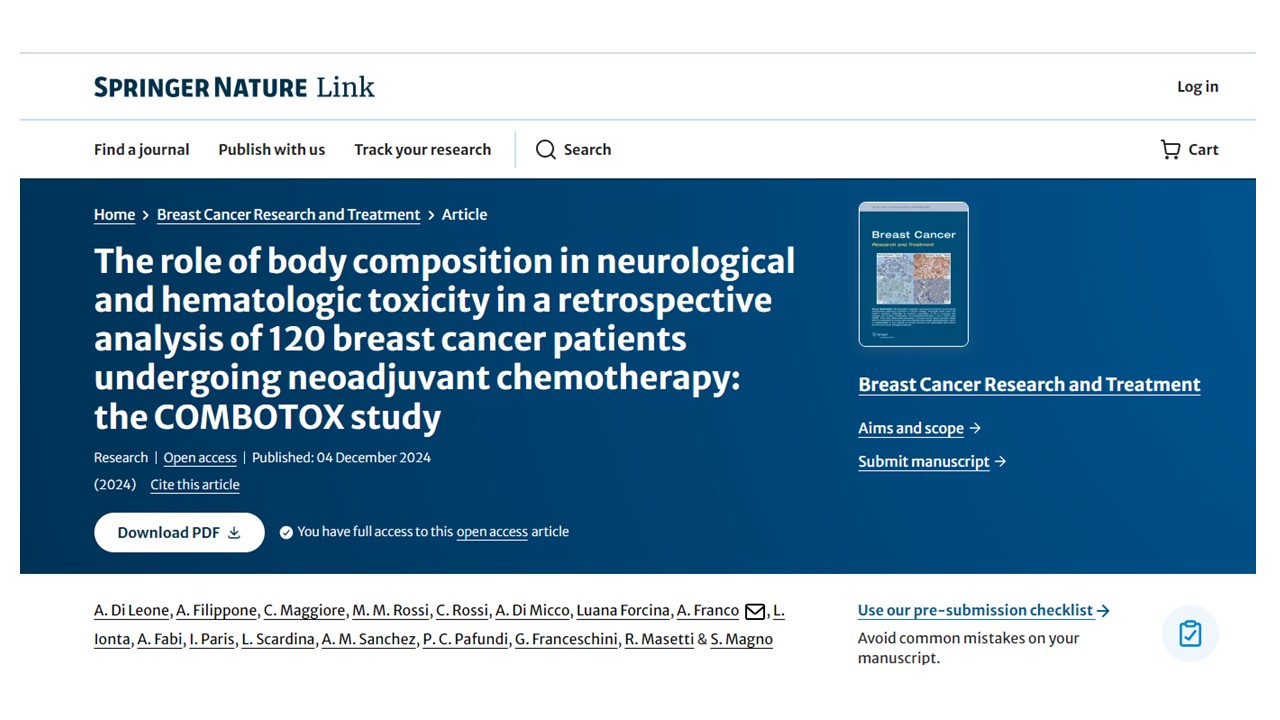
The role of body composition in neurological and hematologic toxicity in a retrospective analysis of 120 breast cancer patients undergoing neoadjuvant chemotherapy: the COMBOTOX study - Breast Cancer Research and Treatment

Purpose Neoadjuvant chemotherapy (NAC) has a well-established role in locally advanced or chemoresponsive breast cancers (BC). Chemotherapic regimens are effective when patients receive the optimal doses. Toxicities are common in overweight/obese patients but may occur also in normal weight counterparts. This leads to delays, reductions, or discontinuation of treatment, with impact on outcomes. Current dosing is based on body weight and predicted Body Surface Area (BSA). These parameters do not take into consideration the individual variations of fat mass (FM) and fat-free mass (FFM) that affect pharmacokinetics. Assessment of body composition (BoCo), rather than Body Mass Index (BMI), could help to better plan chemotherapy and reduce drug-related toxicities. Our aim was to analyze the correlations between body weight, anthropometric measures, BoCO, and toxicities related to NAC in non-metastatic BC patients. Methods This is a retrospective observational cohort study that includes 120 consecutive BC patients undergoing NAC, enrolled between May 2018 and December 2020. All patients received an evaluation of anthropometric parameters (height, weight, waist and hip circumference, BMI) and an assessment of BoCo using Segmental Multi-Frequency-Bioelectrical Impedance Analysis. Results A logistic regression models confirmed that a higher FM was associated with a higher rate of neurological and hematologic toxicities in protocols containing Platinum. Moreover, patients with a low FFM% have a higher risk for hematologic toxicity in protocols containing Platinum. Conclusion A routine assessment of BoCo, in addition to evaluation of anthropometric measures and BMI, could allow to personalize chemotherapy doses, in order to reduce chemotherapy-related toxicities.

Assessment of body composition, rather than Body Mass Index (BMI), could help to better plan chemotherapy and reduce drug-related toxicities.  In our COMBOTOX study in breast cancer patients undergoing neoadjuvant chemo,  a higher FM was associated with a higher rate of neurological and hematologic toxicities in protocols containing Platinum. Moreover, patients with a low FFM% have a higher risk for hematologic toxicity in protocols containing Platinum.

Please sign in or register for FREE

If you are a registered user on Research Communities by Springer Nature, please sign in

Follow the Topic

Breast Cancer
Life Sciences > Health Sciences > Clinical Medicine > Diseases > Cancers > Breast Cancer
Nutrition
Life Sciences > Health Sciences > Health Care > Nutrition
Obesity
Life Sciences > Health Sciences > Clinical Medicine > Diseases > Nutrition Disorder > Obesity

Related Collections

With Collections, you can get published faster and increase your visibility.

Liquid Biopsy in Breast Cancer

Liquid biopsy, the analysis of circulating markers in the blood of cancer patients, is a fast-moving research space. There is tremendous excitement for the clinical adoption of liquid biopsy given the potential for it to revolutionise cancer screening, including breast cancer screening. In this collection, we welcome studies investigating the diverse range of circulating markers - such as circulating DNA (ctDNA), circulating tumour cells and exosomes - for breast cancer diagnosis and treatment.

Publishing Model: Hybrid

Deadline: Ongoing

Cancer Disparities

In line with the UN Sustainable Development Goal to Reduce Inequalities (SDG10), this collection aims to bring together articles enhancing our understanding of cancer health disparities across the different dimensions of inequality research.

There are many expanding fields of health inequalities research but this collection will include articles examining disproportionate cancer burdens in populations such as: rural-urban, gender/sexual, racial/ethnic, religious minority and socioeconomic status groups, and of course any group where health inequality needs to be addressed.

This wider collection builds upon our existing collections more specifically focused on 'Racial and ethnic disparities in cancer' and 'Racial and ethnic disparities in cancer in the US'.

We are building an ongoing knowledge base of content from across oncology journals to increase the discoverability of articles in this important research area. Thus, we call for new contributions to this collection and invite you to read recent research below.

We also wish to highlight a related webinar recording 'Roundtable on Black in cancer research and oncology'.

Editors for Supportive Care in Cancer: Dr Devon Check and Dr. Laura Charlesworth. Prof Janet de Groot was previously Guest Editor.

Editors for Prostate Cancer and Prostatic Diseases: Dr Samuel L. Washington III, Dr Jun Luo, Dr Yaw Nyame, Dr Randy Vince Jr and Dr Jennifer Beebe-Dimmer

Please note that other journals participating in the collection do not have specific Guest Editors appointed and manuscripts are handled on a case by case basis by members of our editorial boards.

Publishing Model: Hybrid

Deadline: Ongoing
Recommended Content