Boron‑Insertion‑Induced Lattice Engineering of Rh Nanocrystals Toward Enhanced Electrocatalytic Conversion of Nitric Oxide to Ammonia


As the global nitrogen cycle faces unprecedented disruption from industrial emissions and agricultural runoff, nitric oxide (NO) stands out as both a lethal pollutant and a squandered resource. Conventional selective catalytic reduction merely converts NO to inert N2, wasting its nitrogen content, while the Haber–Bosch process for ammonia synthesis remains an energy-intensive, carbon-heavy enterprise. Electrocatalytic NO reduction reaction (NORR) offers an elegant dual solution—simultaneously scrubbing toxic NO from the atmosphere and producing green NH3 under ambient conditions. Yet, the field has been starved of catalysts that combine high activity, selectivity, and durability. Now, researchers led by Professor Ye Chen (The Chinese University of Hong Kong), Professor Chongyi Ling (Southeast University), and Professor Zhengxiang Gu (Nanjing Normal University), in collaboration with teams from City University of Hong Kong and the Chinese Academy of Sciences, have unlocked a transformative strategy that redefines noble metal catalysis through lattice engineering.
Why This Catalyst Matters
Traditional rhodium catalysts, while intrinsically active, suffer from suboptimal NO adsorption energetics and competitive hydrogen evolution that erodes Faradaic efficiency. Prior attempts to modify noble metals through composition or defect engineering have yielded incremental gains. The novel hexagonal close-packed boron-inserted rhodium (hcp RhB) nanocrystals overcome these limitations by leveraging phase engineering—a fundamentally different knob that simultaneously reconfigures atomic arrangement, electronic structure, and catalytic behavior. This is not merely doping; it is a phase-regulated lattice reconstruction that turns rhodium into a NORR powerhouse.
Innovative Design and Mechanism
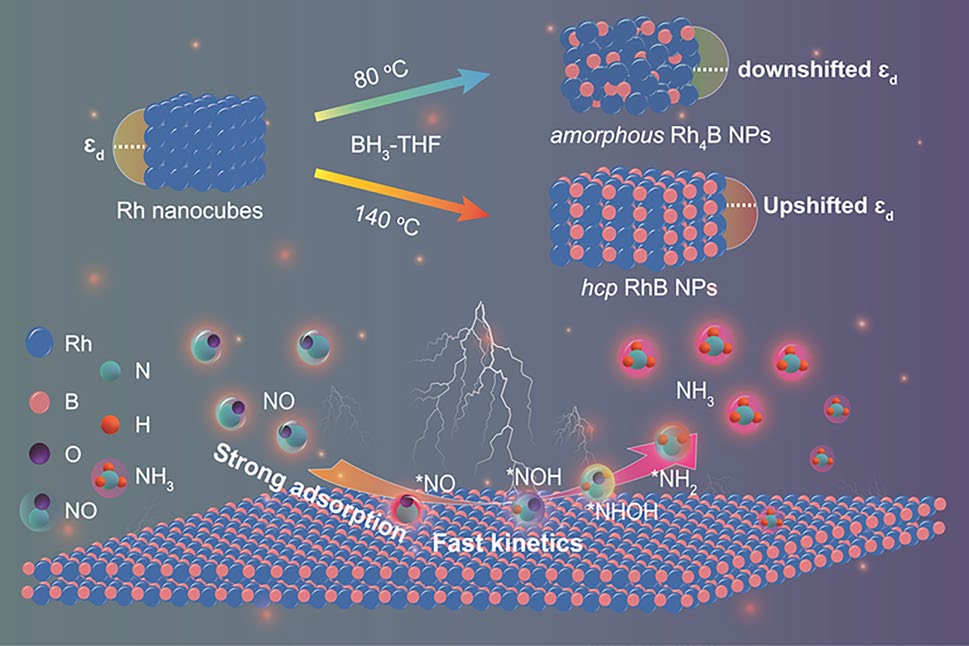
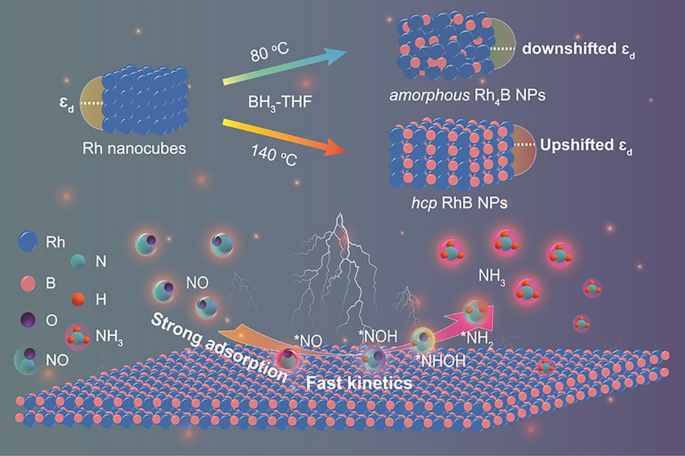
The material is synthesized through a remarkably facile wet-chemical boronization of face-centered cubic (fcc) Rh nanocubes, where temperature alone dictates the phase destiny. At 80 °C, boron insertion yields amorphous Rh4B nanoparticles; cranking the temperature to 140 °C drives a structural metamorphosis into hcp RhB nanocrystals with a 1:1 Rh:B stoichiometry. Advanced characterizations—HRTEM, SAED, XRD, EELS mapping, and ICP-OES—confirm the uniform B distribution and the characteristic "ABAB" atomic stacking of the hcp phase.
The electronic consequences are profound. XPS valence spectra and DFT-projected density of states reveal that hcp RhB exhibits a dramatically upshifted d-band center (−2.074 eV vs. −2.325 eV for fcc Rh and −2.566 eV for amorphous Rh4B). XANES and EXAFS confirm electron transfer from B to Rh, with Rh–B scattering paths at 1.96 Å and contracted Rh–Rh coordination due to lattice expansion. This upshifted εd populates empty antibonding states, creating a surface primed for strong molecular adsorption. In situ ATR-IR spectroscopy shows that NO activates on hcp RhB at lower overpotentials and with stronger bent-mode adsorption than on either fcc Rh or a-Rh4B. DEMS corroborates this with dramatically higher NH3 and NH2OH signal intensities.
DFT calculations unravel the catalytic choreography: hcp RhB surfaces deliver stronger charge transfer to NO (0.44–0.56 e⁻ vs. 0.37 e⁻ on fcc Rh), weakening the N–O bond while strengthening Rh–N coordination. The rate-determining step—hydrogenation of *NO to *HNO—sees its energy barrier plummet to 0.41 eV on RhB(101) and 0.48 eV on RhB(002), compared to 0.58 eV on fcc Rh(100). Critically, *NO adsorption is thermodynamically favored over both *H and *H2O, effectively suppressing the competing hydrogen evolution reaction.
Outstanding Performance
hcp RhB NPs deliver exceptional NORR metrics that place them at the pinnacle of reported catalysts. At −0.5 V vs. RHE, they achieve a maximum Faradaic efficiency of 92.1 ± 1.2% for NH3—far surpassing fcc Rh nanocubes (83.2%) and a-Rh4B (73.2%). The NH₃ yield rate peaks at 629.5 ± 11.0 μmol h-1 cm-2 at −0.6 V, outperforming most reported nanocatalysts in H-type cell configurations. Durability is equally impressive: 425 hours of continuous chronoamperometry at −0.5 V maintains FE above 86.7% with negligible degradation. Post-mortem characterization confirms intact crystal structure, morphology, and Rh:B stoichiometry—boron atoms remain locked in the lattice, resisting leaching.
Applications and Future Outlook
Beyond standalone electrocatalysis, the team assembled a proof-of-concept Zn–NO battery using hcp RhB NPs as the cathode. The device delivers a peak power density of 4.33 mW cm-2—superior to virtually all reported Zn–NO systems—while achieving stable discharge from 0.5 to 6.0 mA cm-2 with concurrent NH₃ production at 180.3 μg h-1 cm-2. This represents a rare convergence of pollutant remediation, green chemical synthesis, and energy generation in a single device.
This work establishes that phase engineering via light nonmetal insertion is not merely a structural curiosity but a powerful design principle for noble metal nanocatalysts. By decoupling electronic modulation from compositional complexity, the strategy opens promising avenues for sustainable nitrogen fixation, environmental remediation, and next-generation metal–air batteries.
Stay tuned for more groundbreaking research from this collaborative team at The Chinese University of Hong Kong, Southeast University, Nanjing Normal University, and partner institutions across Hong Kong and mainland China!

Editor of Nano-Micro Letters, which is an Open-Access, peer-reviewed journal reported papers that have at least one dimension ranging from a few sub-nanometers to a few hundreds of micrometers. The journal is published by Springer Nature and indexed by SCI, EI, SCOPUS, Pubmed, etc. The 2025 JCR Impact Factor is 38.5. The 2025 CiteScore is 58.9.
Follow the Topic
-
Nano-Micro Letters
Nano-Micro Letters is a peer-reviewed, international, interdisciplinary and open-access journal that focus on science, experiments, engineering, technologies and applications of nano- or microscale structure and system in physics, chemistry, biology, material science, and pharmacy.