Call for Chapter for A Textbook of General Forensics: Interdisciplinary Perspectives, Modern Methodologies, and Contemporary Practices
Published in Social Sciences, General & Internal Medicine, and Arts & Humanities

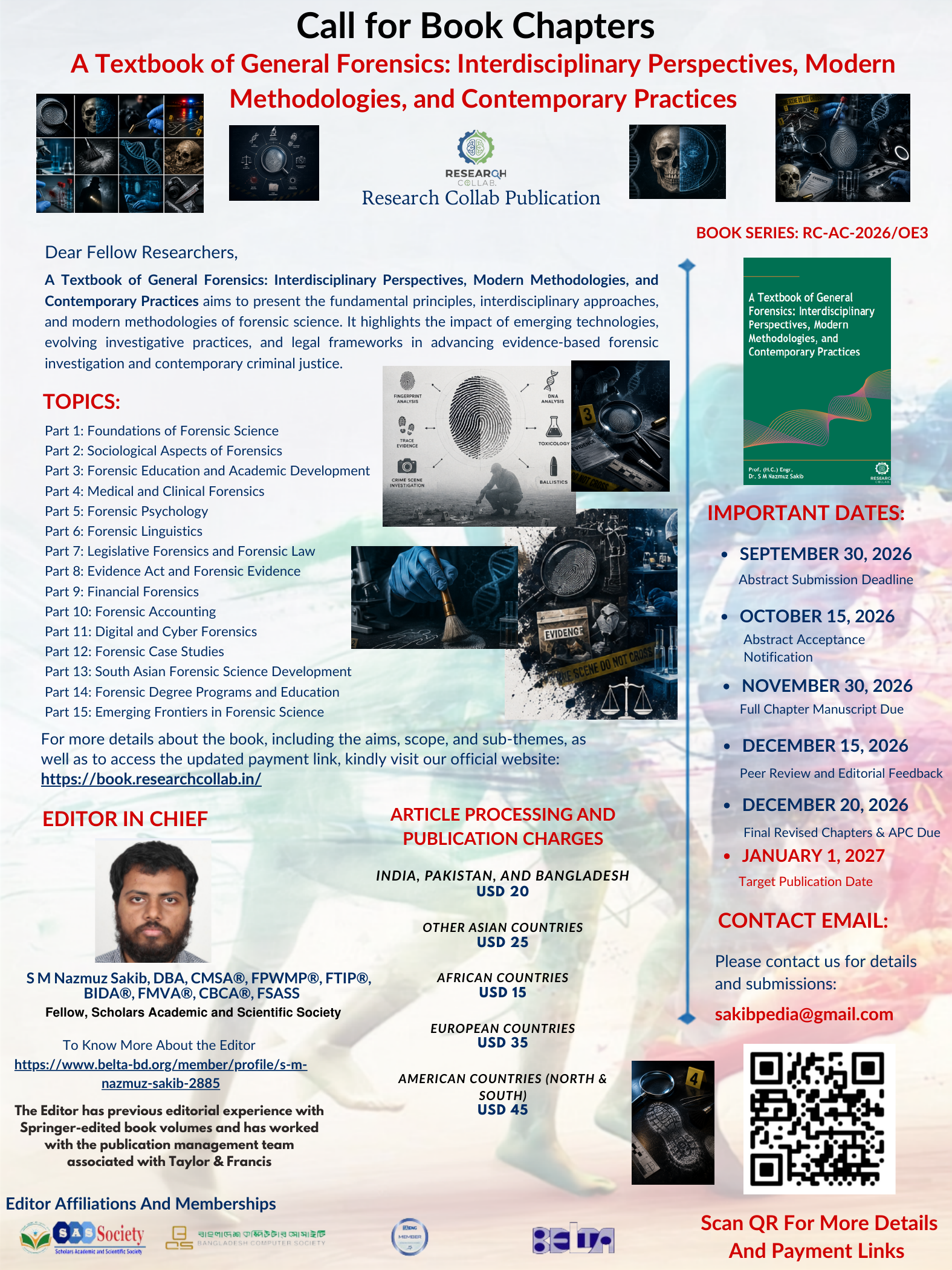
A Textbook of General Forensics: Interdisciplinary Perspectives, Modern Methodologies, and Contemporary Practices
Call for Chapters
Double-Blind Peer Reviewed Edited Volume
ISBN Allocation Underway
Research Collab Academic Press
Editorial Overview and Scientific Rationale
The landscape of forensic science is undergoing a profound and accelerating transformation. Between 2024 and 2026, the field has witnessed a convergence of traditional scientific disciplines with advanced computational tools, artificial intelligence, and portable analytical instrumentation. Handheld Raman and laser-induced breakdown spectroscopy sensors now enable real-time, non-destructive onsite chemical tests. Deep learning and large language models trace complex multilingual data logs and digital audit trails with unprecedented accuracy. The forensic accounting sector has expanded at a compound annual growth rate of 12.0 percent, driven largely by cryptocurrency tracing demands. A critical policy focus has emerged across South Asia, particularly in Bangladesh, India, Pakistan, Nepal, and Sri Lanka.
Despite these rapid advancements, the publishing landscape has lacked a single unified reference that ties together sociological forensics, forensic linguistics, forensic accounting, and digital forensics in a single textbook. This edited volume systematically fills this gap. The project is overseen by an Editor with previous professional editorial experience working with editorial teams associated with Springer and Taylor & Francis publications, ensuring the highest standards of academic rigor and publication quality.
Aims and Curated Thematic Scope
This volume covers fifteen critical themes in forensic research, highlighting standard diagnostic parameters, legislative mandates, technological advancements, and socio-legal frameworks. Authors are invited to contribute chapters aligned with the structured parts detailed below. Custom chapter titles falling within the scope of these fifteen parts are also highly welcomed.
Key Targeted Readers
-
Law and Criminology Students
-
Forensic Practitioners
-
Accounting Professionals
-
Judicial and Policy Researchers
Volume Structure: 15 Thematic Parts
Part 1: Foundations of Forensic Science
This foundational section establishes the epistemological, historical, and procedural underpinnings of modern forensic practice. Chapters in this part should address the evolution from ordeal-based determinations to empirical scientific methods, examining how objectivity, probability, and error rates are conceptualized and managed within forensic frameworks. Critical attention should be given to crime scene management protocols and the chain of custody, alongside cross-jurisdictional frameworks that standardize forensic practices across national boundaries.
Exemplary Chapter Titles:
-
Historical Evolution of Forensic Methodologies: From Ordeal to Empiricism
-
The Epistemology of Forensic Science: Objectivity, Probability, and Error Rates
-
Fundamental Principles of Crime Scene Management and Chain of Custody
-
Cross-Jurisdictional Frameworks for Crime Scene Standards
Part 2: Sociological Forensics
This interdisciplinary section explores the intersection of sociological theory with forensic practice. Authors should examine how media representations shape public expectations of forensic evidence, the influence of cultural factors and bias in crime scene interpretation, and the application of structural criminology to forensic science policy in developing nations. Community-based approaches that integrate restorative justice principles with forensic methodologies are particularly encouraged.
Exemplary Chapter Titles:
-
The CSI Effect: Media Representation and Public Expectation of Forensic Evidence
-
Forensic Sociology: Analyzing Bias, Diversity, and Cultural Influences in Crime Scenes
-
Structural Criminology and Forensic Science Policy in Developing Nations
-
Community-Based Forensics: Restorative Justice and Sociological Impacts
Part 3: Forensic Pedagogy and Academic Standards
This part addresses the educational infrastructure necessary to prepare the next generation of forensic professionals. Contributors should analyze global trends in interdisciplinary curriculum design, accreditation standards, and quality assurance mechanisms for university forensic programs. The pedagogical challenges of bridging laboratory training with courtroom presentation skills merit particular attention, as do innovative digital simulator tools and virtual reality applications in forensic training environments.
Exemplary Chapter Titles:
-
Global Trends in Forensic Pedagogy: Interdisciplinary Curriculum Design
-
Accreditation Standards and Quality Assurance in University Forensic Programs
-
Pedagogical Challenges in Forensic Sciences: Bridging Laboratory and Courtroom
-
Digital Simulator Tools and Virtual Reality in Modern Forensic Training
Part 4: Medical Forensics and Clinical Pathology
This comprehensive medical section covers post-mortem diagnostics, toxicological analysis, entomological markers, and disaster victim identification protocols. Authors should address modern approaches including virtual autopsy techniques, analytical methods for identifying novel psychoactive substances, and micro-environmental markers for estimating post-mortem interval. Forensic odontology and its application in mass disaster scenarios represent priority topics.
Exemplary Chapter Titles:
-
Modern Post-Mortem Diagnostics: Forensic Pathology and Virtual Autopsy
-
Analytical Advances in Forensic Toxicology: Identifying Novel Psychoactive Substances
-
Forensic Entomology: Micro-Environmental Markers for Estimating Post-Mortem Interval
-
Forensic Odontology and Disaster Victim Identification Protocols
Part 5: Forensic Psychology and Behavioral Science
This section examines the psychological dimensions of forensic investigation, from cognitive biases affecting expert evaluations to behavioral evidence analysis in criminal profiling. Authors should explore methodological frameworks for psychological autopsy in equivocal deaths, interrogation ethics, and the phenomenon of false confessions. The integrity of polygraph testing and its evidentiary status across jurisdictions represent important considerations.
Exemplary Chapter Titles:
-
Cognitive Bias in Forensic Evaluations and Eyewitness Testimony
-
Criminal Profiling: Behavioral Evidence Analysis and Clinical Indicators
-
Psychological Autopsy: Methodological Frameworks in Equivocal Deaths
-
Interrogation Ethics, False Confessions, and Polygraph Integrity
Part 6: Forensic Linguistics and Language Evidence
This specialized section addresses the analysis of language as forensic evidence. Contributors should examine authorship attribution methodologies, particularly in ransom notes and cyber-threat communications. Forensic phonetics, voice identification, dialectology, and acoustic analysis represent priority areas. Legal discourse analysis, including power asymmetries in trial cross-examinations, and sociolinguistic profiling in multilingual jurisdictions are particularly encouraged.
Exemplary Chapter Titles:
-
Authorship Attribution in Ransom Notes and Cyber-Threat Communications
-
Forensic Phonetics: Voice Identification, Dialectology, and Acoustic Analysis
-
Legal Discourse Analysis: Power Asymmetries and Language in Trial Cross-Examinations
-
Sociolinguistic Profiling in Multilingual Jurisdictions
Part 7: Forensic Legislation and Regulatory Frameworks
This part provides a comparative analysis of forensic legislation and regulatory standards across jurisdictions. Authors should survey statutory frameworks governing forensic practice, international laboratory standards including ISO/IEC 17025 certification, and the human rights implications of expanding DNA databases and facial recognition technologies. Legal safeguards for forensic analysts, including sovereign immunity and expert liability considerations, represent important topics.
Exemplary Chapter Titles:
-
Comparative Forensic Legislation: A Global Survey of Statutory Frameworks
-
Regulating Forensic Laboratories: International Standards (ISO/IEC 17025)
-
Human Rights and Forensics: Ethical Limits of DNA Databases and Facial Recognition
-
Sovereign Immunity, Expert Liability, and Legal Safeguards for Forensic Analysts
Part 8: Evidentiary Standards and Expert Testimony
This section examines the legal standards governing the admissibility of forensic evidence, from the Frye standard to the Daubert framework and contemporary developments. Authors should analyze regional evidence acts, including the Indian Evidence Act and its counterparts in Bangladesh and Pakistan, particularly regarding expert opinion evidence. The structural and evaluative standards for forensic reports as substantive evidence, along with strategies for cross-examining forensic experts, are priority topics.
Exemplary Chapter Titles:
-
Admissibility of Forensic Evidence: From Frye to Daubert and Beyond
-
The Indian Evidence Act and its Regional Counterparts in Bangladesh and Pakistan on Expert Opinion
-
Forensic Reports as Substantive Evidence: Structural and Evaluative Standards
-
Cross-Examining the Forensic Expert: Strategies and Judicial Safeguards
Part 9: Financial Forensics and Anti-Money Laundering
This comprehensive financial section addresses the detection and tracing of illicit capital flows through anti-money laundering frameworks in the digital age. Authors should examine forensic auditing methodologies for corporate Ponzi schemes and collapsed entities, capital markets forensics for detecting insider trading and market manipulation, and international legal cooperation for asset tracing across offshore tax havens.
Exemplary Chapter Titles:
-
Tracing Illicit Capital Flows: Anti-Money Laundering Frameworks in the Digital Age
-
Corporate Ponzi Schemes: Forensic Auditing of Collapsed Entities
-
Capital Markets Forensics: Detecting Insider Trading and Market Manipulation
-
Asset Tracing across Offshore Tax Havens: International Legal Cooperation
Part 10: Forensic Accounting and Audit Methodologies
This part focuses on the quantitative and statistical methodologies underlying forensic accounting practice. Contributors should address Benford's Law and other statistical anomaly detection techniques in corporate ledger auditing, fraud risk assessment models integrating artificial intelligence in transaction analysis, and tax evasion investigations through forensic audit procedures. The role of forensic accountants as expert witnesses in commercial arbitration represents an important practical consideration.
Exemplary Chapter Titles:
-
Benford's Law and Statistical Anomalies in Corporate Ledger Auditing
-
Fraud Risk Assessment Models: Integrating AI in Transaction Analysis
-
Tax Evasion and Forensic Audit: Standard Practice in Commercial Litigations
-
The Role of Forensic Accountants as Expert Witnesses in Commercial Arbitration
Part 11: Digital Forensics and Cyber Crime Investigation
This critical section addresses the technical and procedural dimensions of digital evidence collection and analysis. Authors should examine volatile memory forensics and live response in incident response workflows, blockchain forensics including cryptocurrency tracing and smart contract auditing, and mobile device decryption with anti-forensics countermeasures. Artificial intelligence-powered deepfake detection and multimedia authenticity verification represent cutting-edge priority areas.
Exemplary Chapter Titles:
-
Volatile Memory Forensics: Live Response in Incident Response Workflows
-
Blockchain Forensics: Tracing Cryptocurrency Transactions and Smart Contract Auditing
-
Mobile Device Decryption and Anti-Forensics Countermeasures
-
AI-Powered Deepfake Detection and Multimedia Authenticity Verification
Part 12: Landmark Case Studies and Forensic Precedents
This part presents detailed case studies that have shaped forensic practice and jurisprudence. Authors should analyze landmark global cases in DNA fingerprinting, including both successes and wrongful convictions that led to procedural reforms. Cyber-heists in emerging economies, particularly the Bangladesh Bank incident and related incursions, merit detailed examination. Forensic auditing of multi-billion dollar scams in South Asia and cold case resolutions via modern genetic genealogy are priority topics.
Exemplary Chapter Titles:
-
Landmark Global Case Studies in DNA Fingerprinting: Successes and Overturns
-
Cyber-Heists in Emerging Economies: Analysis of Bangladesh Bank and Allied Incursions
-
Forensic Auditing of Multi-Billion Dollar Scams in South Asia
-
Cold Case Resolutions via Modern Genetic Genealogy
Part 13: South Asian Forensic Infrastructure and Regional Cooperation
This regionally focused section addresses the specific challenges and opportunities facing forensic science in South Asia. Authors should conduct needs assessments of forensic infrastructure across the region, analyze legislative milestones in Bangladesh and Pakistan, and examine cross-border crime investigation under SAARC mutual legal assistance frameworks. Overcoming resource constraints in rural investigations represents a practical priority.
Exemplary Chapter Titles:
-
The State of Forensic Infrastructure in South Asia: A Regional Needs Assessment
-
Legislative Milestones in Forensic Science in Bangladesh and Pakistan
-
Cross-Border Crime and Evidence Sharing under SAARC Mutual Legal Assistance
-
Overcoming Resource Constraints in South Asian Rural Investigations
Part 14: (Reserved for Emerging Themes)
Part 15: Emerging Technologies and Future Directions
This forward-looking section examines transformative technologies reshaping forensic practice. Authors should address real-time crime scene analysis using handheld Raman and laser-induced breakdown spectroscopy (LIBS), next-generation sequencing (NGS) in forensic genomics for phenotyping and lineage tracing, and large language models with deep learning in processing multilingual digital evidence. Autonomous drones and 3D laser scanning for spatial crime scene reconstruction represent important emerging applications.
Exemplary Chapter Titles:
-
Real-time Crime Scene Analysis using Handheld Raman and Laser Induced Breakdown Spectroscopy (LIBS)
-
Next-Generation Sequencing (NGS) in Forensic Genomics: Phenotyping and Lineage Tracing
-
Large Language Models and Deep Learning in Processing Multilingual Digital Evidence
-
Autonomous Drones and 3D Laser Scanning for Spatial Crime Scene Reconstruction
Submission Guidelines and Formatting Requirements
Abstract Submission
Authors are invited to submit chapter abstracts of 300 to 500 words, accompanied by author biographies and proposed chapter titles. Abstracts should clearly articulate the research question, methodological approach, and anticipated contribution to the field.
Submission Email: sakibpedia@gmail.com
Manuscript Preparation
Accepted chapters should be prepared according to the following specifications:
-
Word Count: 6,000 to 10,000 words, inclusive of references
-
Formatting: APA 7th edition citation style
-
File Format: Microsoft Word document (.docx)
-
Structure: Abstract, keywords, introduction, methodology, findings/discussion, conclusion, references
-
Originality: All submissions must be original and not under consideration elsewhere
Double-Blind Review Process
This volume operates under strict double-blind peer review protocols in compliance with COPE (Committee on Publication Ethics) guidelines. To ensure blinding:
-
Author names and affiliations must appear exclusively in the submission cover email
-
The manuscript document must not contain any identifying information
-
Self-citations should be appropriately anonymized
-
All submissions undergo plagiarism screening and AI-generation metrics
Important Dates and Milestones
| Milestone | Date |
|---|---|
| Formal Call for Chapters Opens | August 1, 2026 |
| Abstract Submission Deadline | September 30, 2026 |
| Abstract Acceptance Notification | October 15, 2026 |
| Full Chapter Manuscript Due | November 30, 2026 |
| Peer Review and Editorial Feedback | December 15, 2026 |
| Final Revised Chapters and APC Due | December 20, 2026 |
| Target Publication Date | January 1, 2027 |
Article Processing Charges (APC)
Research Collab implements a tiered chapter processing structure to sustain open-access indexing, DOI registration, typesetting, and editing workflows. Authors are charged only upon formal acceptance of the peer-reviewed camera-ready manuscript.
Regional APC Rates
| Author Affiliation Region | Processing Fee |
|---|---|
| India | USD 20 |
| Pakistan and Bangladesh | USD 20 (offline channel) |
| Other Asian Countries | USD 25 |
| African Countries | USD 15 |
| European Countries | USD 35 |
| American Countries (North and South) | USD 45 |
Payment Channels
India Channel: Razorpay payment gateway available for Indian authors
Pakistan and Bangladesh: Offline bank remittance coordination via WhatsApp at +91 60023 13260. Waiver tokens may be available upon request.
International Authors: Secure Stripe payment gateway for all other regions
Distinguished Peer Review Panel
Our reviewers are distinguished academicians and subject experts committed to maintaining the highest standards of scholarly peer review:
Prof. Dr. Erwin L. Rimban
Cagayan State University
Contact: dr.erwinrimban@gmail.com
Md. Abu Hanif, PhD
Assistant Professor, Department of Law
Faculty of Security and Strategic Studies (FSSS)
Bangladesh University of Professionals (BUP), Bangladesh
Contact: abuhanif@bup.edu.bd
Md. Ruhul Amin, PT, PhD
Associate Professor
Institute of Medical Technology
University of Dhaka, Bangladesh
Contact: ruhul31physio@yahoo.com
Dr. Md. Abdullah, PT
Lecturer
Institute of Medical Technology
University of Dhaka, Bangladesh
Contact: physioabdullah@gmail.com
Call for Reviewers
We are actively expanding our panel of interdisciplinary peer-reviewers. Academicians and practitioners with published contributions in forensic sciences or related fields are invited to submit their CV to the editorial desk.
Editorial Secretariat
Chief Editor:
Prof. (H.C.) Engr. Dr. S M Nazmuz Sakib
CMSA®, FPWMP®, FTIP®, BIDA®, FMVA®, CBCA®, FSASS
ORCID ID: 0000-0001-9310-3014
Submission and Contact Email: sakibpedia@gmail.com
WhatsApp: +91 60023 13260
Operational Hours: Monday to Saturday, 09:00 to 18:00 UTC
Academic Standards and Compliance
This book series operates in strict compliance with COPE (Committee on Publication Ethics) guidelines. All accepted chapter drafts undergo:
-
Plagiarism screening through professional detection software
-
Double-blind peer review by subject matter experts
-
AI-generation metrics to ensure originality
-
CrossRef membership for DOI registration
International Payment Gateway
International authors, editors, reviewers, and collaborators can securely complete their payments through our online payment gateway. Bangladesh and Pakistan authors should coordinate offline bank remittances and waiver tokens with our local assistants.
Contact Information
Editorial Secretariat
Research Collab Academic Press
Submission Email: sakibpedia@gmail.com
Contact Email: sakibpedia@gmail.com