Can hospitals improve quality without improving governance?

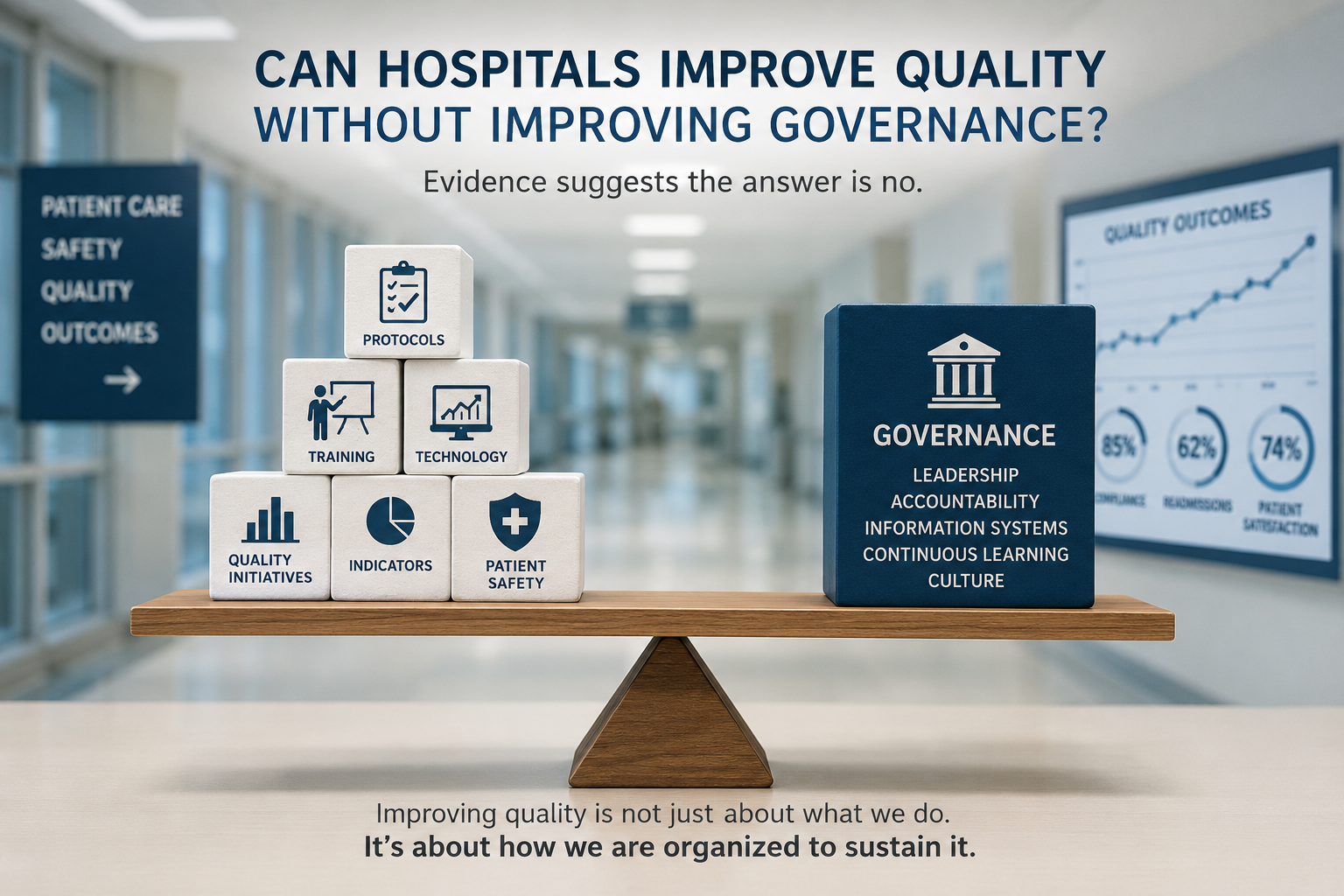
Healthcare organizations invest heavily in quality improvement initiatives, yet outcomes often vary considerably between hospitals. Could the difference lie not in the interventions themselves, but in the governance structures responsible for sustaining them over time?
Can hospitals improve quality without improving governance?
Like

Share this post

Choose a social network to share with, or copy the URL to share elsewhere

This is a representation of how your post may appear on social media. The actual post will vary between social networks

A melhoria da qualidade tornou-se um dos objetivos centrais dos sistemas modernos de saúde. Os hospitais investem recursos substanciais em protocolos clínicos, programas de acreditação, treinamento de funcionários, soluções digitais e iniciativas de segurança do paciente. No entanto, uma pergunta recorrente permanece:

Por que intervenções de qualidade semelhante produzem resultados tão diferentes entre organizações?

Uma possível explicação está além da própria intervenção e dentro da capacidade de governança da organização.

A qualidade da saúde é frequentemente discutida em termos de processos, indicadores e resultados clínicos. No entanto, a capacidade de sustentar melhorias ao longo do tempo pode depender de algo menos visível: a maturidade do sistema organizacional responsável por coordenar esses esforços.

Discussões recentes sobre governança e melhoria da qualidade da saúde têm destacado cada vez mais a importância das estruturas de liderança, mecanismos de responsabilização, coordenação operacional e cultura organizacional na determinação se iniciativas de melhoria se tornam capacidades institucionais ou projetos isolados.

Essa questão se tornou particularmente relevante para mim ao participar de projetos envolvendo acreditação, Saúde Enxuta, avaliação da maturidade organizacional e governança clínica em hospitais brasileiros.

Em muitas organizações, iniciativas de qualidade são lançadas com entusiasmo. Novos protocolos são introduzidos. Os indicadores são monitorados. São realizadas sessões de treinamento. No entanto, após a fase inicial de implementação, os resultados frequentemente se estabilizam ou se deterioram gradualmente.

O problema raramente é a falta de conhecimento técnico.

Mais frequentemente, isso reflete limitações na governança.

Sem responsabilidade clara, alinhamento de liderança, sistemas de informação confiáveis e mecanismos para aprendizado contínuo, os esforços de melhoria da qualidade podem continuar dependendo do compromisso individual em vez da capacidade institucional.

Essa observação é consistente com os achados do nosso recente estudo longitudinal sobre maturidade organizacional e governança de qualidade em um hospital brasileiro. Ao longo de um período de quatro anos, melhorias na maturidade organizacional estiveram associadas a avanços em múltiplos domínios relacionados à governança, processos de cuidado, suporte diagnóstico e terapêutico, e infraestrutura organizacional.

O estudo sugeriu que a melhoria da qualidade pode não depender apenas da adoção das melhores práticas. Pode depender da capacidade da organização de coordenar, sustentar e aprimorar continuamente essas práticas ao longo do tempo.

Essa distinção é importante.

Protocolos podem padronizar o cuidado.

O treinamento pode melhorar competências.

A tecnologia pode aumentar a eficiência.

Mas a governança cria as condições que permitem que esses elementos trabalhem juntos.

Em ambientes complexos de saúde, a fragmentação continua sendo uma das maiores ameaças à qualidade.

Comunicação fragmentada.

Responsabilidade fragmentada.

Prioridades fragmentadas.

Tomada de decisão fragmentada.

Quando as estruturas de governança são fracas, até mesmo iniciativas tecnicamente sólidas podem ter dificuldades para alcançar um impacto duradouro.

Por outro lado, organizações com mecanismos de governança mais fortes frequentemente demonstram maior capacidade de se adaptar, aprender e sustentar melhorias apesar da pressão operacional.

Isso não significa que a governança por si só garanta qualidade.

Na verdade, a governança pode ser o mecanismo pelo qual a qualidade se torna sustentável.

À medida que os sistemas de saúde se tornam cada vez mais complexos, o desafio pode não ser mais identificar o que deve ser melhorado.

O desafio pode ser desenvolver sistemas organizacionais capazes de melhorar consistentemente.

Talvez a questão não seja se os hospitais podem melhorar a qualidade sem melhorar a governança.

Talvez a verdadeira questão seja quanto tempo essas melhorias podem durar sem ele.

Pesquisas e referências relacionadas

  • Rodrigues Filho RND, Morais LG. Maturidade Organizacional como Ferramenta para Governança de Qualidade: Um Estudo Longitudinal em um Hospital Brasileiro. Revista Internacional para Qualidade em Comunicações em Saúde. 2026. DOI: 10.1093/ijcoms/lyag022.
  • Literatura sobre governança em saúde, maturidade organizacional, acreditação e melhoria da qualidade.
  • Pesquisa sobre sustentabilidade das intervenções de melhoria da qualidade em sistemas de saúde complexos.

Please sign in or register for FREE

If you are a registered user on Research Communities by Springer Nature, please sign in

Follow the Topic

Health Administration
Life Sciences > Health Sciences > Public Health > Health Administration
Quality Control, Reliability, Safety and Risk
Technology and Engineering > Mechanical Engineering > Industrial and Production Engineering > Industrial Management > Quality Control, Reliability, Safety and Risk
Public Administration
Humanities and Social Sciences > Economics > Public Economics > Public Administration

Related Collections

With Collections, you can get published faster and increase your visibility.

Food security, nutrition, and dietary trends

BMC Global and Public Health is calling for submissions to our Collection on food security, nutrition, and dietary trends. These are interconnected elements that profoundly impact global health and well-being. As the world grapples with rapid population growth, climate change, and economic disparities, the challenges surrounding food access, quality, and sustainability have intensified. This Collection aims to gather diverse research that examines these complex relationships, focusing on how dietary patterns, food availability, and nutritional status influence overall health outcomes. By exploring the multifaceted nature of food systems, this Collection seeks to showcase pathways to achieve improved food security and nutritional health worldwide.

The goal of this Collection is to build a comprehensive body of knowledge that informs policy and practice. We encourage submissions that investigate:

Impact of dietary patterns on health outcomes

Addressing food insecurity through policy

Role of ultra-processed foods in nutrition

Personalized nutrition and dietary therapy

Nutritional supplements for malnutrition

This Collection supports and amplifies research related to SDG 2: Zero Hunger and SDG 3: Good Health and Well-Being.

We encourage work from local, regional, national, and global partnerships and collaboration among multidisciplinary scientists using multiple methodologies. We ask that authors be careful to use non-stigmatizing/preferred language in their manuscripts as outlined in relevant language guidelines for their respective fields.

All manuscripts submitted to this journal, including those submitted to collections and special issues, are assessed in line with our editorial policies and the journal’s peer-review process. Reviewers and editors are required to declare competing interests and can be excluded from the peer review process if a competing interest exists.

Publishing Model: Open Access

Deadline: Aug 28, 2026

Climate change and human health: Unpacking connections, advancing solutions

BMC Global and Public Health is calling for submissions to our Collection on the intersection of climate change and global and public health. This Collection seeks to unpack the profound impacts of climate change on population health, health equity, and health systems – and the solutions needed to protect health, reduce inequities, and enhance health system resilience.

We welcome papers covering diverse geographies and populations (especially marginalized groups), climate hazards and risks (both direct and indirect), diseases and health outcomes (including physical and mental health), and health system areas. Submitted papers may fall under the following sub-themes:

1. Climate and Health Pathways and Mechanisms

How climate change affects population health, health equity, and health systems – with a focus on the pathways and mechanisms, the wide range of upstream drivers (ex. ecosystem change) and downstream determinants (ex. social conditions) involved, and existing and emerging solutions to address them

2. Climate Justice and Health Equity

How climate change worsens existing health inequities and impacts marginalized communities – and the range of solutions – from the community to the policy level – required to achieve climate justice and health equity

3. Data for Climate and Health: Challenges and Innovations

What data gaps and challenges are faced in climate and health research and action – and the emerging methodological, technological, and governance innovations for overcoming them to inform policies and societal responses

4. Interventions for Climate Change and Health

What are the emerging interventions – ex. clinical, technological, community-based, institutional – for climate-health problems – at micro, meso, and macro levels – and evidence of effectiveness, lessons learned from their implementation, and prospects for sustainability and scale up

This Collection supports and amplifies research related to SDG 3: Good Health and Well-Being and SDG 13: Climate Action.

We encourage work from local, regional, national, and global partnerships and collaboration among multidisciplinary scientists using multiple methodologies. We ask that authors be careful to use non-stigmatizing/preferred language in their manuscripts as outlined in relevant language guidelines for their respective fields.

All manuscripts submitted to this journal, including those submitted to collections and special issues, are assessed in line with our editorial policies and the journal’s peer-review process. Reviewers and editors are required to declare competing interests and can be excluded from the peer review process if a competing interest exists.

Publishing Model: Open Access

Deadline: Aug 13, 2026