Carbon Dots Intercalated MXene for Flexible Organic Hydrogel Absorbers with Synergistically Enhanced Dielectric Loss
Published in Bioengineering & Biotechnology, Chemistry, and Materials


Introduction: The Challenge of Electromagnetic Pollution
The rapid proliferation of flexible electronics, 5G communications, and wearable devices has brought unprecedented convenience to modern life. However, this progress has also led to an increase in electromagnetic interference (EMI) and electromagnetic pollution, which can interfere with sensitive electronic components and potentially impact human health. Traditional electromagnetic wave (EMW) absorbers are often based on rigid ceramic or metallic powders. While effective, these materials are brittle, heavy, and lack the mechanical flexibility required for next-generation wearable technology.
To address this, a research team led by Professor Xuqing Liu has published a breakthrough study in Nano-Micro Letters. They have developed a novel organic hydrogel absorber that integrates MXene nanosheets and catechol-functionalized carbon dots (CDs). This hybrid material not only provides exceptional microwave absorption but also offers the mechanical robustness and flexibility necessary for practical applications in wearable electronics.
The Material Architecture: MXene and Carbon Dots Synergy
The core of this innovation lies in the synergistic combination of two advanced nanomaterials within a specialized polymer network.
- The Role of MXene: MXenes are a class of two-dimensional transition metal carbides known for their high metallic conductivity and large surface area. In the context of microwave absorption, MXenes provide the primary conductive loss mechanism. However, pristine MXene nanosheets tend to restack due to van der Waals forces, which can lead to excessive conductivity and poor impedance matching—meaning waves are reflected off the surface rather than being absorbed into the material.
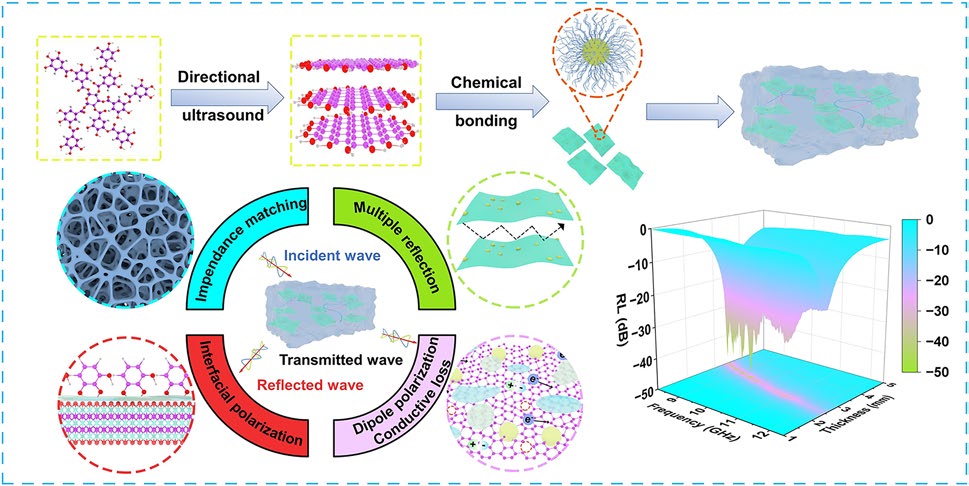
- The Role of Catechol-Functionalized Carbon Dots: To solve the restacking issue, the researchers synthesized carbon dots functionalized with catechol groups. These dots act as spacers that intercalate between the MXene layers. By preventing restacking, the carbon dots increase the accessible surface area and create a more complex network for electromagnetic energy dissipation. Furthermore, the chemical anchoring of these dots onto the MXene surface creates numerous heterogeneous interfaces, which are vital for enhancing interfacial polarization loss.
The Organic Hydrogel Matrix: Flexibility and Impedance Matching
Unlike traditional solid absorbers, this material is formulated as an organic hydrogel. This choice of matrix provides two strategic advantages: mechanical durability and tunable dielectric properties.
The hydrogel is built upon a dual-crosslinked polymer network, which ensures that the material can be stretched, bent, and compressed without losing its structural integrity or its microwave-absorbing properties. This makes it an ideal candidate for integration into smart clothing or flexible shields for mobile devices.
Moreover, the researchers employed a glycerol-regulated solvent system. By adjusting the ratio of water to glycerol within the gel, they were able to tune the polarity of the medium. This level of control is essential for optimizing impedance matching. When the impedance of the absorber is perfectly matched to that of free space, electromagnetic waves enter the material with minimal reflection, where they can then be converted into thermal energy.
Mechanisms of Energy Dissipation
The high efficiency of the MXene-CDs hydrogel is attributed to three primary dissipation mechanisms:
First, conduction loss occurs as the high-conductivity MXene network allows for the migration of electrons under the influence of the electromagnetic field, converting wave energy into heat.
Second, polarization loss is significantly enhanced by the carbon dots. The interfaces between the carbon dots, the MXene nanosheets, and the polymer matrix create dipole centers that oscillate in response to the microwave field. This interfacial polarization is a dominant factor in the high-frequency range.
Third, multiple reflections and scattering happen within the porous and layered structure of the hydrogel. As the waves bounce through the intercalated MXene layers, their energy is gradually attenuated, ensuring that very little radiation escapes the absorber.
Practical Application and Mechanical Robustness
One of the most impressive features of this hydrogel is its environmental stability and mechanical performance. Traditional hydrogels often lose water and become brittle over time. However, the inclusion of glycerol prevents dehydration, allowing the absorber to maintain its flexibility and performance even in harsh environments.
The material can be easily molded into different shapes or applied as a coating on various surfaces. In testing, the hydrogel demonstrated the ability to shield sensitive electronics from high-frequency interference while being subjected to repeated mechanical deformation. This combination of "softness" and "shielding power" represents a significant leap forward compared to standard rigid foam or rubber-based absorbers.
Conclusion and Future Outlook
The development of the carbon dots intercalated MXene hydrogel offers a powerful new tool for the flexible electronics industry. By moving away from heavy, rigid materials and toward multifunctional, bionic-inspired hydrogels, this research provides a blueprint for managing electromagnetic pollution in the age of 5G and beyond.
The ability to chemically tune the interface between zero-dimensional carbon dots and two-dimensional MXene nanosheets opens up new possibilities for other energy-related applications, such as flexible supercapacitors and sensors. As wearable technology continues to evolve, materials like this will be essential for creating devices that are both high-performing and seamlessly integrated into our daily lives.

Editor of Nano-Micro Letters, which is an Open-Access, peer-reviewed journal reported papers that have at least one dimension ranging from a few sub-nanometers to a few hundreds of micrometers. The journal is published by Springer Nature and indexed by SCI, EI, SCOPUS, Pubmed, etc. The 2024 JCR Impact Factor is 36.3. The 2024 CiteScore is 53.1.
Follow the Topic
-
Nano-Micro Letters
Nano-Micro Letters is a peer-reviewed, international, interdisciplinary and open-access journal that focus on science, experiments, engineering, technologies and applications of nano- or microscale structure and system in physics, chemistry, biology, material science, and pharmacy.




Please sign in or register for FREE
If you are a registered user on Research Communities by Springer Nature, please sign in