Charge dynamics of a noncentrosymmetric magnetic Weyl semimetal
Published in Physics


Explore the Research
 Nature
Charge dynamics of a noncentrosymmetric magnetic Weyl semimetal - npj Quantum Materials
npj Quantum Materials - Charge dynamics of a noncentrosymmetric magnetic Weyl semimetal
We study the broadband charge dynamics (i.e., longitudinal optical conductivity) of the ferromagnetic (FM), noncentrosymmmetric PrAlGe material and reveal its electronic environment, based on correlated Weyl states, which favours an unusually large anomalous Hall conductivity (AHC) at low temperatures. We thus propose a suitable experimental approach in order to trace the relevant ingredients of the electronic structure deploying substantial Berry curvatures, indispensable for AHC.
The family of the noncentrosymmetric RAlGe (R = rare-earth) materials is a suitable arena in order to advance our knowledge on novel topological states which cover all varieties of Weyl semimetals, including type I, type II, inversion and time-reversal breaking symmetry, depending on the choice of the rare-earth element. PrAlGe is of particular relevance, since it breaks both the space-inversion and time-reversal symmetry, leading to the formation of pairs of type I Weyl nodes.
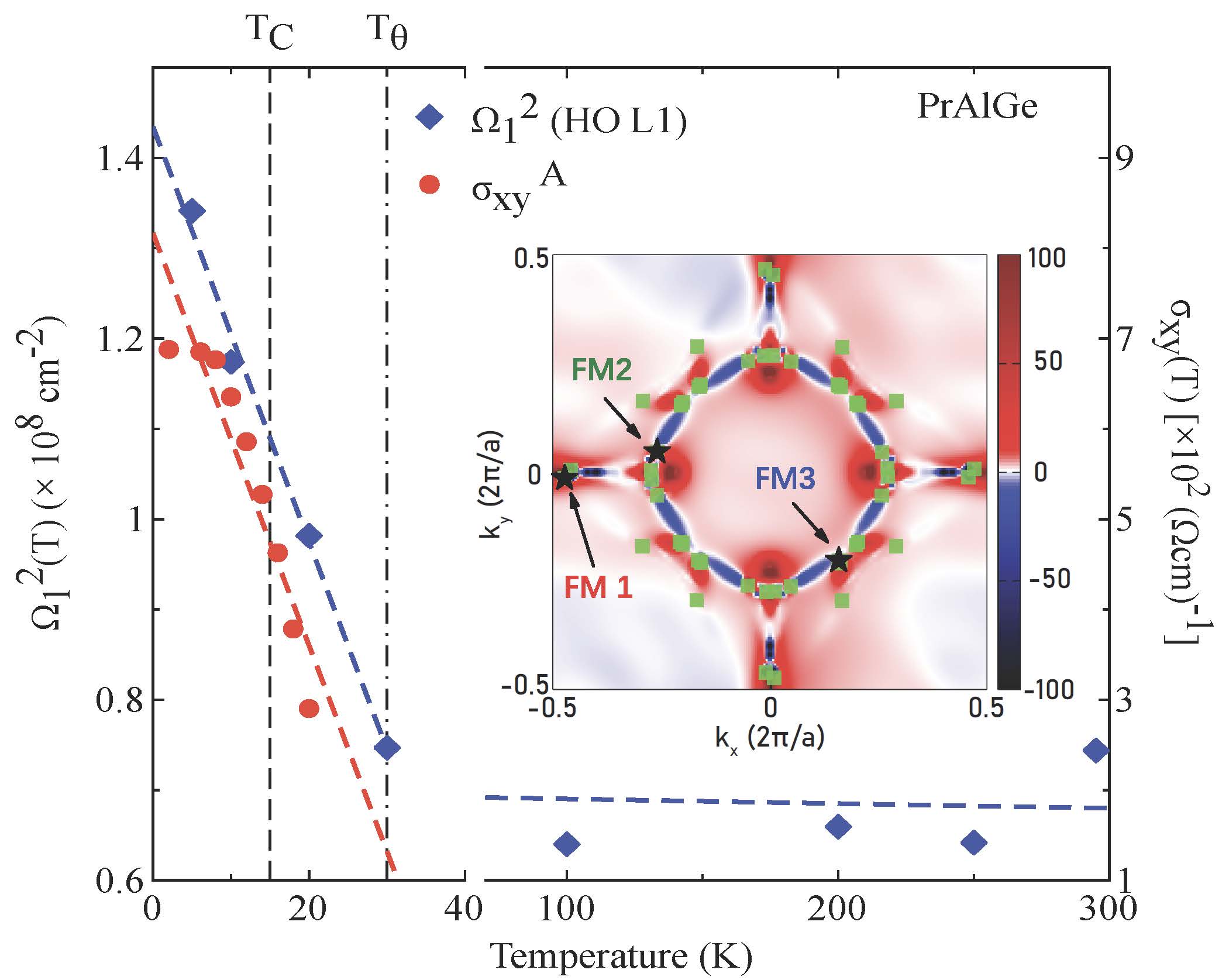
Fig. 1: Temperature dependence of the squared strength (i.e., spectral weight) of the FIR absorption and of the anomalous Hall conductivity σxy∼σxyA, reproduced from the literature. The linear fits (dashed lines) are guide to the eyes. The vertical dashed and dashed-dotted lines mark the Curie (TC) and the Curie-Weiss (Tθ) temperature, respectively. Inset: effective Berry curvature below TC with the projected location of Weyl states (green squares and black stars for the FM state).
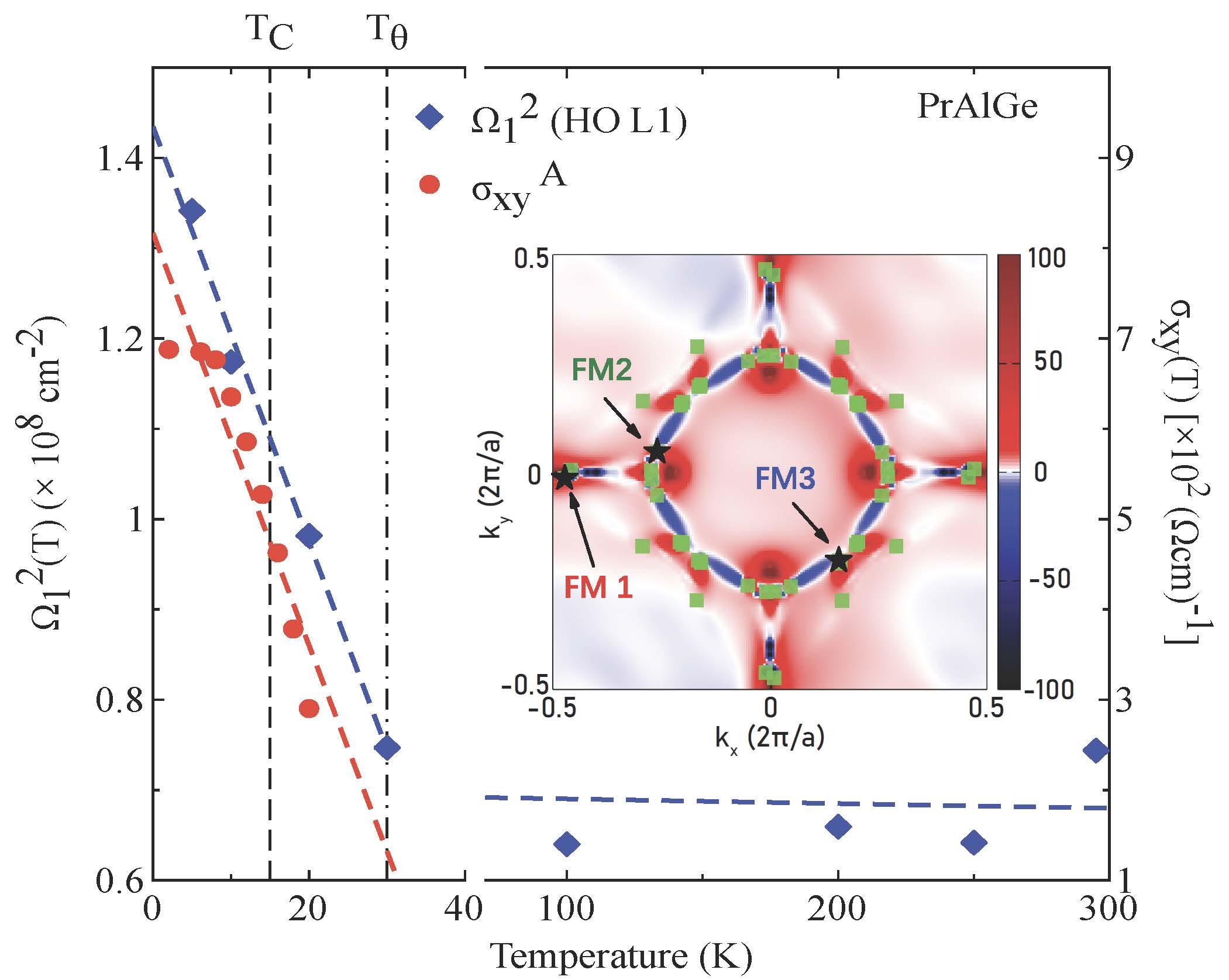
Our work presents measurements of the optical reflectivity, collected from the far infrared (FIR) to the ultraviolet at nearly normal incidence as a function of temperature, which is the prerequisite in order to perform reliable Kramers-Kronig transformation of the measured quantity, giving access to all optical functions. Our discussion is then supported by devoted first-principles calculations of the electronic band structure. We discover that electronic correlations get reinforced upon lowering temperature and induce a renormalisation of the non-trivial bands hosting the Weyl nodes. This is reflected in a sizeable reduction of the Fermi velocity with respect to the bare band value. In the FM state, the charge dynamics maps a band reconstruction, which additionally causes a reshuffling of spectral weight in FIR. Figure 1 depicts the most relevant implications of our findings: in the FM state the FIR spectral weight, pertinent to the electronic interband transitions involving the Weyl states, harbours an equivalent enhancement as for AHC. This indicates the empowered matrix element of dipole active excitations related to non-trivial states for which a large effective Berry curvature may be predicted.
Follow the Topic
-
npj Quantum Materials
An open access journal that publishes works that significantly advance the understanding of quantum materials, including their fundamental properties, fabrication and applications.

Related Collections
With Collections, you can get published faster and increase your visibility.
Intertwined Orders in Quantum Materials – In Memory of Daniel Khomskii
Publishing Model: Open Access
Deadline: Nov 13, 2026
Quantum Anomalous Hall Effect
Publishing Model: Open Access
Deadline: Nov 14, 2026