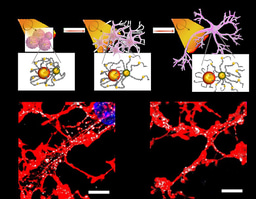
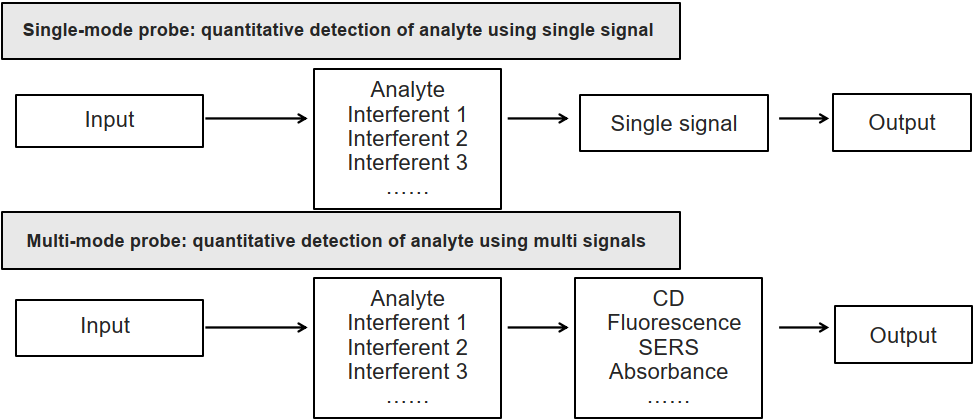
 Biomarker detection for early disease diagnosis demands materials with high sensitivity and anti-interference capability. However, conventional single-signal nanosensors often fail in complex biological matrices due to autofluorescence and matrix interference. To address these challenges, we report the synthesis of chiral multi-modal nanoprobes that integrate circular dichroism, fluorescence, and magnetic resonance signals. These probes, constructed using either ‘intrinsic chiral nanomaterials’ or ‘hybrid chiral assemblies’, leverage synergistic interactions between chiral frameworks and target analytes to enable orthogonal signal cross-validation. The operation time for their synthesis is usually less than 6 h, includes rapid screening (~1 h) of sensitivity and selectivity through optimization of spectral parameters. This strategy accelerates the development of advanced sensing materials, offering a robust platform for biomarker detection in biomedical applications. The protocol requires familiarity with nanomaterial synthesis, surface functionalization, and spectroscopic characterization.