Chronic pain has a metabolic state: immunometabolic remodeling in the spinal cord
Published in Chemistry, Neuroscience, and General & Internal Medicine

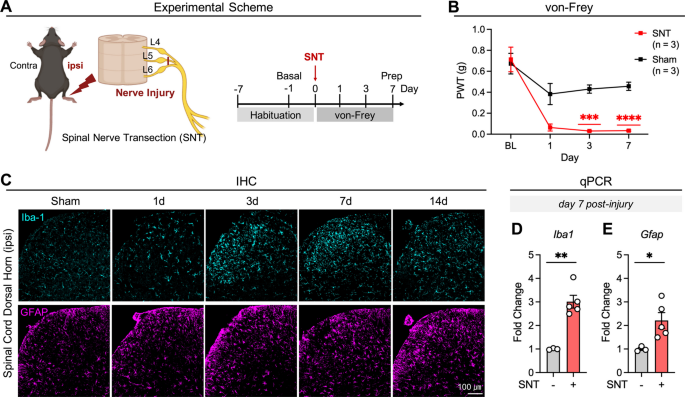

Neuropathic pain begins with nerve injury, but its persistence is sustained within the central nervous system. We asked whether this chronic state is accompanied by a distinct metabolic environment in the spinal cord.
Untargeted GC–MS metabolomics revealed a clear metabolic separation between nerve-injured and control spinal cords. The shift was strikingly coordinated: lactate, itaconate, and glycine increased, while multiple saturated and unsaturated free fatty acids—including palmitate, stearate, oleate, linoleate, and vaccenate—were broadly depleted.
This was not simply a signature of one experimental model. Across four independent spinal cord RNA-seq datasets representing distinct neuropathic pain paradigms, we found the same molecular direction: immune and inflammatory programs were consistently activated, whereas fatty-acid metabolism, cholesterol homeostasis, and other lipid-associated programs were suppressed. Targeted qPCR in our model reproduced this pattern, with Ldha, Hk2, and Acod1 increased and Fasn, Elovl5, and Elovl6 decreased.
Together, these findings suggest that persistent neuropathic pain is not only a state of neuronal sensitization and neuroinflammation—it is also a metabolically remodeled tissue state.
Rather than viewing metabolism as a passive consequence of chronic inflammation, our results position metabolic remodeling as an integral dimension of pain chronification. The convergence of immune activation and lipid metabolic suppression may define a biochemical environment that helps sustain the chronic pain state.
Persistent pain may therefore have a metabolic identity of its own—and that identity could reveal a new therapeutic axis beyond conventional neuronal or inflammatory targets.
Reference
- Miyamoto, K. et al. (2019) Astrocyte-neuron lactate shuttle sensitizes nociceptive transmission in the spinal cord. Glia 67, 27-36.
- Bolaños, J.P. and Magistretti, P.J. (2025) The neuron-astrocyte metabolic unit as a cornerstone of brain energy metabolism in health and disease. Nat. Metab. 7, 2414-2423.
- Park, J.S., Jun, H.W., Lee, J. et al. Peripheral nerve injury induces an immunometabolic signature involving reduced free fatty-acid pools. Metab Brain Dis. 41, 184 (2026).
- Mabou Tagne, A. et al. (2025) Metabolic reprogramming in the spinal cord drives the transition to pain chronicity. Cell Rep. 44, 116261.
- Park, J.S. et al. (2026) Astrocytic glycogenolysis gates Warburg-like metabolic reprogramming that promotes neuropathic pain chronification. Prog. Neurobiol. 262, 102924.
- Chen, Y. et al. (2025) Sox9 regulation of hexokinase 1 controls neuroinflammatory astrocyte subtypes in a rat model of neuropathic pain. Nat. Commun. 16, 10249.
Follow the Topic
-
Metabolic Brain Disease
This is a forum for publishing high-quality basic and clinical papers on a broad range of brain disorders in human and animal studies.