Closed‑Loop Synergistic Nitric Oxide/Hydrogen Delivery with Feedback Control for Diabetic Wound Healing
Published in Healthcare & Nursing, Bioengineering & Biotechnology, and General & Internal Medicine
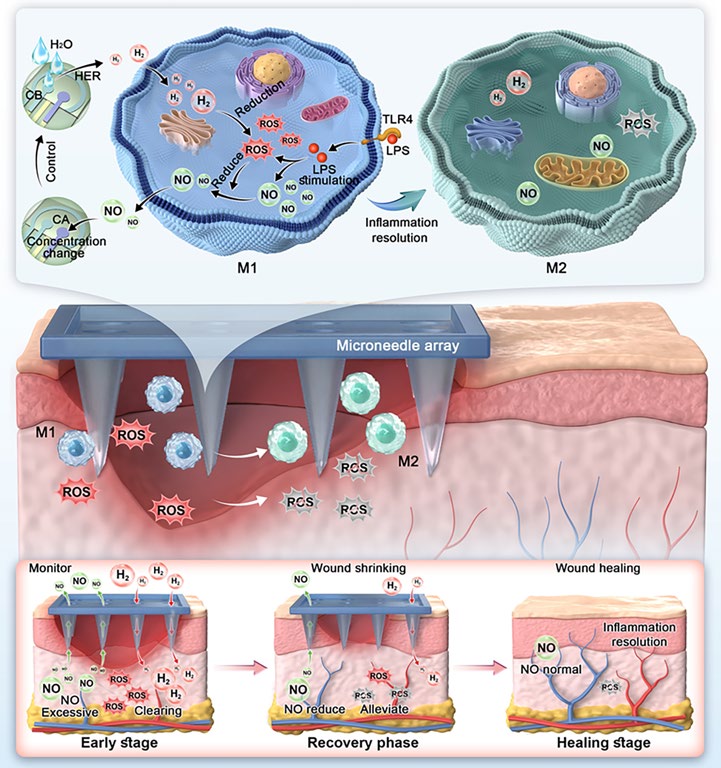
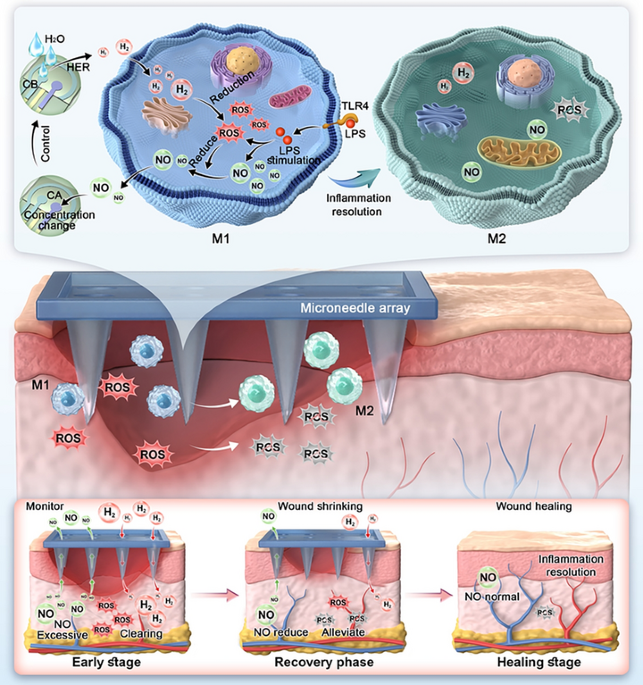

Diabetic wound healing represents a prototypical inflammation-driven pathology where conventional therapeutic hydrogen delivery lacks real-time, pathology-responsive regulation. Existing platforms often suffer from a critical decoupling between ultrasensitive sensing modules and high-performance therapeutic actuators, leading to compromised detection limits, delayed responses, and suboptimal treatment precision. Now, researchers led by Pengfei Wen, Pan Luo, Fuqiang Gao, Mingyi Yang, Junyou Li, and Zhi Yang have developed a breakthrough Pd-Ni5P4/dual-channel electrocatalytic flexible system (Pd- Ni5P4/DCEFS) that bridges this divide through an integrated closed-loop sensing–feedback–intervention paradigm.
Innovative Design and Mechanism
The system integrates a high-performance bifunctional Pd–Ni5P4 catalyst, a 3D-printed dual-channel flexible electrode (DCEF), and a biocompatible microneedle array via catalytic ink spin coating and gelatin-assisted bonding. This architecture enables two synergistic functions: Channel A performs ultrasensitive real-time electrochemical detection of nitric oxide (NO)—a pivotal inflammatory biomarker—with a remarkable detection limit of 9.6 nM, while Channel B drives on-demand hydrogen evolution reaction (HER) with a low overpotential of −91.0 mV at −10 mA cm-2.
The closed-loop mechanism directly employs endogenous NO concentration as the feedback signal to dynamically modulate the rate of therapeutic hydrogen release, establishing a single-cycle "sense–hydrogen treatment–sense" strategy. Mechanistically, in situ electrochemical Raman spectroscopy reveals that Pd and Ni cooperatively adsorb H₂O, facilitating the dissociation of *H2O into *H on Pd sites and thereby accelerating neutral HER kinetics. Crucially, the evolved hydrogen selectively scavenges deleterious reactive oxygen/nitrogen species (·OH, ONOO⁻) while preserving essential species such as HClO, creating an ideal microenvironment that drives macrophage polarization from the pro-inflammatory M1 phenotype toward the pro-healing M2 phenotype.
Outstanding Performance
The NO sensor exhibits a broad linear range from 10.0 nM to 3.0 μM with exceptional sensitivity of 1.0 μA nM-1 cm-2 and outstanding selectivity against physiological interferents including H2O2, ascorbic acid, glucose, and nitrite. The HER catalyst demonstrates a Tafel slope of 55.6 mV dec-1—approaching Pt–C performance—and maintains near-100% Faradaic efficiency with a stable current response over 20 hours. At the cellular level, three cycles of closed-loop dynamic treatment achieve near-complete inflammatory clearance in LPS-stimulated RAW264.7 macrophages, with 35 minutes of hydrogen supply at −0.25 V identified as the optimal anti-inflammatory protocol.
In a diabetic mouse wound model, the adaptive hydrogen strategy markedly suppresses inflammation within 5 days, achieves substantial wound closure by day 7, and attains >92% wound closure with complete re-epithelialization by day 11—despite a progressive reduction in treatment frequency from three times daily to once daily. Systemic biosafety evaluations confirm negligible Ni ion leaching (<<5.0 nM) and no detectable histopathological damage to major organs.
Applications and Future Outlook
By establishing a closed-loop dynamic treatment platform guided by lesion-specific biomarker levels, this work introduces a novel precision therapeutic paradigm for refractory diabetic wounds and other inflammation-associated disorders. The decoupled-free coupling of real-time NO sensing and electrocatalytic hydrogen generation provides a robust material and engineering framework for next-generation self-adaptive therapeutic platforms in regenerative medicine and precision healthcare.
Stay tuned for more groundbreaking research from this collaborative team at Xi'an Jiaotong University, Beijing Chaoyang Hospital, China-Japan Friendship Hospital, and Sungkyunkwan University!

Editor of Nano-Micro Letters, which is an Open-Access, peer-reviewed journal reported papers that have at least one dimension ranging from a few sub-nanometers to a few hundreds of micrometers. The journal is published by Springer Nature and indexed by SCI, EI, SCOPUS, Pubmed, etc. The 2024 JCR Impact Factor is 36.3. The 2024 CiteScore is 53.1.
Follow the Topic
-
Nano-Micro Letters
Nano-Micro Letters is a peer-reviewed, international, interdisciplinary and open-access journal that focus on science, experiments, engineering, technologies and applications of nano- or microscale structure and system in physics, chemistry, biology, material science, and pharmacy.



Please sign in or register for FREE
If you are a registered user on Research Communities by Springer Nature, please sign in