Convergence of Soft Electronics and Artificial Intelligence: From Materials to Intelligent Systems
Published in Materials, Physics, and Computational Sciences
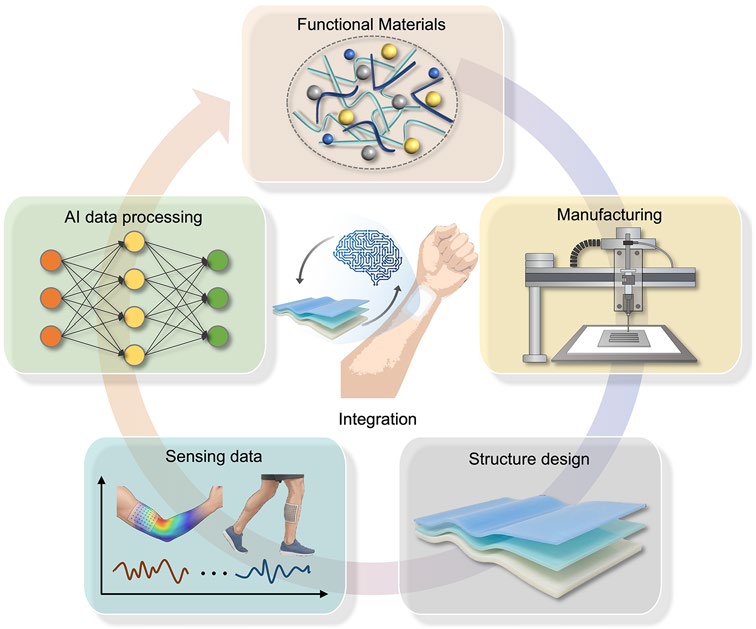

As wearable devices evolve from simple fitness trackers to sophisticated health monitors, a critical challenge remains: how to maintain reliable signal acquisition under real-world conditions where skin moves, sweats, and changes temperature. Now, researchers from Seoul National University and Gachon University, led by Professor Seung Hwan Ko and Professor Daeho Lee, have presented a comprehensive framework for the convergence of soft electronics and artificial intelligence—a synergy that transforms mechanically compliant sensors into truly intelligent systems.
Why This Convergence Matters
Traditional soft sensors excel at conformal contact but suffer from motion artifacts, hysteresis, and long-term drift that severely degrade signal quality. Conventional signal processing fails to compensate for these nonlinear, time-varying disturbances. The integration of AI with soft electronics overcomes this limitation by enabling adaptive denoising, drift-aware calibration, and multimodal inference directly at the edge—combining skin-like mechanical compliance with brain-like computational intelligence.
Innovative Design and Mechanism
The review identifies three interconnected pillars driving this field:
- Advanced Material Foundations: From intrinsically stretchable PEDOT:PSS conductors (>4100 S cm⁻¹ at 100% strain) and MXene-based biointerfaces to piezoelectric nanofiber textiles and self-healing hydrogels—materials are engineered not just for transduction, but for stable long-term interfacing with dynamic human skin.
- Intelligent Manufacturing & Integration: Scalable roll-to-roll gravure printing, laser-induced nanowire interlocking, and multilayer stretchable interconnects with through-via technologies enable high-density, deformation-tolerant circuitry that maintains performance across thousands of bending cycles.
- AI-Driven Computational Layer: Convolutional denoising autoencoders suppress motion artifacts in ECG signals; LSTM frameworks compensate for viscoelastic hysteresis; graph neural networks exploit irregular sensor topologies; and spiking neural networks deliver <1 mW event-driven inference for always-on wearables.
Outstanding Performance
The AI-soft electronics synergy delivers remarkable metrics across applications:
- Healthcare: Grade A blood pressure accuracy (−0.05 ± 4.61 mmHg systolic) via piezoelectric wristbands; 93.2% drowsiness detection accuracy from dry ear-EEG; closed-loop wound therapy with AI-driven stage diagnosis and adaptive electrical stimulation/drug delivery.
- Human-Machine Interfaces: ~97% gesture recognition accuracy with stretchable sEMG arrays; real-time silent speech decoding from skin-conformal strain gauges; immersive full-body motion tracking with haptic feedback networks.
- Soft Robotics: Tactile intelligence enabling texture classification, slip detection, and reinforcement learning-based collision-aware grasping with human-like dexterity.
Neuromorphic Frontiers
Beyond algorithmic AI, the review highlights material-level intelligence through organic electrochemical transistors (OECTs) that simultaneously sense, amplify, and memorize signals; polymer memristors with atomic-scale conductive filaments for non-volatile synaptic weights; and in-sensor reservoir computing that exploits intrinsic material dynamics for complex temporal inference—reducing data movement and power consumption by orders of magnitude.
Applications and Future Outlook
When co-designed across materials, manufacturing, hardware, and algorithms, AI-integrated soft electronics achieve what neither can accomplish alone: continuous, reliable operation in everyday settings. From personalized closed-loop therapeutics and immersive VR/AR interfaces to tactilely intelligent soft robots, this convergence establishes a new paradigm for next-generation wearable systems—where mechanical compliance meets computational autonomy, and where sensors don't just collect data, but understand it.
Stay tuned for more groundbreaking research from this collaborative team at Seoul National University and Gachon University!

Editor of Nano-Micro Letters, which is an Open-Access, peer-reviewed journal reported papers that have at least one dimension ranging from a few sub-nanometers to a few hundreds of micrometers. The journal is published by Springer Nature and indexed by SCI, EI, SCOPUS, Pubmed, etc. The 2025 JCR Impact Factor is 38.5. The 2025 CiteScore is 58.9.
Follow the Topic
-
Nano-Micro Letters
Nano-Micro Letters is a peer-reviewed, international, interdisciplinary and open-access journal that focus on science, experiments, engineering, technologies and applications of nano- or microscale structure and system in physics, chemistry, biology, material science, and pharmacy.



Please sign in or register for FREE
If you are a registered user on Research Communities by Springer Nature, please sign in