Coordination Thermodynamic Control of Magnetic Domain Configuration Evolution toward Low‑Frequency Electromagnetic Attenuation
Published in Materials
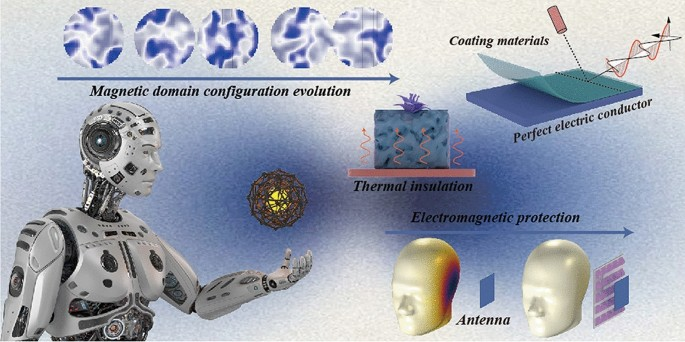

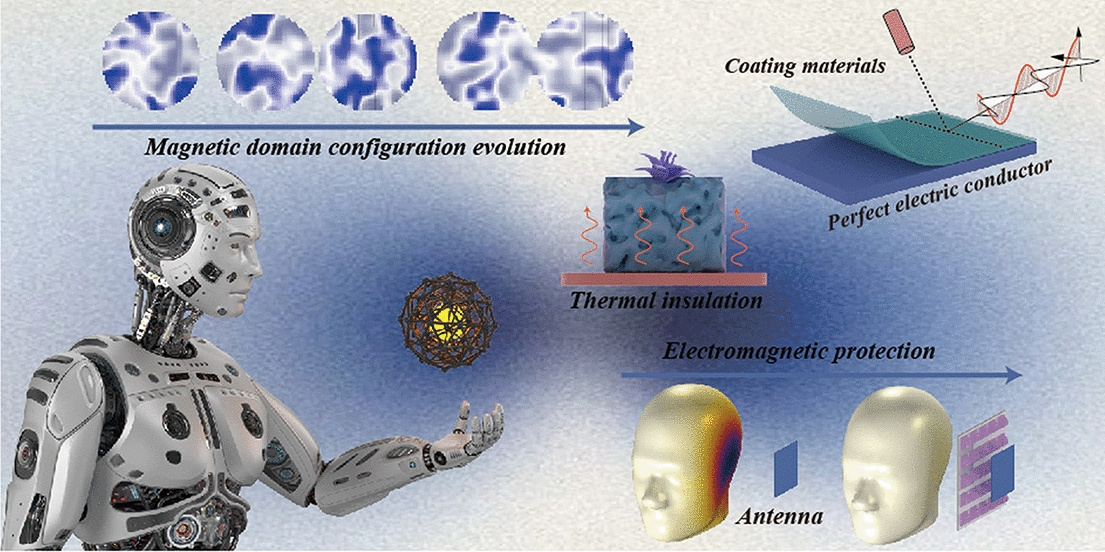

As the rapid development of Bluetooth technology and 5G communication continues to accelerate, electromagnetic interference issues in the ISM band (2.4–2.48 GHz) for Bluetooth devices, as well as the n77 (3.3–4.2 GHz), n78 (3.3–3.8 GHz), and n79 (4.4–5.0 GHz) bands for 5G communications, have become increasingly severe. Now, researchers from Nanchang Hangkong University, Nanchang University, Jiangxi Agricultural University, and Fudan University, led by Professor Chongbo Liu, Professor Yuhui Peng, Professor Guangsheng Luo, and Professor Xuliang Nie, have presented a breakthrough method for controlling magnetic nanoparticle spacing and magnetic domain configurations. This work offers valuable insights into the development of next-generation low-frequency electromagnetic wave absorption materials that can overcome the Snoek limitation.
Why Magnetic Domain Configuration Control Matters
- Low-Frequency Electromagnetic Wave Absorption: Precise tuning of magnetic domain configurations enables effective attenuation of low-frequency EM energy in the S-band (2–4 GHz) and C-band (4–8 GHz), addressing critical electromagnetic interference and radiation pollution challenges.
- Breaking the Snoek Limit: The unique magnetic coupling phenomenon surpasses the Snoek limit in the low-frequency range, significantly enhancing permeability beyond what conventional ferromagnetic materials can achieve.
- Multifunctional Integration: The developed composites offer additional radar stealth and thermal insulation performances, making them suitable for extreme temperature conditions and complex application environments.
Innovative Design and Features
- Thermodynamically Controlled Coordination Strategy: A periodic coordination thermodynamical strategy is proposed to modulate magnetic domain configurations, achieved through aldimine condensation, coordination thermodynamics, and thermal reduction. This approach enables precise regulation of magnetic nanoparticle spacing from individual to coupled and ultimately to crosslinked domain configurations.
- Built-in Electric Field Enhancement: The Fe-injected Ni/N-doped carbon aerogel (NF@NCA) interface generates a spontaneous built-in electric field due to work function differences, which significantly enhances interfacial electron transport and polarization loss.
- Magnetic-Carbon Heterogeneous Interface: The formation of magnetic-carbon heterogeneous interfaces between NF nanoparticles and graphitic carbon enhances polarization loss and facilitates charge migration under alternating EM fields.
Applications and Future Outlook
- Effective Low-Frequency Absorption: The crosslinked magnetic configuration achieves effective low-frequency EM wave absorption at 3.68 GHz, encompassing nearly the entire C-band, with a maximum effective absorption bandwidth of 3.68 GHz.
- Radar Stealth Performance: Radar cross-section simulations demonstrate that NF@NCA-4 achieves a maximum RCS reduction value of 32.68 dB·m², indicating superior radar wave absorption capabilities for practical far-field conditions.
- Thermal Insulation: NF@NCA-3 composites exhibit excellent thermal insulation capabilities with a thermal conductivity of 0.045 W·m⁻¹·K⁻¹ and temperature difference exceeding 63°C, suitable for extreme temperature applications.
- Ultrabroadband Absorption: A robust gradient metamaterial design with honeycomb-perforated structure achieves full-band absorption covering 2–40 GHz, effectively mitigating the impact of EM pollution on human health and environment.
- Electromagnetic Protection: The metamaterial demonstrates excellent EM protection properties for Bluetooth devices, with negligible radiation observed in simulations compared to unprotected models.
This comprehensive study elucidates the evolution mechanisms of magnetic domain configurations, addresses gaps in dynamic magnetic modulation, and provides novel insights for the development of high-performance, low-frequency EM wave absorption materials. Stay tuned for more groundbreaking work from Professor Chongbo Liu and the research team!

Editor of Nano-Micro Letters, which is an Open-Access, peer-reviewed journal reported papers that have at least one dimension ranging from a few sub-nanometers to a few hundreds of micrometers. The journal is published by Springer Nature and indexed by SCI, EI, SCOPUS, Pubmed, etc. The 2025 JCR Impact Factor is 38.5. The 2025 CiteScore is 58.9.
Follow the Topic
-
Nano-Micro Letters
Nano-Micro Letters is a peer-reviewed, international, interdisciplinary and open-access journal that focus on science, experiments, engineering, technologies and applications of nano- or microscale structure and system in physics, chemistry, biology, material science, and pharmacy.