Down‑Top Strategy Engineered Large‑Scale Fluorographene/PBO Nanofibers Composite Papers with Excellent Wave‑Transparent Performance and Thermal Conductivity
Published in Electrical & Electronic Engineering and Materials
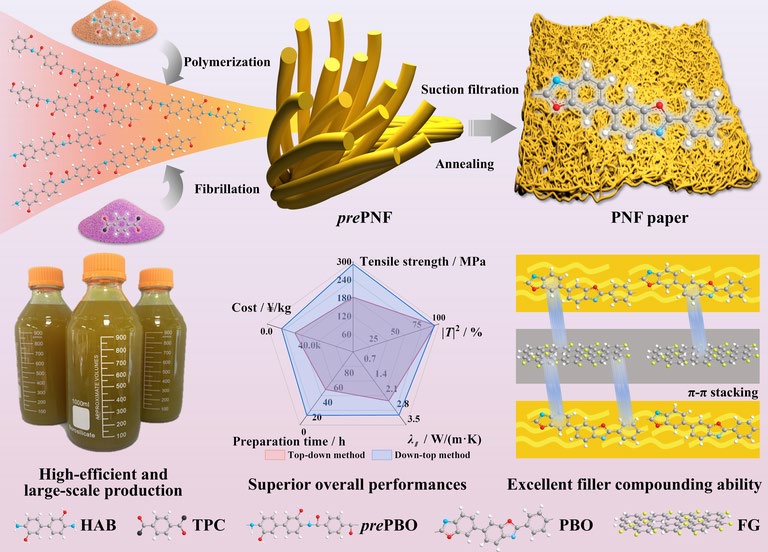


As 5G/6G communications, aerospace systems, and high-frequency electronics advance, the demand for lightweight, wave-transparent, and thermally conductive materials has become increasingly urgent. Now, researchers from the Shaanxi Key Laboratory of Macromolecular Science and Technology at Northwestern Polytechnical University, led by Professor Junliang Zhang and Professor Junwei Gu, have developed a groundbreaking down–top strategy to fabricate fluorographene/poly(p-phenylene benzobisoxazole) nanofiber (FG/PNF) composite papers with exceptional wave-transparent performance, thermal conductivity, and mechanical strength. This work offers a scalable and cost-effective solution for next-generation electromagnetic and thermal management applications.
Why FG/PNF Composite Papers Matter
- Wave-Transparent Performance: With a transmittance (|T|2) of 96.3% at 10 GHz, these composite papers outperform traditional polymer-based materials, making them ideal for radar radomes and antenna systems.
- Thermal Conductivity: In-plane (λ∥) and through-plane (λ⊥) thermal conductivities reach 7.13 W·m-1·K-1 and 0.67 W·m-1·K-1, respectively—critical for heat dissipation in high-power devices.
- Mechanical Strength: Tensile strength and toughness reach 197.4 MPa and 11.6 MJ·m-3, ensuring durability under extreme conditions.
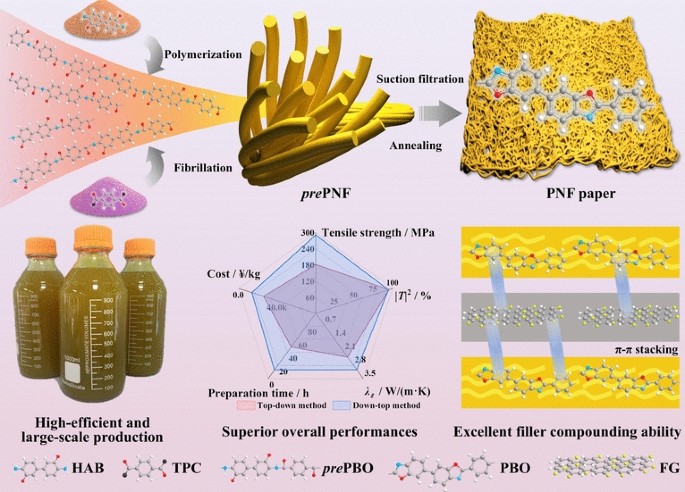
- Scalability & Cost Efficiency: The down–top strategy reduces preparation time from 50 to 14 hours and cuts raw material cost by nearly 50%, enabling large-scale industrial production.
Innovative Design and Features
- Down–Top Strategy: Unlike traditional top–down methods that rely on harsh acids to dissolve PBO fibers, this approach synthesizes PBO precursor nanofibers (prePNF) with abundant hydroxyl and amino groups, enhancing compatibility with fluorinated graphene (FG).
- Interfacial Engineering: Hydrogen bonding and π–π interactions between FG and PNF improve dispersion stability and structural uniformity, minimizing electromagnetic losses and phonon scattering.
- Controlled Microstructure: Vacuum-assisted filtration and thermal annealing produce dense, layered composite papers with aligned FG sheets, optimizing both electromagnetic and thermal performance.
Applications and Future Outlook
- 5G/6G Base Stations & Radar Systems: FG/PNF papers serve as high-performance radome materials, reducing electromagnetic heating and improving signal fidelity.
- Aerospace & Transportation: Their lightweight, thermally stable, and hydrophobic properties make them suitable for antenna covers and electromagnetic shielding components.
- Thermal Management: Infrared thermal imaging confirms superior heat dissipation compared to conventional materials, extending device lifespan and reliability.
- Challenges and Opportunities: Future research will focus on long-term environmental stability, integration into flexible electronics, and further optimization of FG loading for multifunctional performance.
This comprehensive study provides a scalable roadmap for developing advanced nanocomposite papers that integrate electromagnetic transparency, thermal management, and mechanical robustness—a crucial step toward smarter, faster, and more reliable communication and sensing systems. Stay tuned for more innovations from Professor Junliang Zhang and Junwei Gu’s team at Northwestern Polytechnical University!

Editor of Nano-Micro Letters, which is an Open-Access, peer-reviewed journal reported papers that have at least one dimension ranging from a few sub-nanometers to a few hundreds of micrometers. The journal is published by Springer Nature and indexed by SCI, EI, SCOPUS, Pubmed, etc. The 2025 JCR Impact Factor is 38.5. The 2025 CiteScore is 58.9.
Follow the Topic
-
Nano-Micro Letters
Nano-Micro Letters is a peer-reviewed, international, interdisciplinary and open-access journal that focus on science, experiments, engineering, technologies and applications of nano- or microscale structure and system in physics, chemistry, biology, material science, and pharmacy.