Editor Story: Dr. Nikolaos Dimakis
Published in Astronomy


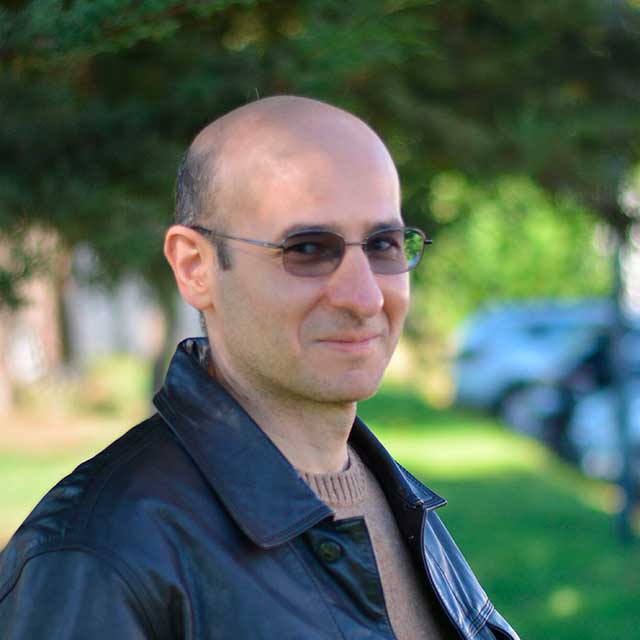
Dr. Nikolaos Dimakis is an assistant professor at the Universidad de La Frontera (UFRO), in Temuco, Chile. He joined the Editorial Board of Scientific Reports in 2026.
His research spans gravitation and cosmology, focusing on cosmological and gravitational solutions in modified theories of gravity, quantum cosmology, and particle dynamics in curved backgrounds. In particular, he concentrates on theoretical aspects and the application of mathematical methods related to symmetries.
***
We recently invited Dr. Nikolaos Dimakis for a Q&A where they answered questions about their research and what it is to work as an Editorial Board Member at Scientific Reports. Some of the questions they answered are below
What do you like most about being an Editorial Board Member for Scientific Reports?
I value the experience of participating in the process that a scientific manuscript follows to become a formal publication. This is an opportunity for me to broaden my scope and contribute to the community.
What do you like most about handling manuscripts at Scientific Reports?
I have the opportunity to engage with work belonging to a broader scope than my own research. What I value most is that authors trust us with their manuscripts, which are the culmination of hard work, and our role is to find the right experts whose constructive criticism can help make them better. Whenever an author thanks a reviewer for helping to improve their paper, I feel that the entire process was truly worth it.
We know that finding reviewers is one of the hardest parts of an editorial role. Do you have any tricks on finding reviewers?
I follow the guidance from the introductory editorial training course on how to find reviewers. It is true, however, that it is becoming increasingly difficult. Most experienced academics must balance multiple responsibilities (teaching, research, administrative duties, etc.), and their available time is extremely limited. It is usually early-career researchers who are more inclined to accept reviewing a manuscript, both for the experience and because they have fewer academic commitments. I always emphasize in invitation letters that deadlines are not rigid, so reviewers know they can evaluate a manuscript without the pressure of having to rush through it.
If you were to give a piece of advice to other Editors, what would that be?
Accept to handling manuscripts within your general area of expertise, be open-minded, but make no compromises on scientific rigor.
How important is reproducibility in research? As an Editor, how do you help authors report reproducible results?
It really depends on the type of research. In theoretical physics, results are mathematically derived, so what matters most is that the assumptions and premises are well-founded and sufficiently justified. In experimental work, reproducibility is essential. Authors must demonstrate that results are confirmed over multiple measurements rather than being an isolated anomaly. An editor should ensure that conditions are clearly explained and data are available, so reviewers can scrutinize the core assumptions and verify the results.
What are the key things journals should do to ensure scientific rigor?
First and foremost, journals should support reviewers, as they carry much of the burden of verifying the scientific validity of manuscripts. This includes providing enough time for evaluations, as well as proper recognition and compensation for their efforts.
Do you think Scientific Reports help reduce publication bias, and if yes – how?
Yes, I believe it does. By being inclusive and publishing research as long as it is scientifically rigorous, rather than based on perceived impact, Scientific Reports helps reduce publication bias in the literature. It provides an important platform for research that might otherwise be overlooked.
What would you like to share with your fellow researchers on publishing in an inclusive journal?
Inclusive journals are necessary because they prioritize scientific soundness over current trends. All new knowledge in science, irrespective of whether it is considered “hot” at a specific moment, deserves to be shared and published. We cannot know whether a result that does not appear particularly relevant today will become important for future breakthroughs. Each contribution is a brick, large or small, in the edifice of science, and we cannot afford to exclude sound findings because we cannot predict the future. In this sense, I would encourage fellow researchers to consider inclusive journals for their work.
What are the biggest challenges that you see for the future of research and research dissemination?
Current research already suffers from over-reliance on metrics. Many researchers are forced to publish to secure a position, maintain it, obtain funding, and so on. In many cases, this has turned academia into an industry that ultimately prioritizes quantity over quality. With advances in Artificial Intelligence (AI), an already problematic situation can easily get out of hand. Of course, if AI is used responsibly as a helpful tool for correcting grammar or typos, searching the literature, assisting with derivations, and maintaining strict human oversight of the outcome, I consider it entirely acceptable. However, using it primarily to increase productivity, publish rapidly without proper verification, chase trends, and simply accumulate citations is a problematic practice. Distinguishing genuine research from automated, metric-driven production will be a significant challenge.
What are responsible ways to integrate AI into the peer review process, and how can editors feel empowered to explore these new tools to provide helpful solutions for authors, editors, reviewers, and AI experts?
I consider AI agents to be very useful tools, if users verify the validity of the output rather than simply copying and pasting it. I find them valuable for literature searches, summarizing research, identifying typos, language editing, and exploring counterarguments. However, a review report must reflect the scientific opinion of the referee. AI tools can support the process, but the final evaluation should be made by experts in the field.
ORCID ID: https://orcid.org/0000-0002-1307-1073
Follow the Topic
-
Scientific Reports
An open access journal publishing original research from across all areas of the natural sciences, psychology, medicine and engineering.



