Emerging Role of 2D Materials in Photovoltaics: Efficiency Enhancement and Future Perspectives
Published in Bioengineering & Biotechnology, Chemistry, and Materials
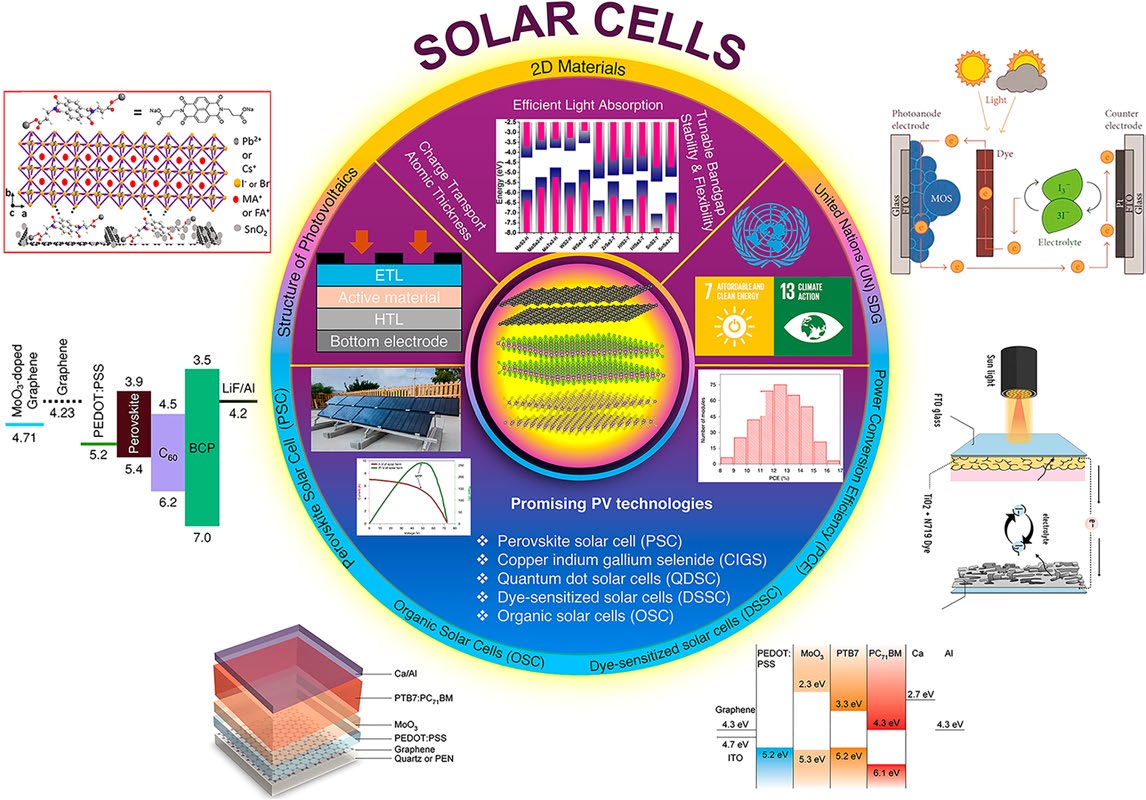
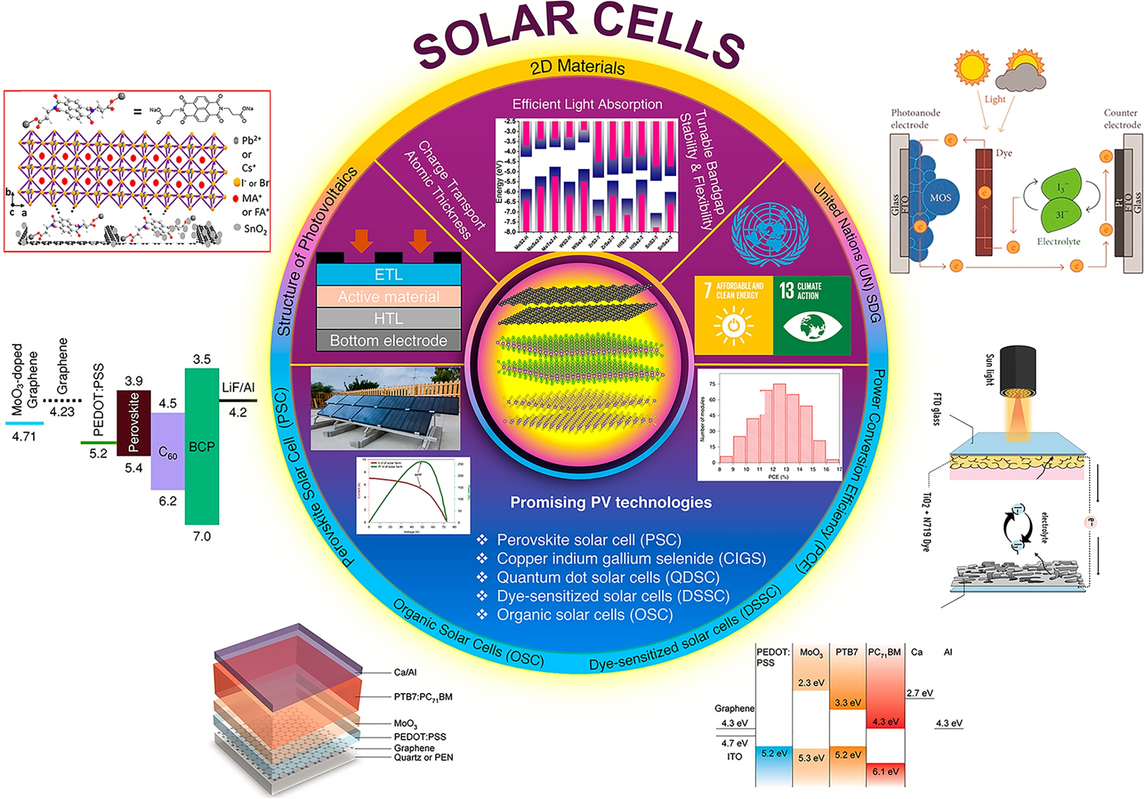

As the global energy crisis intensifies and climate change accelerates, the limitations of conventional silicon-based photovoltaics in terms of efficiency, stability, and flexibility become increasingly pronounced. Now, an international research team led by Professor Ghulam Dastgeer from Sejong University and Professor Zhiming Wang from the University of Electronic Science and Technology of China has presented a comprehensive review on two-dimensional materials and their revolutionary applications in solar energy harvesting. This work offers valuable insights into the development of next-generation photovoltaic technologies that can overcome these fundamental limitations.
Why 2D Materials Matter in Photovoltaics
- Efficiency Boost: Atomically thin 2D materials (e.g., graphene, MoS2, MXenes) enable tunable bandgaps, high carrier mobility, and superior charge transport, addressing key losses in traditional solar cells.
- Interface Engineering: As electron/hole transport layers (ETLs/HTLs) or passivation agents, they reduce recombination and enhance energy-level alignment in perovskite, organic, and dye-sensitized solar cells (PSCs, OSCs, DSSCs).
- Stability & Flexibility: Their chemical robustness and mechanical flexibility unlock lightweight, bendable devices for wearable/portable applications.
Innovative Design and Features
- Material Diversity: Covers graphene, TMDCs (MoS2, WS2), black phosphorus, MXenes, and elemental 2D sheets (silicene, stanene), each tailored for specific photovoltaic functions (e.g., transparent electrodes, catalytic counter electrodes).
- Device Architectures: Detailed roles in planar, bulk heterojunction, and nanocomposite solar cells, optimizing light absorption, exciton dissociation, and charge extraction.
- Scalability Solutions: Advances in CVD growth, liquid-phase exfoliation, and roll-to-roll transfer tackle large-area fabrication challenges.
Applications and Future Outlook
- Perovskite Solar Cells: 2D materials passivate defects (e.g., Pb–S bonding), guide epitaxial growth, and block moisture/ion migration, achieving >26% PCE and 1,000+h stability.
- Organic Solar Cells: Work-function-tuned 2D HTLs/ETLs (e.g., WS2, ZrSe2) reduce recombination, enabling 17%+ efficiency and bending durability (>1,000 cycles).
- Dye-Sensitized Solar Cells: Pt-free 2D counter electrodes (e.g., WSe2:Zn, MoP/MXene composites) deliver 10%+ PCE via enhanced electrocatalytic activity for I3⁻ reduction.
- Challenges & Roadmap: Key hurdles include limited light absorption (atomic thickness), defect susceptibility, and scalable synthesis. Future focus: machine-learning-driven material screening, multifunctional heterostructures, and 10,000+h stability testing.
This review provides a roadmap for 2D material integration into terawatt-scale photovoltaic technologies, emphasizing interdisciplinary collaboration to achieve >28% PCE and commercial viability by 2030.

Editor of Nano-Micro Letters, which is an Open-Access, peer-reviewed journal reported papers that have at least one dimension ranging from a few sub-nanometers to a few hundreds of micrometers. The journal is published by Springer Nature and indexed by SCI, EI, SCOPUS, Pubmed, etc. The 2024 JCR Impact Factor is 36.3. The 2024 CiteScore is 53.1.
Follow the Topic
-
Nano-Micro Letters
Nano-Micro Letters is a peer-reviewed, international, interdisciplinary and open-access journal that focus on science, experiments, engineering, technologies and applications of nano- or microscale structure and system in physics, chemistry, biology, material science, and pharmacy.


Please sign in or register for FREE
If you are a registered user on Research Communities by Springer Nature, please sign in