EquiFashion: Balancing Creativity and Realism in AI-Generated Fashion Design
Published in Computational Sciences
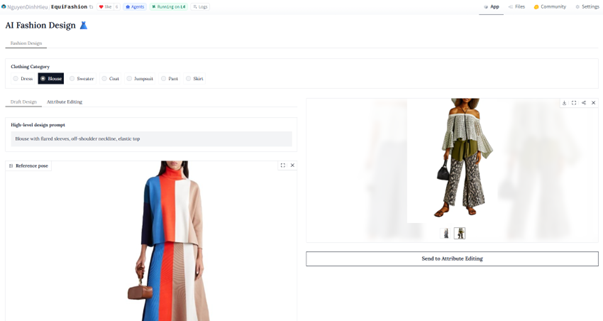


Behind the Paper: EquiFashion – Bridging Creativity and Fidelity in AI-Generated Fashion Design
Fashion is not only a form of artistic expression but also a complex industry where creativity, structure, and human preferences must be carefully balanced. With recent advances in generative artificial intelligence, text-to-image models have opened new possibilities for automated fashion design. However, generating high-quality fashion images remains challenging because AI systems must understand detailed garment attributes, preserve realistic human structures, and produce diverse yet meaningful designs.
Existing generative approaches often face a fundamental challenge: balancing diversity and fidelity. GAN-based models are capable of exploring creative and diverse designs but may suffer from instability and limited control. On the other hand, diffusion-based models provide high-quality and realistic images but can struggle with complex textual descriptions, where attributes such as colors, garment parts, or textures may be incorrectly assigned.
To address this challenge, we developed EquiFashion, a hybrid GAN–Diffusion framework designed to achieve a better balance between creative exploration and realistic fashion generation.
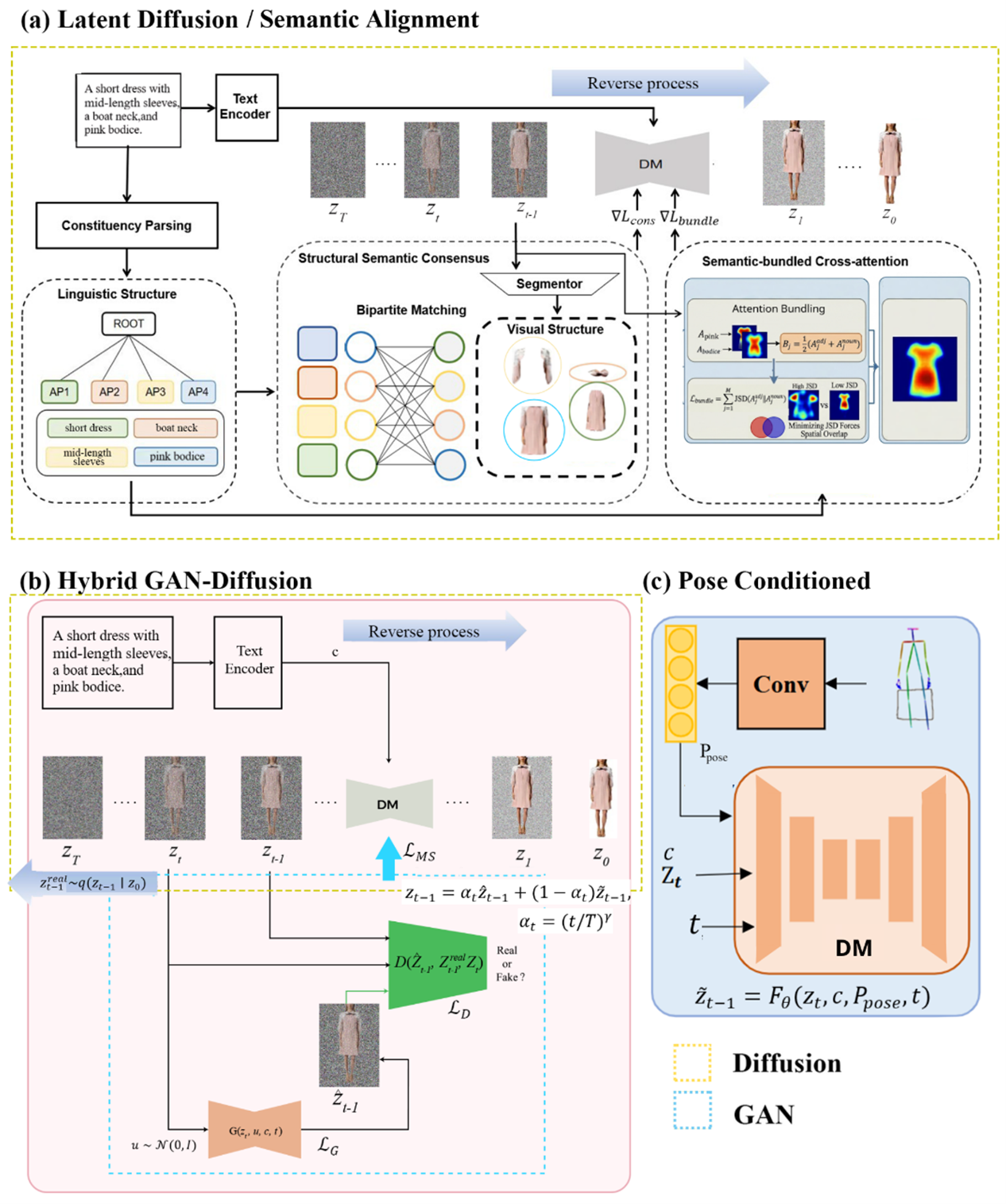
The main idea behind EquiFashion is to combine the complementary strengths of GANs and diffusion models. The GAN branch encourages stylistic exploration by generating diverse latent fashion concepts from the same textual description. Meanwhile, the diffusion branch focuses on refinement, improving visual details, texture quality, and photorealistic appearance.
Beyond the hybrid architecture, EquiFashion introduces several mechanisms to improve semantic understanding between text descriptions and generated images.
First, we propose Structural Semantic Consensus (SSC), which decomposes input descriptions into fine-grained attribute phrases and aligns them with corresponding garment regions. For example, when a prompt describes a “pink bodice” or “mid-length sleeves”, the model should understand that these attributes belong to specific clothing areas rather than affecting unrelated parts of the garment. This alignment helps reduce attribute confusion and improves structural consistency.
Second, we introduce Semantic-Bundled Cross-Attention (SBCA), which improves the localization of textual attributes during generation. Instead of processing individual words independently, SBCA combines related adjective–noun concepts, allowing the model to better associate descriptions with their corresponding visual regions. This improves semantic accuracy and reduces attribute leakage.
Fashion generation also requires realistic interaction between clothing and human bodies. Therefore, EquiFashion incorporates pose-conditioned latent diffusion, where human pose information guides the generation process. This enables the model to preserve body geometry, garment silhouette, and realistic clothing alignment.
Alongside the proposed framework, we introduce EquiFashion-DB, a large-scale dataset designed for text- and pose-guided fashion generation. The dataset contains approximately 200,000 fashion samples, standardized at 512×512 resolution, covering more than 40 categories with aligned image, text, and pose annotations. In addition, EquiFashion-DB includes controlled text noise augmentation to evaluate how models perform under realistic user inputs, such as incomplete descriptions, ambiguous attributes, or imperfect prompts.
Through extensive experiments, EquiFashion demonstrates improved performance in terms of visual fidelity, generation diversity, and text-image semantic alignment. The results show that combining GAN-based exploration with diffusion-based refinement can provide a more reliable approach for AI-assisted fashion design.
We believe EquiFashion represents a step toward future intelligent fashion systems, where artificial intelligence can support designers by expanding creative possibilities while maintaining the original design intent.
The project resources are publicly available:
Paper (DOI):
https://doi.org/10.1007/978-981-92-1926-1_15
Source Code:
https://github.com/nguyendinhhieu1309/EquiFashion.git
Dataset (EquiFashion-DB):
https://huggingface.co/datasets/NguyenDinhHieu/EquiFashion-DB