Exploring Fairness in Remote Blood Pressure Estimation with EquiNet
Published in Bioengineering & Biotechnology and Computational Sciences


Remote photoplethysmography (rPPG) uses subtle changes in facial video to extract physiological information without physical contact. While exploring existing approaches, we became interested in how signal quality can vary across different skin tones, lighting conditions, and motion scenarios. Existing rPPG datasets also provide limited representation of darker Fitzpatrick skin types, making it challenging to understand how models behave across diverse populations. These observations motivated us to explore fairness not only from a modeling perspective, but also through the way datasets are constructed and evaluated.
As part of this work, we introduced EquiNet-DB, a video dataset designed to include a broader range of participants and recording conditions. The dataset contains 73 participants, with more than 40% represented by Fitzpatrick skin types V and VI. Recordings include different lighting conditions and various scenarios such as neutral expressions, talking, head rotation, and natural movement. Rather than simply increasing the amount of data, our goal was to support further investigation into how physiological signals vary across individuals and environments.
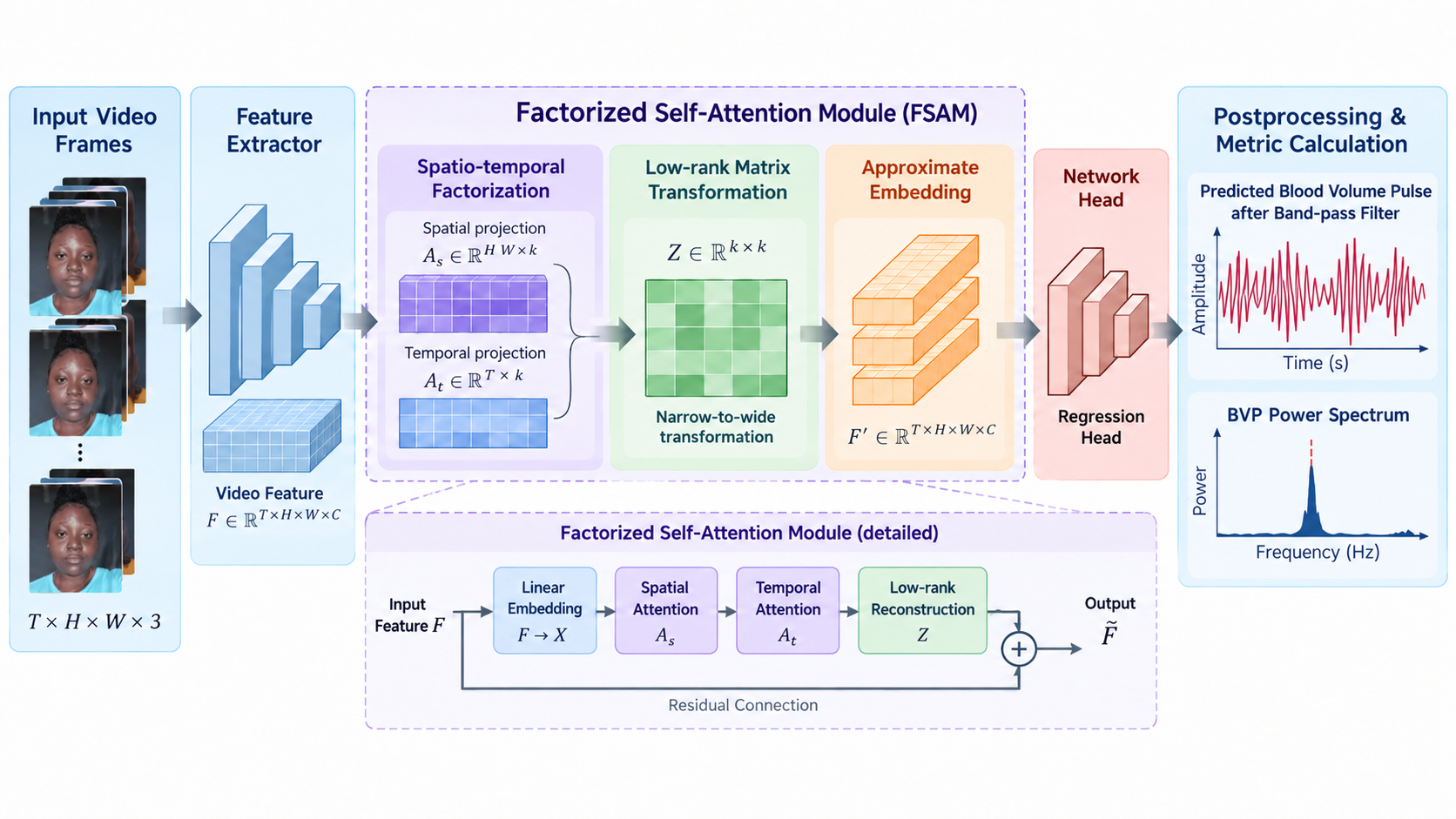
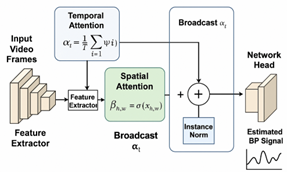
Alongside the dataset, we explored EquiNet, a 3D-CNN-based architecture combining a Joint Spatio-Temporal Attention mechanism (JSTA) with a Factorized Self-Attention Module (FSAM). The motivation was to examine spatial and temporal information together, as physiological signals in facial video can be subtle and distributed across both facial regions and consecutive frames. JSTA focuses on feature interactions across these dimensions, while FSAM further refines representations while preserving temporal information.
An important part of this work was also considering how these systems should be evaluated. Beyond overall prediction error, we examined performance across Fitzpatrick skin-tone groups. Our experiments considered common evaluation metrics such as MAE, RMSE, and Pearson correlation, together with group-level measures including performance disparity and worst-group error. This perspective allows us to consider not only average performance, but also how consistently a system behaves across different groups.
For us, the broader value of this work lies in the questions it raises. How should physiological datasets represent different populations? How should fairness be assessed when overall metrics may hide differences between groups? And how can model design consider challenging signal conditions from the beginning?
By sharing EquiNet-DB, the EquiNet architecture, and our evaluation approach, we hope to contribute to ongoing discussions around fairness and reliability in remote physiological sensing.
There is still much to explore. Future directions include RGB–thermal sensing, personalized adaptation, evaluation in less controlled environments, deeper analysis across combinations of skin tone, age, and gender, and further validation in real-world healthcare scenarios. We see this work as one step in a continuing research effort and hope that sharing our approach can encourage discussion, comparison, and collaboration within the research community.
Paper (DOI):
https://doi.org/10.1007/978-3-032-10489-2_12