ESG - Questionaire Scoring & Probabilistic Evaluation
Published in Mathematics, Business & Management, and Economics



Explore the Research
Quantitative ESG scoring model and metric for alternative investments and venture capital targets
Introduction & Background
In the alternative investments business (funds, funds of funds investing in start up or small - middle enterprises) where available ESG-related data are rare / very scarce or even not available at all, investment's targets may be ESG-assessed via questionnaire.
Questionnaire are seen as valid qualitative instrument (ex. due diligence questionnaires - DDQ) for qualitative assessments but not yet seen as valid qualitative source of information. Actually an open question, without currently a unique answer in the corporate world, is how to quantitatively measure questionnaires results in this field and if/how to produce an ESG sustainability / ESG risk probability based on the questionnaire results.
The article provides an answer to this question, developing a structured quantitative framework to score and interpretate the results of an ESG questionnaire from a very general perspective, providing also empirical data (companies ESG Assessed) in small measure but looking forward to produce available statistical points.
Behind-the-scenes
The approach followed by the author (please look into the poster for a synthesis and in the articole itself for details) is to start with an abstract mathematical approach thinking the questionnaire and its answer as a QxA cartesian set and the score value as a set function symilar to a signed measure (even if it's real set function nature is the relevant one). Seeing the score as a set function it's possible to rethink it as a probability, mapping it in 0,1 (via a sigmoid function in the article but it is valid for a general probabilistic mapping). Both ESG Score and Probability will have specifics (these are valid topics to follow up) however they already provide the quantitative framework to develope an ESG metric answering the "open question" the Business community has and also deriving results to abilitate the usage of questionnaires for scoring purpposes.
Summary of main results
The article introduces a new mathematical approach that uses modern mathematics to answer the interrogative, considering scoring a questionnaire the result of a real value set function / similar to a measure on the answer space and linking the score value to an ESG-risk probability via a score-probability mapping with a probabilistic interpretation.
The methodology introduced for these specific types of questionnaires, being abstractly defined, is applicable to other questionnaires type where Y/N answer are the possible outcomes, it is however been developed for ESG questionnaire.
The article shows some empirical results of the methodology developed and opens to a broaden application both empirical (submitting questionnaires to more available companies) and theoretical digging into the possible quantitative implication of the approach introduced leveraging from the parallelism introduce between a questionnaire to be scored and the building of the real valued set function s as it would be a random walk, with the score value advancing when the answer is ESG-positive and stepping back (or staying still) when the answer is ESG-negative.
Theoretically the article describes answering a questionnaire like a score function walk where the measure value s increase or decreases (Y/N) based on the questions’ answers. 2 models are introduced one where positive answer get +1 and negative -1 (s is signed) and a model where positive answers get +1 and negative answers 0 (s is always positive). The question relevance is taken into account by a rank r ∈ (1,2,3) and each answer has a contribution of type (±1 er ), with an exponential behaviour able to intercept questions with differenct degrees of impact actually low (r=1), middle (r=2) and high (r=3). The summed score s is mapped into a probability by a 1 parameter sigmoidal of type 1/(1 + e-x ) function that is chosen among other probability mappings for its limited growth underlying assumptions and deep probbailistic interpretation. Also, a distance between scores is finally derived. The model tries to introduce a rigorous approach in scoring the ESG questionnaire embracing the opportunity to have a normalised value (probability) to compare each company measurement and a company in time.
Empirically the questionnaire is applied to few (4) companies and future publication will bring more empirical points / scored companies.
Follows up and topic to discuss.
A set of topics introduced in the article are open to follows up in both theoretical and empirical application. A (non complete) list:
1. The idea of having a set function on the c & a probability associated with it, has been merged with a “dimensional” view where each E,S,G dimension is assimilated to an x, y , z euclidean space with therefore a dynamic (temporal evolution of P) . It turns out the opportunity to measure the distance between P on different times for 1 company and P between different companies (in general P between different questionnaires). This line of theory had been only sketched suggesting to acknowledge that the dynamical system for P in the E,S,G space should be investigated usyng metric spaces and dynamical systems techniques.
2. The choice of the Sigmodial function to map the set function score value into a probability (0,1) has deep roots, however it's not the unique choice & a general investigation on probability mappings is definetly an avilable line of research.
3. The notion of score as a set function can be extended and made more rigorous taking from measure theory and its implication. An even higher degree of abstraction can be introduced above the idea of a questionnaire answer space. The process of making abstract a theory is very valuablee and opens to new and unexpected results. Same for the idea of a (random) walk as building up the final score value is a line of research.
4. Empirically a set of questionnaire will be submitted to more companies and real statistical data will be driven in order to assess evolution of the ESG score & probability as well avareges values among business classes and cases.
5. Finally Survey of acutal corporate world questionnaire scoring is definetly valuable as it seems that in ESG (and not only) questionnaire are yet understimated as assessment instrument while lacking quantitative perspective that the author belive the present article has helped to retrieve and support.
Conclusions
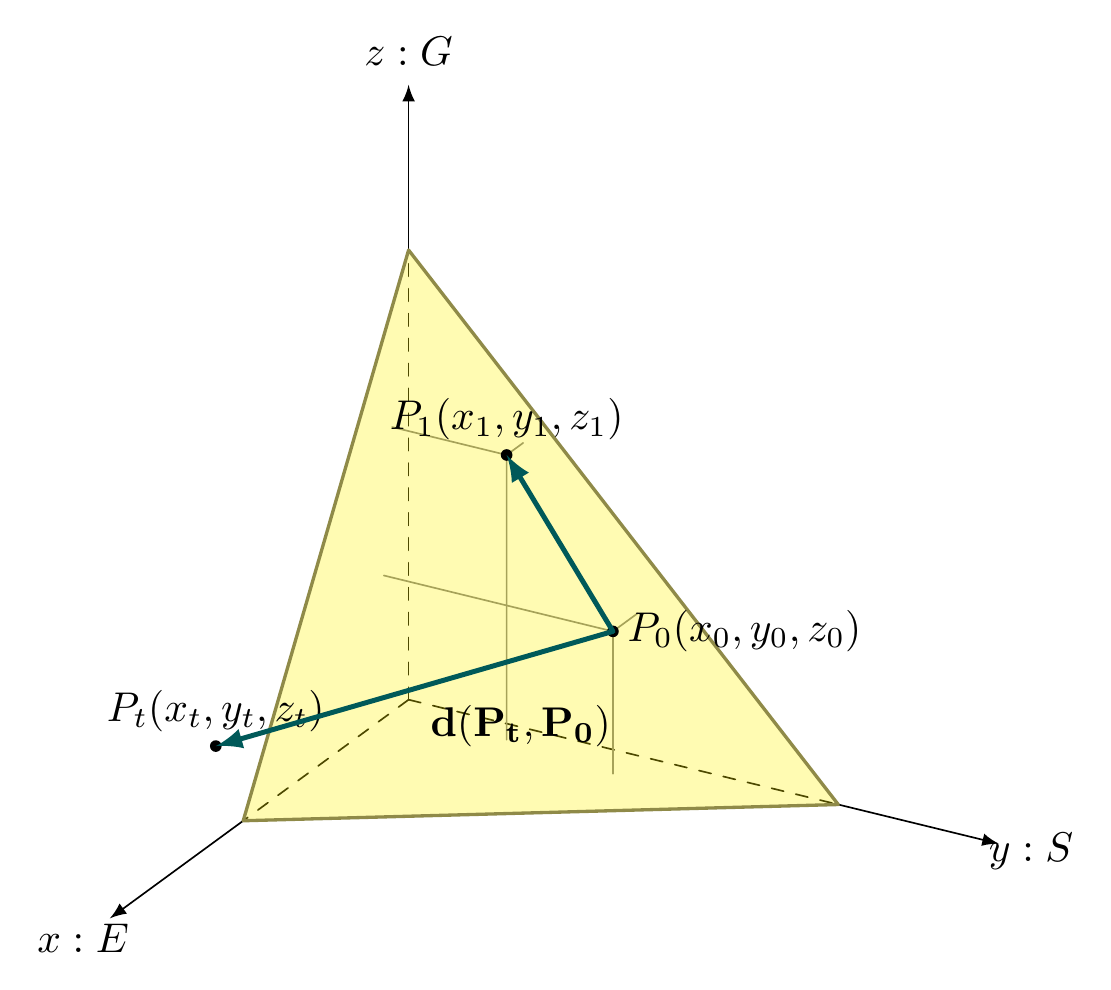
The idea of having a set function on the answer space and a probability associated with it has been merged with a “dimensional” view where each E,S,G dimension is assimilated to an x, y , z space with therefore a dynamic (temporal evolution of P) and therefore possibility to measure the distance between P on different times and P between different companies (in general P between different questionnaire). This line of theory had been sketched suggesting to acknowledge that the dynamical system for P in the E,S,G space should be investigated.
Pictures.
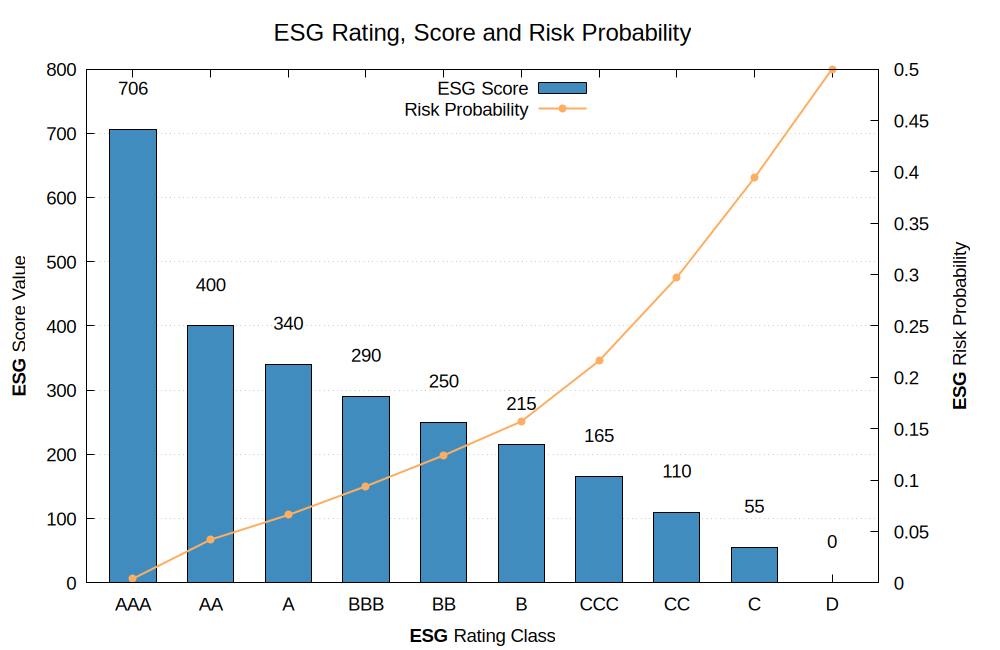
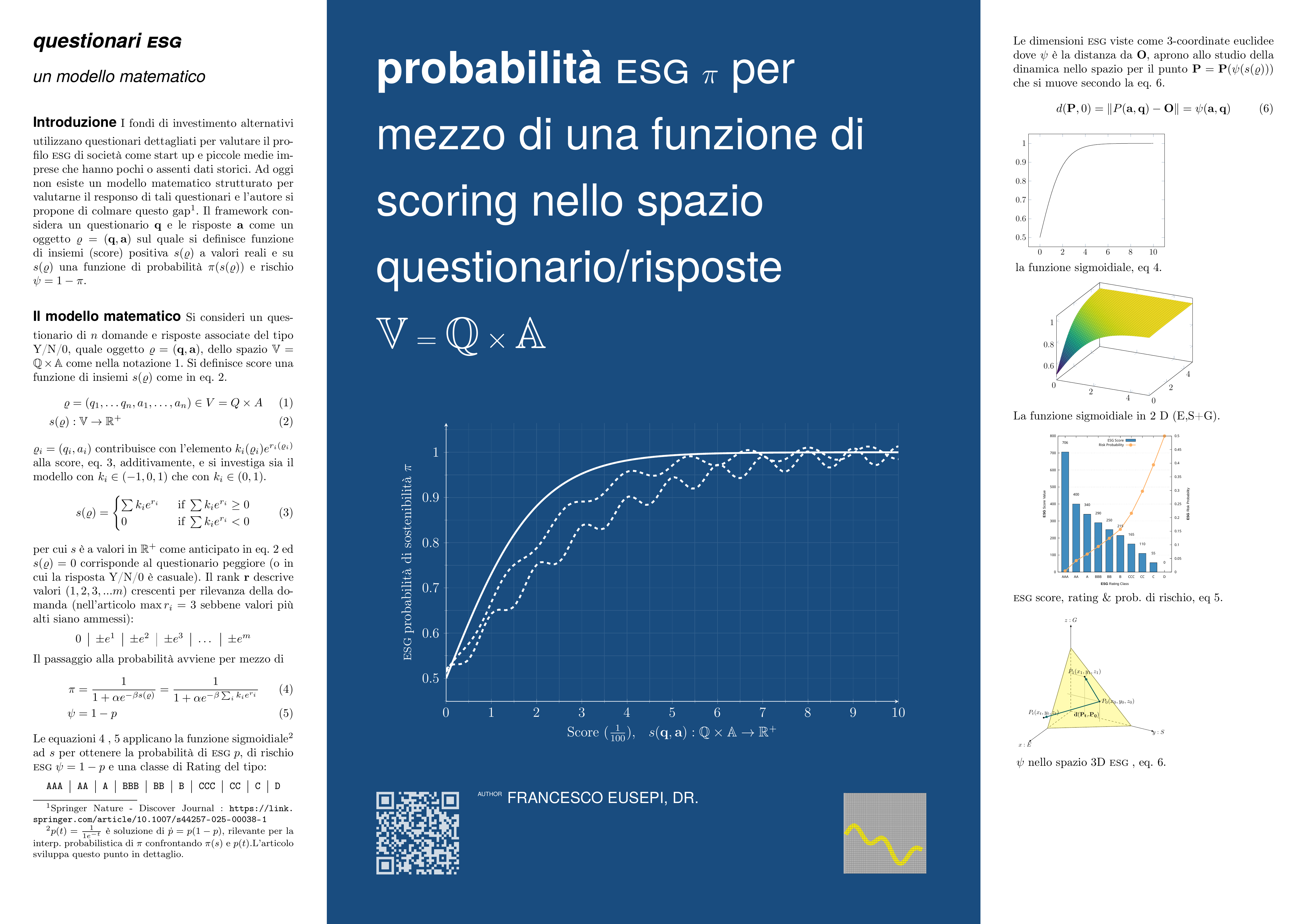
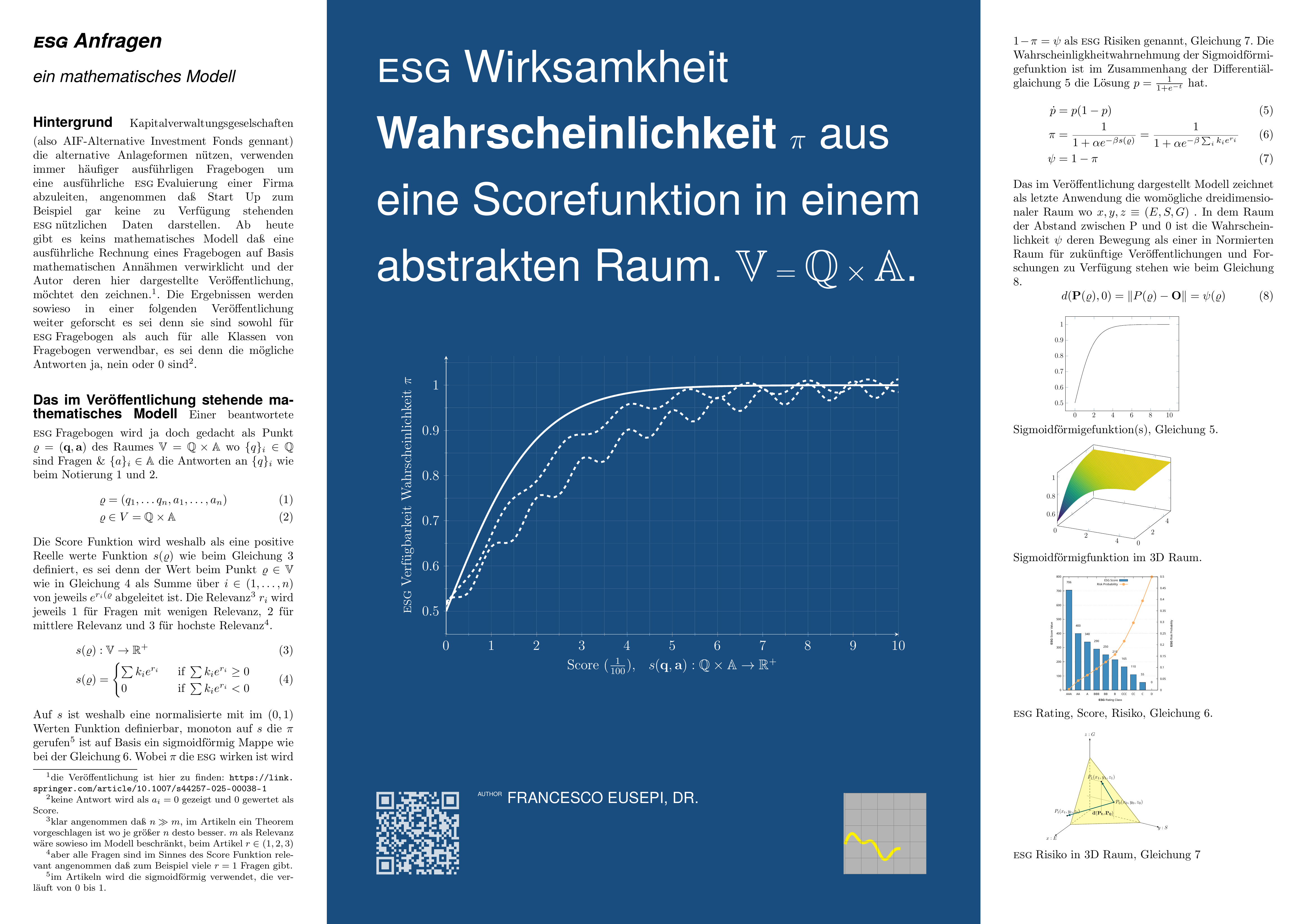
The attached figure shows the Rating scale, defined for each score range and the associated sigmoidal probability function that (increasing as the score decreases) provides a probabilistic interpretation of the set function defined via the score value.
In the following picture, is provided a representation of the ESG score risk probability as a point in the 3 dimensional E, S, G space, where distance between P on different times (and between different companies) is definable and measurable.
Article Poster as concise summary.
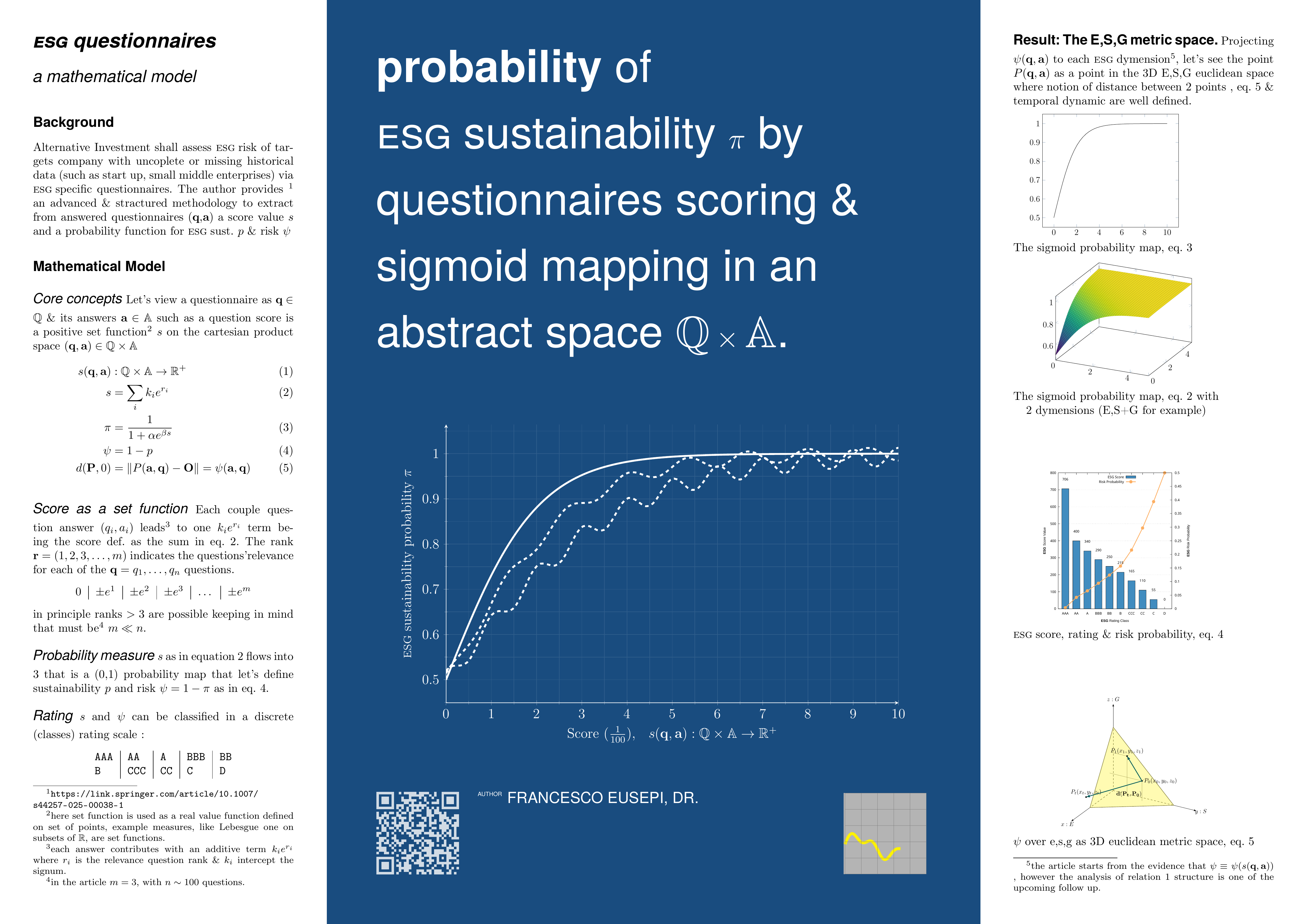
The summary poster had been done also in German and in Italian language as per completeness in order to be as sharable as possible. both are here attached.

I'm a physicist that moved to quantitative finance and I'm now doing active and intense theoretical and empirical research on application of advanced mathematics to financial & corporate problems. I'm fascinated by the variety of problems in finance standard mathematical and theoretical physics can address in an innovatove and creative way. I pursue both theoretical and empirical research and I welcome suggestions on both areas based on my pubblications and also on general basis.
Follow the Topic
-
Discover Analytics
This is an international, open access journal that publishes research on computational, mathematical, methodological, and descriptive aspects of analytics.

Related Collections
With Collections, you can get published faster and increase your visibility.
Decision-Making Under Uncertainty: Applications in Engineering and Management
This Collection aims to explore the critical role of advanced decision-making methodologies under uncertainty, focusing specifically on the robust application of aggregation operators based on various fuzzy set extensions across complex systems in engineering and management. Modern systems—from dynamic supply chains and healthcare analytics to sustainable circular economy models—are inherently exposed to multifaceted uncertainty and vagueness that conventional quantitative models often fail to capture effectively.
We seek high-quality research that bridges the gap between theoretical advancements in fuzzy aggregation and their real-world implementation in solving complex decision problems. The collection will highlight novel fuzzy aggregation operators, computational tools, and empirical studies that effectively address ambiguity and imprecision in decision-making processes.
Topics of particular interest include, but are not limited to:
1. Methodological Advancements in Fuzzy Aggregation Operators:
• Aggregation Operators on Various Classes of Fuzzy Sets: Research on operators for extensions such as Type-2 Fuzzy Sets, Hesitant Fuzzy Sets (HFSs), Pythagorean Fuzzy Sets, and Neutrosophic Sets, etc., to handle different complexities of uncertainty.
• Developing Decision-Making Algorithms under Different Fuzzy Environments: Algorithms and techniques like TOPSIS, VIKOR, and ELECTRE, TPIVFFDM adapted and enhanced using the advanced fuzzy environments for Multi-Criteria Decision Making (MCDM).
2. Domain-Specific Applications:
• Transportation and Logistics: Optimization of routing, scheduling, and resource allocation under uncertain travel times, demand, and capacity constraints, using fuzzy decision models.
• Supply Chain Management (SCM): Enhancing SCM resilience, supplier selection, risk assessment (various sectors, for ex, energy, construction), and demand forecasting by applying fuzzy aggregation to handle vague qualitative and quantitative data.
• Circular Economy (CE) and Sustainability: Decision-making for optimal waste management, material flow tracking, product lifecycle planning, and green technology adoption, where data is often subjective or uncertain.
• Healthcare Analytics and Management: Improving clinical and managerial decisions through the application of fuzzy methods in areas such as medical diagnosis, patient flow optimization, resource scheduling (beds, staff), and risk assessment in treatments.
This Collection will serve as a crucial resource for academics and practitioners, showcasing the power of fuzzy aggregation operators to model human-like judgments and handle intrinsic vagueness, thereby leading to more robust, reliable, and interpretable decisions in high-stakes engineering and management domains.
Keywords: aggregation operators; circular economy; supplier selection; supply chain management; decision-making; fuzzy sets
Publishing Model: Open Access
Deadline: Nov 27, 2026
System Dynamics, Decision Analytics and Simulation: Modelling and Understanding Complex Systems
Contemporary engineering, organisational and societal challenges are increasingly shaped by complex systems characterised by nonlinear interactions, feedback processes and dynamic behaviour over time. Traditional analytical approaches often struggle to capture these systemic interdependencies, which can lead to unintended consequences and suboptimal decision-making.
System dynamics provides a powerful framework for analysing and modelling complex systems by focusing on feedback structures, accumulations, flows and time delays. When combined with decision analytics and simulation methods, this approach enables researchers and practitioners to explore system behaviour, evaluate alternative policies and support more robust decision-making in uncertain and rapidly changing environments.
This Collection aims to bring together cutting-edge contributions that advance the theory, methodology and applications of system dynamics, decision analytics and simulation. The Collection seeks to provide new insights into how complex systems can be modelled, analysed and better understood across different domains.
We welcome original contributions from researchers and practitioners addressing theoretical developments, methodological innovations and empirical applications. Interdisciplinary research bridging engineering, management, analytics and policy studies is particularly encouraged.
Possible topics include, but are not limited to:
- System dynamics and systems thinking
- Decision analytics in complex systems
- Dynamic modelling and simulation methods
- Causal loop diagrams and stock–flow modelling
- Hybrid simulation approaches
- Decision support systems and policy analysis
- Engineering systems modelling
- Industrial and operations management systems
- Supply chain dynamics and resilience
- Socio-technical systems and organisational dynamics
- Sustainability transitions and environmental systems
- Applications in healthcare, infrastructure and public policy
Both conceptual and applied contributions are welcome. Case studies demonstrating the practical use of modelling and simulation to support strategic and policy decisions are particularly encouraged. This Collection aims to provide a valuable reference for researchers, practitioners and postgraduate students interested in the analysis, modelling and governance of complex systems.
Publishing Model: Open Access
Deadline: Dec 13, 2026