Examining Saudi teachers’ professional competency and attitudes toward technology-integrated teaching for students with intellectual disabilities
Published in Education



When Saudi Arabia launched Vision 2030, education suddenly felt different. The national conversation shifted to digital transformation and inclusive schooling at the same time. As a special education researcher working in this context, I always wondered about a simple but uncomfortable question:
“We’ve invested in devices and platforms, but are our teachers actually ready to use them with students who have intellectual disabilities?”
This paper grew out of that question.
From policy promises to classroom realities
Saudi special education has grown rapidly, with new schools, programs, and policies defining the rights, services, and classifications for students with intellectual disabilities. Yet, in practice, very concrete obstacles keep appearing: teachers may have tablets but little meaningful training, assistive software is available but often feels too complex to use confidently, and many are understandably anxious about having to troubleshoot technical problems in the middle of a lesson.
At the same time, the research I could find from Saudi Arabia was mostly small-scale and local important but limited to single districts or institutions.
What was missing was a national, multi-region snapshot of special education teachers’ readiness to integrate technology specifically for students with intellectual disabilities, one of the most marginalized learner groups.
Building a study that captured “readiness”
I knew from international literature that “readiness” is more than just knowing how to click or swipe. It lives at the intersection of:
- Pedagogical–technological competence (TPACK)
- Attitudes and intentions (Theory of Planned Behavior)
- Confidence (self-efficacy)
- Context and adoption climate (Diffusion of Innovations)
So instead of simply asking, “Do you use technology in your class?”, I designed a questionnaire that tried to honor all of these dimensions:
- items on integrating tools into actual lessons rather than just operating devices
- items on attitudes, perceived expectations, and ease or difficulty
- items on confidence in troubleshooting and adapting tools
- items on access to trials, peer examples, and institutional support
Developing and validating this instrument piloting it, refining wording, and running factor analyses was one of the most time-consuming parts of the project, but also one of the most satisfying. It forced me to be explicit about what we really mean when we say “competent with technology.”
Reaching teachers across a vast country
Saudi Arabia is geographically huge, and special education teachers are scattered across regions and school types. Using an online survey and cluster sampling, I ultimately gathered responses from 443 teachers working directly with students with intellectual disabilities.
Seeing the dataset for the first time was a genuine “high” in this project: it felt like the beginning of a truly national conversation, not just a local snapshot.
The findings that surprised me
Some results fit what I expected; others were sobering.
- Competency: On average, teachers rated their professional competency in technology-integrated teaching as moderate (mean 3.83 out of 5). They felt relatively confident about using and adapting tools, but less confident in troubleshooting technical problems, which emerged as a clear weak spot. (Table 1, page 9)
- Attitudes: Teachers’ attitudes were very positive (mean 4.21 out of 5). They strongly agreed that technology can improve learning outcomes and that they are open to new tools. (Table 2, page 11)
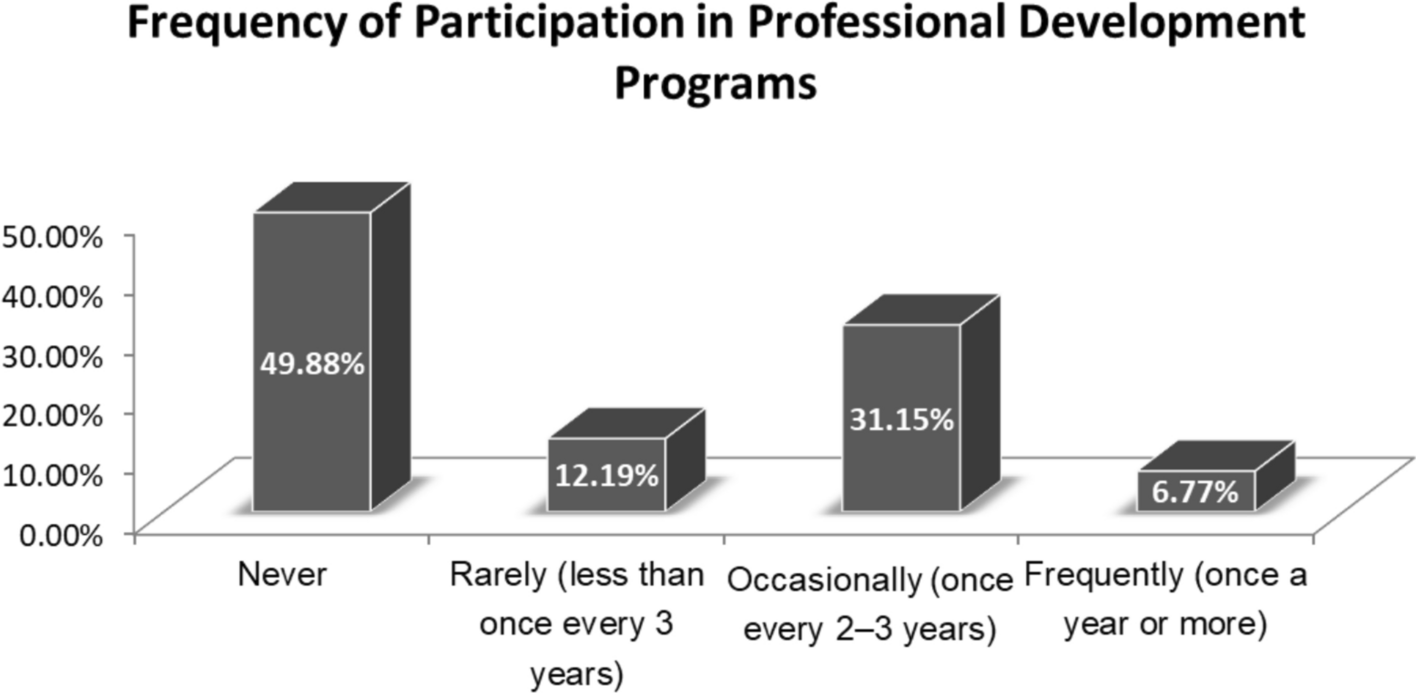
- Professional development: This was the most striking and worrying finding. Nearly half of the teachers (49.88%) had never participated in any professional development focused on technology integration for students with intellectual disabilities. The bar chart on page 10 makes this gap painfully clear.
Yet, among those who did attend PD, most rated it as effective or very effective (Figure 2, page 11), suggesting that when teachers are given good training, they feel the difference.
- Who feels most ready? Younger teachers and those in the 11–15-year experience range showed higher competency scores, while gender differences were negligible.
In short: teachers want to use technology, largely believe in it, and feel moderately capable but the system has not consistently invested in giving them sustained, targeted support.
The low points: limitations and self-critique
A Behind the Paper piece should also acknowledge the doubts.
For me, two issues were particularly challenging:
- Self-report data. I knew from the start that asking teachers to rate their own competence has limitations. Social desirability, differing internal standards, and lack of observational data all matter. The paper is very explicit about these limitations and calls for future studies to include classroom observations and performance measures.
- Cross-sectional design. The theoretical framework suggests pathways how professional development might shape self-efficacy, which then shapes competence and intention. But with cross-sectional data, we have to be careful not to over-claim causality. Some of the most interesting relationships in the data are, for now, hypothesis-generating, not definitive proof.
Being honest about these limitations in the discussion was not easy, but it was necessary. Good theory deserves cautious interpretation, not over-confident storytelling.
What this study changed for me
Working through the data, I found my own thinking shifting in three ways:
- I stopped assuming that “more technology” automatically means “better outcomes.” The real bottleneck is professional learning, not just devices.
- I began to see age and experience patterns not as simple “digital native vs. non-native” stories, but as clues about where mentoring and peer coaching could be most powerful.
- I became more convinced that special education needs its own evidence base on technology integration, not just borrowed insights from general education.
What’s next?
This study is a descriptive starting point. The next steps I hope to see some of which I plan to pursue include:
- designing practice-based PD models that combine workshops, peer coaching, and follow-up support
- testing these models in longitudinal designs to see whether teacher competence and classroom practice truly change over time
- examining which specific tools (from low-tech aids to advanced apps) are most useful for students with different profiles of intellectual disability
Ultimately, the goal is simple: when a student with intellectual disabilities walks into a classroom in any region of Saudi Arabia, the technology around them should not be decorative it should be used confidently, thoughtfully, and routinely to support their learning.

Follow the Topic
-
Discover Education
An international, peer-reviewed open access journal that publishes original work in all areas of education, serving the community as a broad-scope journal for academic trends and future developments in the field.

Related Collections
With Collections, you can get published faster and increase your visibility.
Advancing Teaching & Learning: Integrating AI, Emerging Technologies, and Pedagogical Innovation
Collection "Advancing Teaching & Learning: AI, Emerging Technologies and Pedagogical Innovation" addresses a major challenge in education today. There is a lack of resources that bring advanced technologies and innovative teaching together. AI, digital tools and emerging technologies are transforming classrooms. Yet many teachers and education leaders struggle to use these tools effectively. This Collection fills that gap. It offers expert insights, practical strategies and real-world examples for modern teaching and learning.
The Collection is linked to the United Nations Sustainable Development Goal 4 on quality education. It shows how to make learning more accessible, inclusive and effective for all. AI, adaptive learning platforms and immersive technologies can personalise instruction. They can engage students and support diverse needs. At the same time, the human element of teaching remains central.
Readers will find practical guidance on curriculum design, digital literacy and evidence-based teaching methods. The approaches can be applied in classroom, blended and online learning. Beyond tools, the Collection inspires educators to rethink traditional methods. It encourages them to embrace innovation while keeping learning meaningful and student-focused.
By addressing the lack of comprehensive resources on advanced technologies, Advancing Teaching & Learning helps teachers, school leaders and instructional designers navigate the digital age. It equips them to create engaging, future-ready learning experiences. Students are prepared for a connected, digital world. Educators gain the confidence to unlock the full potential of every learner.
This Collection supports and amplifies research related to the United Nations Sustainable Development Goal 4 on quality education. It shows how to make learning more accessible, inclusive and effective for all. AI, adaptive learning platforms and immersive technologies can personalise instruction. They can engage students and support diverse needs. At the same time, the human element of teaching remains central.
Keywords: Teaching and Learning; AI in Education; Emerging Technologies; Digital Tools in Classrooms; Pedagogical Innovation; Adaptive Learning Platforms; Immersive Technologies; Quality Education (SDG 4); Classroom Innovation; Blended and Online Learning; Student Engagement; Teacher Professional Development; Future-Ready Learning; Instructional Design; Educational Technology Integration.
Publishing Model: Open Access
Deadline: Apr 15, 2027
Advancing Health Professions Education: Innovations, Strategies, and Global Perspectives
Health Professions Education (HPE) plays an important role in preparing competent, ethical, and compassionate healthcare professionals capable of responding to the complex demands of contemporary healthcare systems. In recent years, the field of HPE has witnessed a paradigm shift towards learner-centred, competency-based, and interprofessional education models that prioritize not only clinical expertise but also communication, professionalism, teamwork, and leadership skills.
This Collection invites original research, systematic or scoping reviews, case studies and brief reports and that critically examine the evolving landscape of HPE across medicine, dentistry, nursing, pharmacy, and other allied health disciplines. Key areas of interest include curriculum design and reform, innovative teaching and assessment methods, integration of digital and blended learning technologies, interprofessional education (IPE), faculty development, educational management, student support and well-being, and strategies to promote equity, diversity, and inclusivity in HPE.
We also welcome contributions that explore challenges and best practices in clinical training, rural and underserved community placements, global health education, policy development, accreditation, and institutional leadership in health education. Studies from low- and middle-income countries are strongly encouraged to enhance global representation and to promote scholarly exchange on scalable and contextually relevant innovations.
By consolidating scholarly work in this Collection, we aim to advance the discourse on high-quality, evidence-informed HPE that supports the achievement of Sustainable Development Goals (SDG 3 and SDG 4) and ultimately contributes to improved healthcare outcomes worldwide.
Publishing Model: Open Access
Deadline: Nov 30, 2026