Flexible High-Aspect-Ratio COF Nanofibers: Defect-Engineered Synthesis, Superelastic Aerogels, and Uranium Extraction Applications
Published in Chemistry and Materials

Flexible High-Aspect-Ratio COF Nanofibers: Defect-Engineered Synthesis, Superelastic Aerogels, and Uranium Extraction Applications

Like

Share this post

Choose a social network to share with, or copy the URL to share elsewhere

This is a representation of how your post may appear on social media. The actual post will vary between social networks

Explore the Research

SpringerLink
SpringerLink SpringerLink

Flexible High-Aspect-Ratio COF Nanofibers: Defect-Engineered Synthesis, Superelastic Aerogels, and Uranium Extraction Applications - Nano-Micro Letters

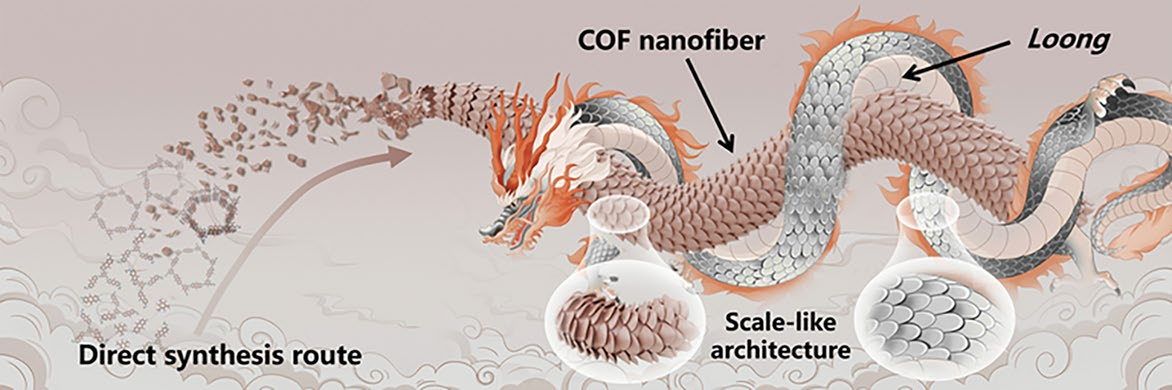
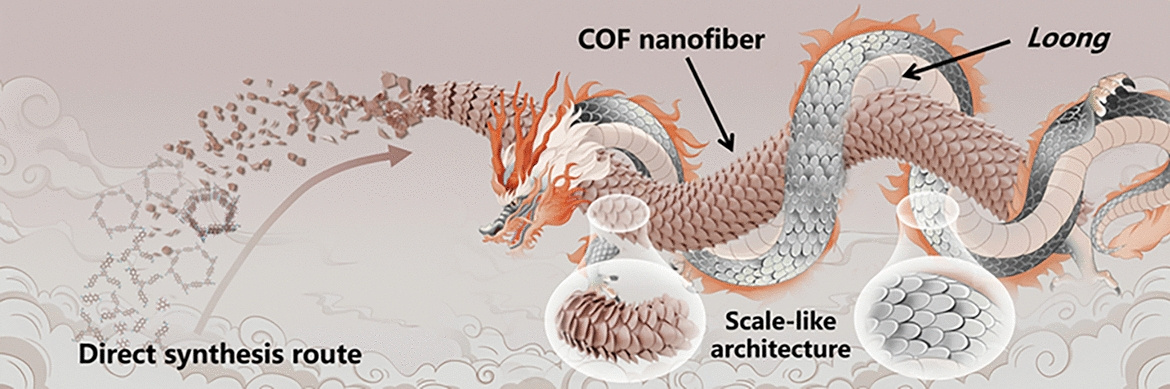
The lack of macro-continuity and mechanical strength of covalent organic frameworks (COFs) has significantly limited their practical applications. Here, we propose an “alcohol-triggered defect cleavage” strategy to precisely regulate the growth and stacking of COF grains through a moderate reversed Schiff base reaction, realizing the direct synthesis of COF nanofibers (CNFs) with high aspect ratio (L/D = 103.05) and long length (> 20 μm). An individual CNF exhibits a biomimetic scale-like architecture, achieving superior flexibility and fatigue resistance under dynamic bending via a multiscale stress dissipation mechanism. Taking advantages of these structural features, we engineer CNF aerogels (CNF-As) with programmable porous structures (e.g., honeycomb, lamellar, isotropic) via directional ice-template methodology. CNF-As demonstrate 100% COF content, high specific surface area (396.15 m2 g−1) and superelasticity (~ 0% elastic deformation after 500 compression cycles at 50% strain), outperforming most COF-based counterparts. Compared with the conventional COF aerogels, the unique structural features of CNF-A enable it to perform outstandingly in uranium extraction, with an 11.72-fold increment in adsorption capacity (920.12 mg g−1) and adsorption rate (89.9%), and a 2.48-fold improvement in selectivity (U/V = 2.31). This study provides a direct strategy for the development of next-generation COF materials with outstanding functionality and structural robustness.

The lack of macro-continuity and mechanical strength of covalent organic frameworks (COFs) has significantly limited their practical applications. Here, we propose an “alcohol-triggered defect cleavage” strategy to precisely regulate the growth and stacking of COF grains through a moderate reversed Schiff base reaction, realizing the direct synthesis of COF nanofibers (CNFs) with high aspect ratio (L/D = 103.05) and long length (> 20 μm). An individual CNF exhibits a biomimetic scale-like architecture, achieving superior flexibility and fatigue resistance under dynamic bending via a multiscale stress dissipation mechanism. Taking advantages of these structural features, we engineer CNF aerogels (CNF-As) with programmable porous structures (e.g., honeycomb, lamellar, isotropic) via directional ice-template methodology. CNF-As demonstrate 100% COF content, high specific surface area (396.15 m2 g−1) and superelasticity (~ 0% elastic deformation after 500 compression cycles at 50% strain), outperforming most COF-based counterparts. Compared with the conventional COF aerogels, the unique structural features of CNF-A enable it to perform outstandingly in uranium extraction, with an 11.72-fold increment in adsorption capacity (920.12 mg g−1) and adsorption rate (89.9%), and a 2.48-fold improvement in selectivity (U/V = 2.31). This study provides a direct strategy for the development of next-generation COF materials with outstanding functionality and structural robustness.

Please sign in or register for FREE

If you are a registered user on Research Communities by Springer Nature, please sign in

Follow the Topic

Nanoscale Design, Synthesis and Processing
Physical Sciences > Materials Science > Nanotechnology > Nanoscale Design, Synthesis and Processing
Organic Chemistry
Physical Sciences > Chemistry > Organic Chemistry
Nanochemistry
Physical Sciences > Materials Science > Nanotechnology > Nanochemistry
Porous Materials
Physical Sciences > Chemistry > Materials Chemistry > Porous Materials
Bioinspired Materials
Physical Sciences > Materials Science > Soft Materials > Bioinspired Materials
  • Nano-Micro Letters Nano-Micro Letters

    Nano-Micro Letters is a peer-reviewed, international, interdisciplinary and open-access journal that focus on science, experiments, engineering, technologies and applications of nano- or microscale structure and system in physics, chemistry, biology, material science, and pharmacy.