From a question about zinc oxide to a nanowire-based cancer vaccine
Published in Bioengineering & Biotechnology, Cancer, and Materials
 In October 2017, I posted a question on ResearchGate: “How is ZnO supporting the immune system for vaccines or cancer immunotherapeutics?” Reports suggested that zinc oxide could act as an immune-stimulating material, but I wanted to understand how its properties translated into useful immune responses.
That question captures a central motivation behind our continuing research: understanding how material design can support antigen delivery and antitumor immunity.
Our 2017 study in Nanoscale investigated the intracellular delivery of biomacromolecules using clusters of ZnO nanowires. It laid the groundwork for investigating how nanowire architecture could enhance cellular interactions and the transport of biological cargo.
In our subsequent Nanoscale study, published in 2019, we investigated radially grown ZnO nanowires on poly-L-lactic acid (PLLA) microfibers as a therapeutic cancer-vaccine platform. By combining this structure with a tumor antigen, we explored its ability to stimulate cellular immunity and suppress established tumor growth in mice.
Our new paper in Cancer Nanotechnology extends this work by addressing complementary questions: can the platform support both antibody and cellular immune responses, and can vaccination before tumor challenge provide protection?
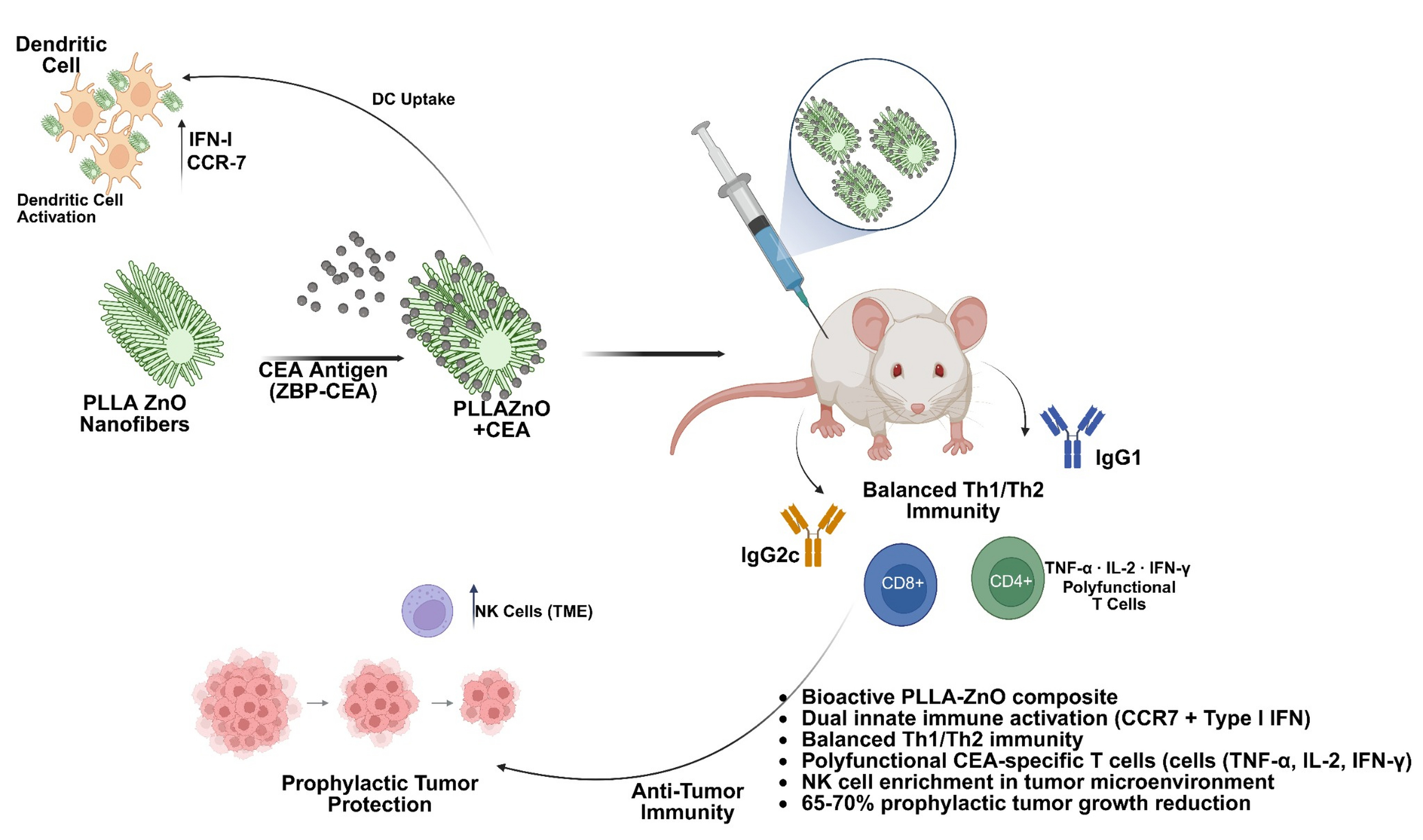
The vaccine combines PLLA microfibers, ZnO nanowires, and carcinoembryonic antigen (CEA), a tumor-associated protein. This architecture brings together antigen delivery and the immune-interacting properties of the material.
In mice, PLLA–ZnO/CEA stimulated strong antibody responses involving both IgG1 and IgG2c, supporting the balanced Th1/Th2-associated immunity described in the study. It also elicited antigen-specific T-cell responses. Together, these findings allowed us to explore the platform's effects beyond the previously demonstrated cellular immune responses.
Vaccination before challenge with CEA-expressing tumor cells reduced tumor growth by approximately 65–70% compared with PBS controls during the study’s observation period.
The immune changes extended beyond circulating antibodies. Vaccinated tumor-bearing mice showed increased CD8 T cells in the spleen and increased natural killer cells within tumors. These observations connect systemic immunity with changes in the local tumor immune environment. They also raise further questions about which immune populations are essential for protection and how those populations cooperate with each other.
For me, this finding is a particularly interesting connection to our broader work on nanocomposites and the tumor microenvironment. Generating an immune response and supporting its activity within a tumor are closely related challenges that we need to study together.
These results remain preclinical. Vaccination before an experimental tumor challenge does not establish prevention of human cancer. Important next steps include evaluating durable immune memory, testing additional tumor antigens and models, and clarifying the mechanisms underlying the observed protection.
I am deeply grateful to my mentors, Professor Nam-Hyuk Cho and Professor Young Keun Kim, and to all collaborators and co-authors who contributed to this research journey.
We welcome discussion from researchers working on vaccine adjuvants, antigen delivery, and tumor immunology: which experiments would best establish durable protection and define the contributions of individual immune-cell populations?
Read our new study: PLLA–ZnO nanowire nano-vaccine orchestrates balanced Th1/Th2 immunity and confers prophylactic antitumor protection.
Related work:
- Intracellular biomolecule delivery using ZnO nanowire clusters (Nanoscale, 2017)
- PLLA–ZnO nanowires for therapeutic cancer immunotherapy (Nanoscale, 2019)
- ZnO-based nanocomposites for vaccines and cancer immunotherapy (Pharmaceutics, 2019)
- Nanocomposites modulating the tumor microenvironment (Bioactive Materials, 2024)