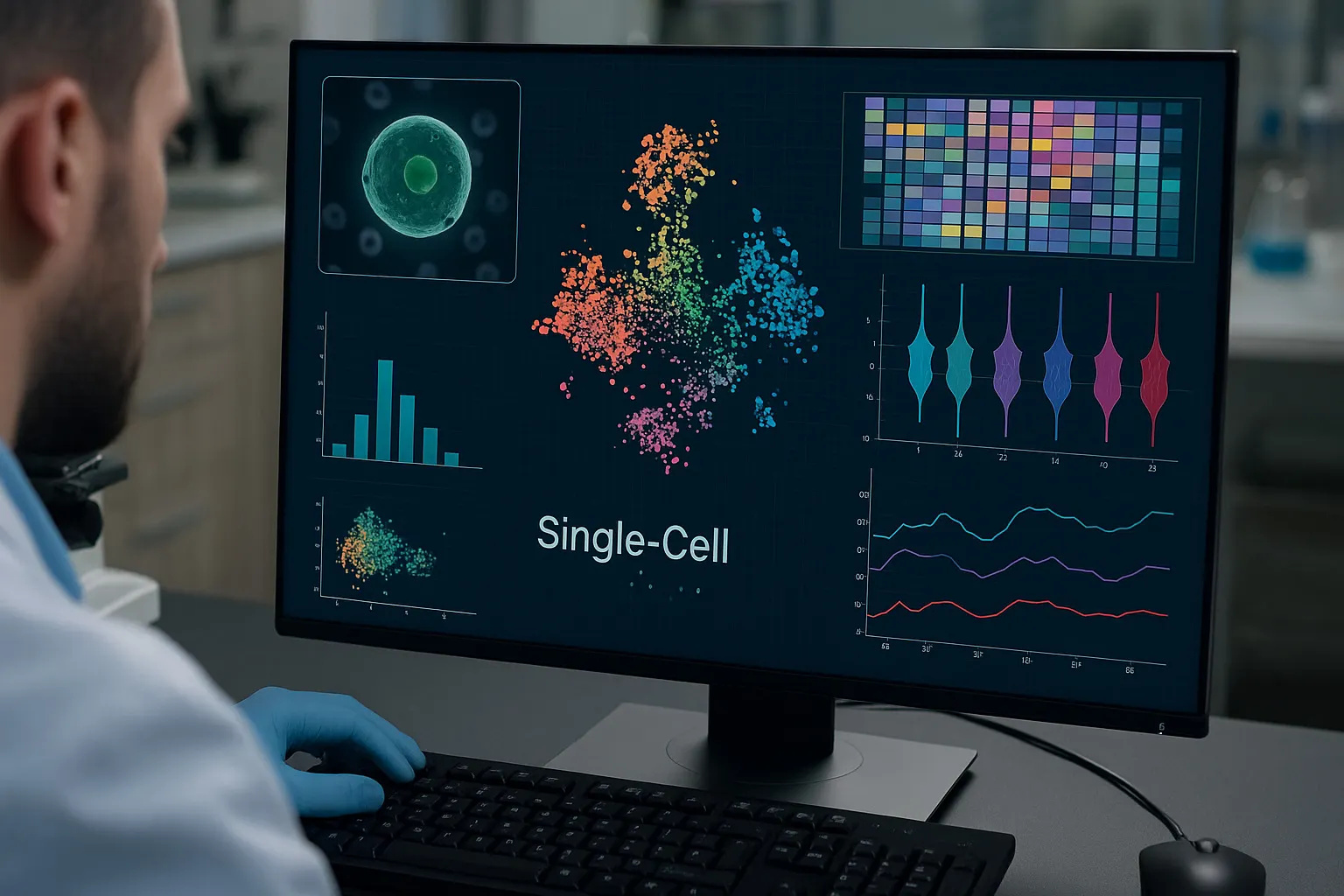
Single-cell RNA sequencing (scRNA-seq) has transformed modern biology. For the first time, scientists can observe the behavior of individual cells in exquisite detail, tracking how genes switch on and off, how cellular states transition, and how disease reshapes the molecular landscape of tissues.
Over the past decade, this technology has produced a staggering array of datasets and atlases. We’ve clustered millions of cells, identified new subtypes, and built intricate maps of the tumor microenvironment, brain circuitry, and immune landscape.
But somewhere in this process, the field became comfortable with clustering and mistook it for understanding.
Clustering tells us which cells look similar. It does not tell us why they differ, nor which molecular events truly drive pathology. It is descriptive, not diagnostic. It gives us patterns, not principles.
The Clustering Trap
Most single-cell pipelines today, no matter how elegant their mathematics or visualization, still revolve around the same premise: reduce high-dimensional gene expression data into a low-dimensional space, cluster cells by similarity, and annotate those clusters based on marker genes or known cell types.
Even the newest frameworks, like TCAT (T-cell Annotation via Gene Expression Programs) and scvi-hub, represent incremental refinements of this paradigm. TCAT, for example, replaces discrete clustering with the scoring of T cells along dozens of gene expression programs derived from large reference datasets. scvi-hub provides pre-trained models to standardize embeddings and annotations across studies.
These are genuine technical advances. They make analyses more comparable and reduce noise between datasets. Yet they remain within the clustering mindset. They improve how we group cells, but not why those groupings should matter biologically.
Reproducibility under this paradigm remains fragile. Clustering is inherently stochastic. Results depend on arbitrary parameters: the choice of normalization, the distance metric, the number of clusters, and even random seed initialization. Two analysts using the same data can reach different biological conclusions. This is not a minor inconvenience, it is a systemic limitation that prevents reproducibility and undermines translational value.
We cannot build precision medicine on shifting analytical sand.
The Classification Shift
At Bioada, we took a different approach to the single-cell problem. Instead of asking, Which cells are similar?, we ask, Which molecular features distinguish health from disease?
That question transforms everything.
By treating single-cell analysis as a classification problem rather than a clustering one, we move from pattern recognition to biological inference. Classification is not about forming arbitrary groups, it is about learning the molecular decision boundaries that define disease at its most granular level.
Our proprietary Genomarker platform does this deterministically. It compares every healthy and diseased cell one-to-one, identifying the specific genes, pathways, and interactions that separate them. Unlike clustering, this approach does not rely on pre-trained models, curated gene sets, or population-level averaging. It operates directly at the cellular and molecular level, uncovering true causality rather than correlation.
This shift also transforms scRNA-seq from a descriptive technology into a diagnostic and predictive engine. Once you can classify a cell as malignant or healthy, inflamed or quiescent, degenerative or regenerative based on its intrinsic molecular signature, you can begin to understand disease progression, predict therapeutic response, and discover new targets for intervention.
Moreover, classification integrates naturally with multi-omics data. The same computational framework can ingest transcriptomic, epigenomic, proteomic, metabolomic, and even spatial information, enabling a holistic understanding of cellular identity and behavior. It unifies the biological narrative across data types, creating a coherent model of disease.
Reproducibility by Architecture
The conversation about reproducibility in computational biology often revolves around standardization: shared models, common preprocessing pipelines, public data repositories, and benchmark datasets. These are all valuable. But they are procedural fixes to a deeper structural problem.
At Bioada, we reimagined reproducibility not as an outcome, but as an architectural principle. It is built into the core of the Genomarker platform.
Every discovery, whether a biomarker, a therapeutic target, or a mechanistic pathway, is automatically validated across datasets, populations, and technologies. This is not post-hoc verification; it is an intrinsic function of the analytical process itself.
The result is deterministic reproducibility:
- Running the same analysis twice yields identical results.
- Running it on independent cohorts confirms the same discoveries.
- Running it on different sequencing platforms or populations still identifies the same molecular drivers.
This level of consistency eliminates analyst bias, algorithmic randomness, and dependency on external reference models. It transforms reproducibility from aspiration into architecture, a built-in property of discovery rather than a quality-control step applied afterward.
This is also why Bioada can make the claim few others can: our biomarkers and therapeutic targets are not only statistically significant, they are biologically and clinically reproducible.
From Standardization to Understanding
The reproducibility discussion is often framed as a technical challenge, but at its core, it’s a philosophical one. Are we trying to make the same mistakes more consistently, or are we trying to understand biology better?
Standardization can align methods. Only classification-based, causality-seeking analysis can reveal meaning.
When single-cell data are interpreted through the lens of classification, biology becomes computable. Diseases cease to be fuzzy collections of molecular noise, they become structured systems with definable inputs and outputs. Every gene, every pathway, every phenotype can be placed within a deterministic framework that explains why something happens, not just what happens.
From Observation to Intervention
The difference between clustering and classification can be summarized in one sentence:
Clustering observes patterns; classification defines mechanisms.
Clustering gives us atlases. Classification gives us answers. The former describes; the latter diagnoses. And when you can diagnose at the molecular level, you can intervene precisely, predictably, and reproducibly.
This conceptual shift is not merely academic. It is the foundation upon which precision medicine must be built. Without architectural reproducibility and mechanistic classification, the field will remain trapped in descriptive biology, rich in data, poor in translation.
The Future of Single-Cell Science
The single-cell revolution has given us resolution. The next revolution will give us understanding.
To realize the promise of precision medicine, we must move beyond probabilistic clustering toward deterministic classification beyond procedural reproducibility toward reproducibility by design.
At Bioada, we’ve already built that architecture. It’s the difference between describing biology and decoding it. And in that difference lies the future of personalized medicine.



Please sign in or register for FREE
If you are a registered user on Research Communities by Springer Nature, please sign in